
Bedtime collagen peptides,
does it really help with Reduced sleep fragmentation and nocturnal awakenings in exercising people with sleep complaints?
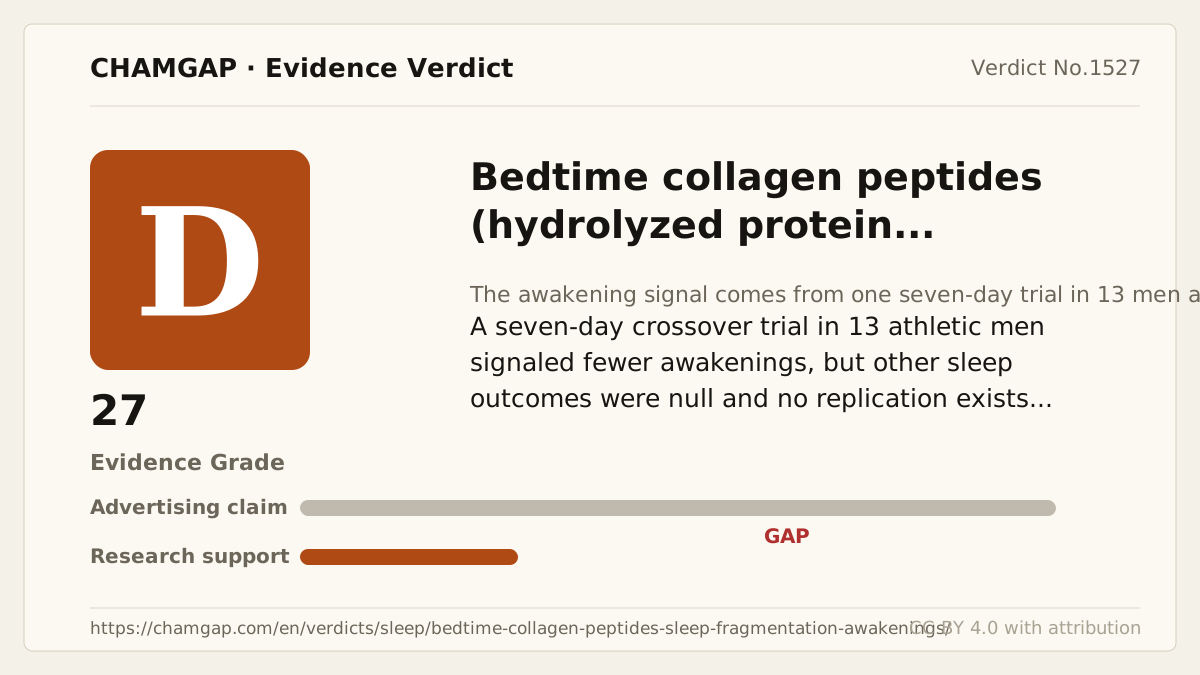
research showsBedtime collagen peptides are rated D for reducing sleep fragmentation and nocturnal awakenings in exercising people with sleep complaints. The only identified direct trial was a seven-day randomized crossover study in 13 athletic men. Collagen peptides at 15 g reduced polysomnographic awakenings and the seven-day average of subjective awakenings, but total sleep time, sleep latency, sleep efficiency, and overall subjective sleep quality did not differ. This extremely small single trial has no replication and cannot establish a reliable effect.
ads claimMarketing expands a small single-trial signal in awakening counts into deeper sleep, longer sleep, or broad relief of insomnia. Direct data are limited to seven days in young athletic men.
Useful facts when choosing a product
- Collagen peptides are hydrolyzed collagen protein mixtures that are relatively rich in glycine, but molecular weight and amino-acid composition vary by product.
- The direct sleep trial used 15 g of collagen peptides one hour before bedtime for seven days.
- The pivotal trial included only 13 young athletic men with self-reported sleep complaints and did not include women, older adults, or patients with diagnosed insomnia disorder.
- Adverse effects are generally uncommon, but fullness, gastrointestinal discomfort, and unpleasant taste can occur, and fish, bovine, or porcine source proteins are relevant to allergies and labeling.
Chamgap Semantic Classification Code
Candidate index · review held
S.bedtime-collagen-peptides.UNK.sleep-fragmentation-and-nocturnal-awakenings-in-exercising-people-with-sleep-complaints.reduce.placeboSupplements and nutraceuticals > Bedtime collagen peptides > Unknown > sleep fragmentation and nocturnal awakenings in exercising people with sleep complaints > Reduction claim > Placebo
An automated migration candidate, not an issued permanent code; exact claim scope remains under review. This machine-generated migration candidate helps retrieval but is not a permanent assignment. The original verdict ID and URL remain authoritative.
What the research actually shows
The randomized crossover trial enrolled 13 athletic men with a mean age of 24 years. Each participant used 15 g of collagen peptides and placebo one hour before bedtime for seven days each, separated by a washout of at least seven days. On night seven, polysomnographic awakenings averaged 21.3 with collagen and 29.3 with placebo; seven-day subjective awakenings averaged 1.3 and 1.9. Total sleep time, latency, efficiency, subjective sleep quality, sleepiness, and fatigue did not differ. No independent trial replicating the same population, timing, and sleep-fragmentation endpoints was identified.
Why this is classified as D (27)
Objective and subjective awakening signals were present, but the evidence consists of one seven-day crossover trial with 13 participants, while sleep quantity, latency, and efficiency were null. No independent replication and potential conflicts of interest give D with 27 points.
Counterpoint. Unlike the awakening signal, total sleep time, sleep latency, sleep efficiency, and overall subjective sleep quality did not improve.
Rejudgment record. New verdict — One seven-day randomized crossover trial in 13 athletic men found fewer awakenings, but other core sleep outcomes were null and no independent replication exists, so rule ② for a very small single study and limited consistency supports D
Sub-claim grades by effect
This ingredient is marketed for several effects. A single overall grade blends strong and weak claims together, so each effect is graded separately here. The overall grade reflects the strongest disconfirming or core claim.
| Effect (sub-claim) | Grade | Basis |
|---|---|---|
| Reduction in sleep fragmentation | D | Polysomnographic awakenings decreased, but evidence is limited to one seven-day trial in 13 participants. |
| Reduction in nocturnal awakenings | D | Objective and subjective awakening signals agreed, but no independent replication exists. |
| Improvement in total sleep time and sleep efficiency | ? | The pivotal trial found no significant improvement, and no positive direct evidence was identified. |
Cross-check — AI research and Codex final gate
Evidence Table
| Study | Design | Sample | Funding | Endpoint | Result | Weight |
|---|---|---|---|---|---|---|
| Thomas C et al. 2024 | Randomized placebo-controlled crossover trial | 13 athletic men with sleep complaints | Rousselot BV supplied the supplements and two company employees were coauthors | Seven-day sleep diaries and actigraphy, night-seven polysomnography, cognition, endocrine function, and inflammation | Objective and subjective awakenings decreased, but sleep time, latency, efficiency, and other sleep measures did not differ. | Only direct trial with an extremely small sample |
| Ivaskiene T et al. 2025 | Narrative review of oral collagen clinical literature | More than 60 clinical studies addressing skin, musculoskeletal, hair, and related outcomes | Academic research from Lithuanian and Finnish institutions | Clinical scope and evidence limitations of collagen supplementation | It discussed the Thomas sleep-fragmentation trial but presented no independent replication of the same sleep outcome. | Scope evidence confirming the absence of direct replication |
Receipt — 2 References
All 2 cited sources were verified for existence at the original page (as of 2026-07-23).
Final verification and publication gate: Codex · Evidence date: 2026-07-23 · Corrections: none
Cite this verdict
[Chamgap] Bedtime collagen peptides x reduced sleep fragmentation and nocturnal awakenings — Evidence Grade D·27. 2 cited sources checked. Source: https://chamgap.com/en/verdicts/sleep/bedtime-collagen-peptides-sleep-fragmentation-awakenings/ · CC BY 4.0CC BY 4.0 — free to use with attribution; do not distort grades, numbers, or verdict meaning.
What this document does and does not do
Chamgap is an information source. It reports what research has and has not confirmed; it does not tell readers what to take or buy. That decision belongs to readers and, when needed, medical or legal professionals. This verdict reflects literature available up to the search date and may change as new research appears. Nothing here is medical advice.