
Adaptive servo-ventilation,
does it really help with Reduced mortality and cardiovascular events in heart failure with reduced ejection fraction?
research showsThe grade is D with 34 points. SERVE-HF and ADVENT-HF both failed to reduce their respective primary cardiovascular composites. Mortality increased in SERVE-HF, but ADVENT-HF did not replicate that harm. Devices, algorithms, apnea populations, and composite endpoints differed, so the mortality signal cannot be pooled as one common effect and the benefit claim remains unsupported.
ads claimASV is not interchangeable with ordinary CPAP. Prescription, sleep testing, reimbursement rules, and specialist review do not establish a survival benefit, and device sales should not imply one.
Useful facts when choosing a product
- SERVE-HF used a ResMed minute-ventilation-targeted device; ADVENT-HF used a Philips peak-flow algorithm.
- Regulatory and professional safety actions followed SERVE-HF; they are safety context, not grading evidence.
- Lower apnea-hypopnea index and fewer cardiovascular events are different claims.
Chamgap Semantic Classification Code
Candidate index · review held
UNK.adaptive-servo-ventilation-added-to-guideline-based-heart-failure-therapy.UNK.mortality-and-cardiovascular-events-in-heart-failure-with-reduced-ejection-fraction.reduce.MULTIUnknown > Adaptive servo-ventilation added to guideline-based heart-failure therapy > Unknown > mortality and cardiovascular events in heart failure with reduced ejection fraction > Reduction claim > Multiple: primary unresolved
An automated migration candidate, not an issued permanent code; exact claim scope remains under review. This machine-generated migration candidate helps retrieval but is not a permanent assignment. The original verdict ID and URL remain authoritative.
What the research actually shows
SERVE-HF randomized 1,325 patients with LVEF at most 45% and predominantly central sleep apnea to ResMed AutoSet CS ASV plus guideline therapy or guideline therapy alone. Its primary first-event composite was all-cause death, lifesaving cardiovascular intervention, or unplanned heart-failure hospitalization: 54.1% versus 50.8%, HR 1.13 (0.97-1.31). All-cause death was 34.8% versus 29.3%, HR 1.28 (1.06-1.55), and cardiovascular death 29.9% versus 24.0%, HR 1.34 (1.09-1.65). Mortality endpoints were prespecified secondary outcomes, but separate multiplicity control was not confirmed. ADVENT-HF analyzed 731 patients with obstructive or central sleep apnea using Philips peak-flow ASV. Its primary composite added cardiovascular hospitalization, new atrial fibrillation or flutter requiring anticoagulation without admission, and appropriate ICD shock without admission to all-cause death. Events were 180/375 (48.0%) in control and 166/356 (46.6%) with ASV, HR 0.95 (0.77-1.18). Deaths were 88/375 (23.5%) and 76/356 (21.3%), HR 0.89 (0.66-1.21). SERVE-HF was funded by ResMed and others; ADVENT-HF by the Canadian Institutes of Health Research and Philips RS North America, which also supplied devices.
Why this is classified as D (34)
Two large randomized trials failed on their respective primary cardiovascular composites, but trial differences and the absence of a validated benefit threshold prevent a stronger refutation, giving D with 34 points.
Counterpoint. SERVE-HF mortality harm matters but was not reproduced by ADVENT-HF; ADVENT-HF's null result also does not prove safety in every subgroup.
Rejudgment record. Cross-check applied — Two large randomized trials using different devices and composites failed to reduce their primary cardiovascular outcomes, while mortality harm in one was not replicated in the other
| Endpoint | H | Hard endpoint - actual events such as death |
| Replication | R1 | Single confirmatory trial |
| Independence | I1 | Mixed funding sources |
| Effect size | E0 | Null |
| Precision | C0 | The confidence interval leaves room for benefit |
Stored derived and displayed grades match; this is not a current recalculation or validity check (D).
Sub-claim grades by effect
This ingredient is marketed for several effects. A single overall grade blends strong and weak claims together, so each effect is graded separately here. The overall grade reflects the strongest disconfirming or core claim.
| Effect (sub-claim) | Grade | Basis |
|---|---|---|
| Reduced mortality and cardiovascular events | D | Both large trials were null on their primary composites. |
| Increased mortality with every ASV device | ? | SERVE-HF harm was not replicated in ADVENT-HF and the devices differed. |
Cross-check — AI research and Codex final gate
Evidence Table
| Study | Design | Sample | Funding | Endpoint | Result | Weight |
|---|---|---|---|---|---|---|
| Cowie MR et al. 2015 SERVE-HF | Multicenter open-label randomized trial with blinded endpoint adjudication | 1,325 randomized | Funded by ResMed and others; AutoSet CS device | First all-cause death, lifesaving cardiovascular intervention, or unplanned heart-failure hospitalization | 54.1% versus 50.8%, HR 1.13 (0.97-1.31); all-cause death HR 1.28 (1.06-1.55) | Large pivotal trial |
| Bradley TD et al. 2024 ADVENT-HF | Multicenter open-label randomized trial with masked outcome assessment | 731 analyzed, 375 control and 356 ASV | Canadian Institutes of Health Research and Philips RS North America; Philips supplied devices | First all-cause death, cardiovascular admission, new atrial fibrillation/flutter, or appropriate ICD shock | 180/375 versus 166/356, HR 0.95 (0.77-1.18); all-cause death HR 0.89 (0.66-1.21) | Large trial with a different device, population, and composite |
Receipt — 2 References
All 2 cited sources were verified for existence at the original page (as of 2026-08-07).
Final verification and publication gate: Codex · Evidence date: 2026-08-07 · Corrections: none
Cite this verdict
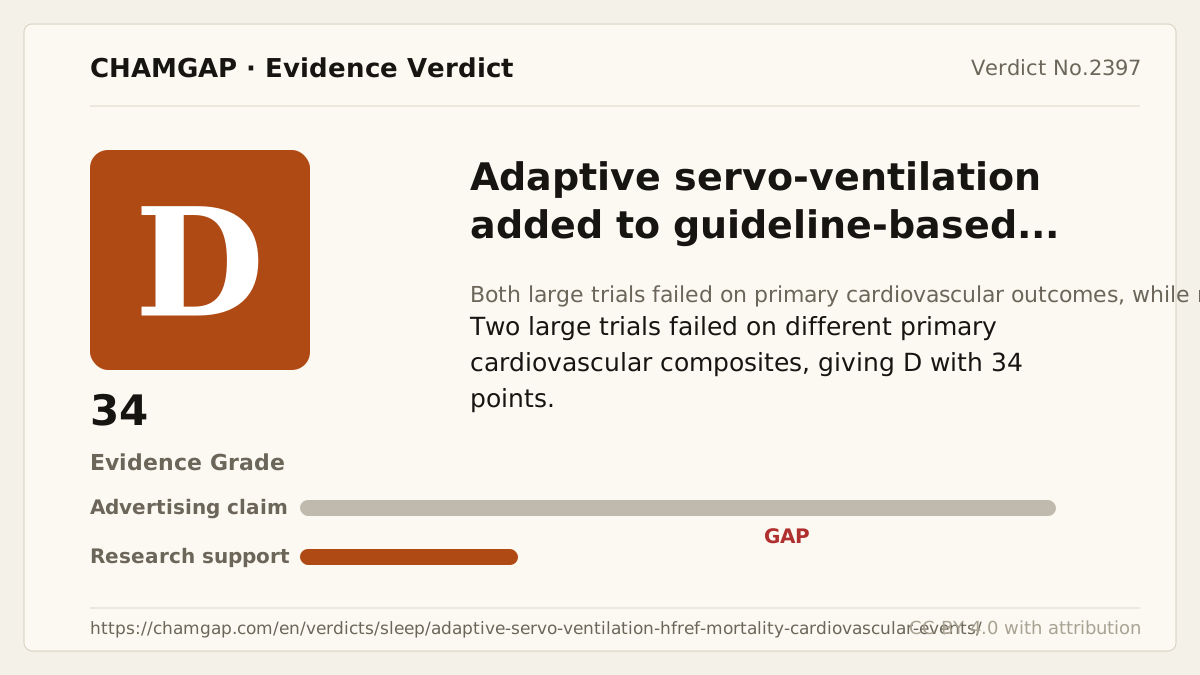
[Chamgap] Adaptive servo-ventilation x reduced death and cardiovascular events in HFrEF — Evidence Grade D·34. 2 cited sources checked. Source: https://chamgap.com/en/verdicts/sleep/adaptive-servo-ventilation-hfref-mortality-cardiovascular-events/ · CC BY 4.0CC BY 4.0 — free to use with attribution; do not distort grades, numbers, or verdict meaning.
What this document does and does not do
Chamgap is an information source. It reports what research has and has not confirmed; it does not tell readers what to take or buy. That decision belongs to readers and, when needed, medical or legal professionals. This verdict reflects literature available up to the search date and may change as new research appears. Nothing here is medical advice.