
Acupressure mat,
does it really help with Improved sleep onset, deep sleep, and insomnia severity when used before bed?
research showsContrary to the hypothesis, a human randomized pilot directly evaluated sleep quality with a spike mat, so the grade is D rather than unknown. In 36 people with neck or back muscle-tension pain, 15 minutes of daily mat use for three weeks did not improve sleep quality. No confirmatory trial measuring sleep onset, deep sleep, or insomnia severity was found, and finger self-acupressure trials cannot be extrapolated to a mat.
ads claimMarketing merges traditional acupressure studies, testimonials, and relaxation into a claim that a mat objectively improves sleep onset and deep sleep. Different interventions and endpoints are not substitutes for direct evidence.
Useful facts when choosing a product
- A spike mat uses hundreds of projections across a broad skin area and is not the same intervention as finger acupressure at specified points or acupuncture.
- The direct randomized pilot used 15 minutes daily for three weeks and did not improve sleep quality.
- No confirmatory trial was found using polysomnography, actigraphy, or a validated insomnia scale for sleep latency, sleep stages, or insomnia severity.
- Projections may cause pain, redness, or irritation; broken skin, skin disease, sensory loss, circulatory impairment, or bleeding tendency warrants avoidance or professional advice.
Chamgap Semantic Classification Code
Candidate index · review held
K.acupressure-or-spike-mat.UNK.sleep-onset-deep-sleep-and-insomnia-severity-when-used-before-bed.improve.UNKFolk and alternative interventions > Acupressure or spike mat > Unknown > sleep onset, deep sleep, and insomnia severity when used before bed > Improvement claim > Unknown
An automated migration candidate, not an issued permanent code; exact claim scope remains under review. This machine-generated migration candidate helps retrieval but is not a permanent assignment. The original verdict ID and URL remain authoritative.
What the research actually shows
Kjellgren and colleagues randomized 36 people with neck or back muscle-tension pain to control or 15 minutes of daily spike-mat relaxation for three weeks. Worst pain decreased, but sleep quality, stress, energy, and several other outcomes did not improve. The insomnia pilot by Yeung and colleagues tested finger pressure at specified acupoints in 31 participants, not a spike mat, and is indirect.
Why this is classified as D (24)
A direct randomized pilot was null for sleep quality, with no confirmatory trial for sleep onset, deep sleep, or insomnia severity, yielding D with 24 points.
Counterpoint. Separate self-acupressure studies were not extrapolated to mat efficacy.
Rejudgment record. New verdict — Excluded an unknown grade under rule ④ because a 36-person randomized pilot directly tested a spike mat and sleep quality, then applied rules ② and ③ to the null small trial and absence of confirmatory detailed sleep endpoints
Sub-claim grades by effect
This ingredient is marketed for several effects. A single overall grade blends strong and weak claims together, so each effect is graded separately here. The overall grade reflects the strongest disconfirming or core claim.
| Effect (sub-claim) | Grade | Basis |
|---|---|---|
| Improved sleep onset with pre-bed use | D | No confirmatory mat trial measured sleep latency, and the direct sleep-quality pilot was null. |
| Increased deep sleep with pre-bed use | D | No polysomnographic or validated sleep-stage trial was found. |
| Reduced insomnia severity | D | No validated-scale mat trial exists, and self-acupressure is a different intervention. |
Cross-check — AI research and Codex final gate
Evidence Table
| Study | Design | Sample | Funding | Endpoint | Result | Weight |
|---|---|---|---|---|---|---|
| Kjellgren A et al. 2011 | Randomized controlled pilot study | 36 adults with neck or back muscle-tension pain | County Council in Värmland | Pain, stress, energy, and sleep quality | Apart from worst pain, wellbeing measures including sleep quality did not improve. | Direct null device trial |
| Yeung WF et al. 2018 | Pilot randomized trial of self-acupressure | 31 adults with insomnia disorder | Hong Kong academic and health-research support | Insomnia and sleep measures | It tested finger pressure at acupoints and did not evaluate a mat. | Indirect evidence defining non-extrapolation |
Receipt — 2 References
All 2 cited sources were verified for existence at the original page (as of 2026-07-23).
Final verification and publication gate: Codex · Evidence date: 2026-07-23 · Corrections: none
Cite this verdict
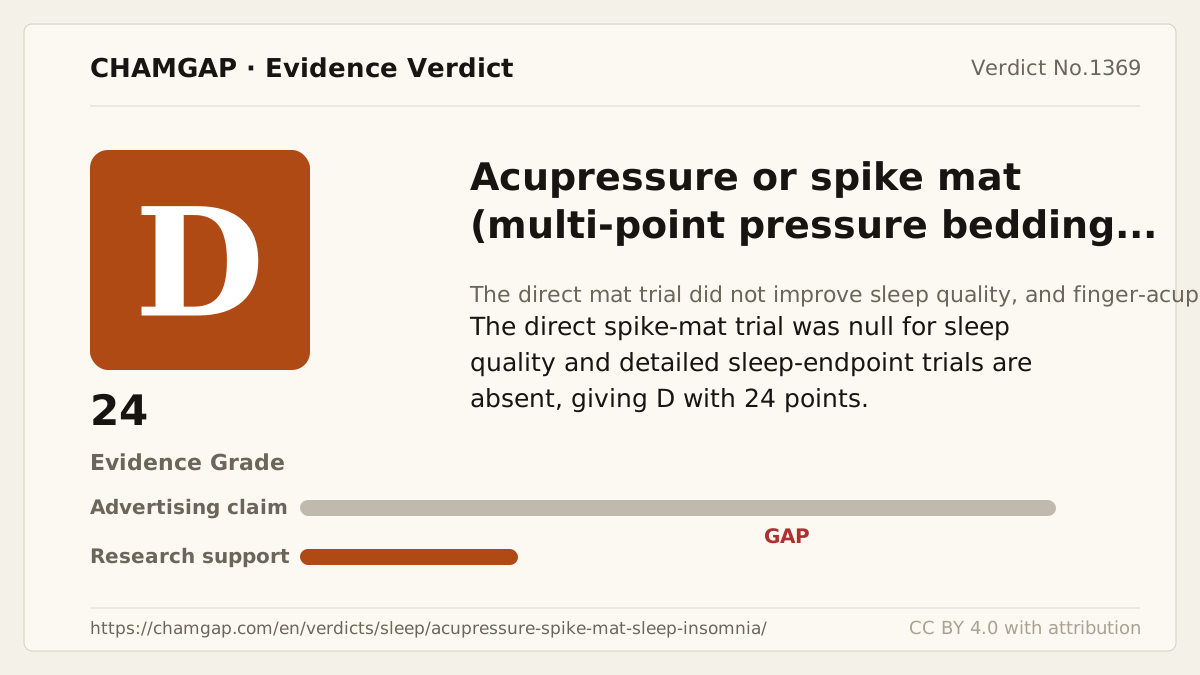
[Chamgap] Acupressure mat x sleep onset, deep sleep, and insomnia improvement — Evidence Grade D·24. 2 cited sources checked. Source: https://chamgap.com/en/verdicts/sleep/acupressure-spike-mat-sleep-insomnia/ · CC BY 4.0CC BY 4.0 — free to use with attribution; do not distort grades, numbers, or verdict meaning.
What this document does and does not do
Chamgap is an information source. It reports what research has and has not confirmed; it does not tell readers what to take or buy. That decision belongs to readers and, when needed, medical or legal professionals. This verdict reflects literature available up to the search date and may change as new research appears. Nothing here is medical advice.