
Active temperature-controlled mattress cover,
does it really help with Improved objective total sleep time, deep sleep, and sleep efficiency through nighttime temperature control?
research showsActive temperature-controlled mattress covers are rated D because completed objective sleep studies are small, short, and inconsistent. A manufacturer-funded before-and-after study in 54 people increased deep or REM sleep in selected sex and temperature windows but did not randomize condition order. An independent 34-person randomized crossover study improved subjective sleep quality while finding no significant change in total sleep time, sleep-onset latency, or sleep efficiency. A 25-person repeated-measures polysomnography study was positive for total sleep time and efficiency but used single nights, a small sample, and product-related support, so it is not independent confirmation.
ads claimProprietary sleep-stage estimates, favorable sex- or phase-specific findings, and subjective comfort can be presented as guaranteed nightly increases in deep sleep, total sleep time, and recovery. Key objective effects have not been reproduced independently over long durations with polysomnography or actigraphy.
Useful facts when choosing a product
- An active temperature-controlled cover changes the bed surface by circulating heated or cooled water through channels or by controlling another powered heat source.
- Sensors, algorithms, and temperature ranges differ by product, so evidence for one cover cannot automatically be transferred to all water-cooled or heated covers.
- A device's proprietary sleep-stage estimate is not equivalent to standard polysomnography; external home-sleep-test or polysomnography outcomes must be distinguished for efficacy assessment.
- Caution is needed for electrical or heater burns, leaks, bacterial or mold contamination of tubing and reservoirs, cleaning, and water replacement.
Chamgap Semantic Classification Code
Candidate index · review held
P.active-temperature-controlled-mattress-cover.device.objective-total-sleep-time-deep-sleep-and-sleep-efficiency-through-nighttime-temperature-control.improve.baselineProcedures, devices and tests > Active temperature-controlled mattress cover > Device delivered > objective total sleep time, deep sleep, and sleep efficiency through nighttime temperature control > Improvement claim > Within-group baseline comparison
An automated migration candidate, not an issued permanent code; exact claim scope remains under review. This machine-generated migration candidate helps retrieval but is not a permanent assignment. The original verdict ID and URL remain authoritative.
What the research actually shows
Moyen et al. 2024 studied 54 people living at home who completed Pod-off followed by Pod-on periods. Early-night cooling increased deep sleep by 14 minutes in men and REM sleep by 9 minutes in women, but order was not randomized and the company funded the study with multiple employee-shareholder authors. Stevenson et al. 2025 randomized and counterbalanced 34 healthy adults across seven on and seven off nights; subjective sleep and thermal perceptions improved, while TST, SOL, and SE did not. Kim et al. 2025 conducted three polysomnography nights in 25 people and reported TST increasing from 356.2 to 383.2 minutes and efficiency from 82.8% to 87.3% with real-time control, but the study was small, single-night per condition, and supported by the product company.
Why this is classified as D (36)
A manufacturer-linked 54-person before-and-after study and a 25-person polysomnography study had some positive objective findings, but TST, SOL, and SE were null in a 34-person randomized crossover trial and long-term independent confirmation is absent, giving D with 36 points.
Counterpoint. Signals for subjective sleep quality and thermal comfort concern different endpoints from objective deep sleep, total sleep time, and efficiency.
Rejudgment record. New verdict — Accepted some positive objective signals in completed human trials but applied rule ② because manufacturer linkage, fixed before-and-after order, single-night small samples, and null TST, SOL, and SE in an independent randomized crossover study make key objective endpoints inconsistent
Sub-claim grades by effect
This ingredient is marketed for several effects. A single overall grade blends strong and weak claims together, so each effect is graded separately here. The overall grade reflects the strongest disconfirming or core claim.
| Effect (sub-claim) | Grade | Basis |
|---|---|---|
| Increased objective total sleep time | D | A 25-person polysomnography study was positive, but a 34-person randomized crossover trial was null and long-term independent replication is absent. |
| Increased deep or slow-wave sleep | D | Evidence relies on a male early-night cooling subgroup in a 54-person manufacturer-linked study and a sex subgroup in a 25-person study. |
| Improved subjective sleep quality | C | A 34-person randomized crossover trial was positive, but expectancy or placebo effects and short-term healthy-adult data limit inference. |
Cross-check — AI research and Codex final gate
Evidence Table
| Study | Design | Sample | Funding | Endpoint | Result | Weight |
|---|---|---|---|---|---|---|
| Moyen NE et al. 2024 | Free-living fixed-order before-and-after intervention study | 54 healthy adults and more than 300 home-sleep-test nights | Funded by Eight Sleep; multiple authors were employees, shareholders, or paid consultants | Home-sleep-test stages, TST, SOL, SE, heart rate, and HRV | Early-night cooling increased deep sleep by 14 minutes in men (p=0.003) and REM by 9 minutes in women (p=0.033), with sex- and temperature-window-specific rather than uniform core effects. | Product-direct but nonrandomized and manufacturer-linked |
| Stevenson S, Suppiah H, Mündel T, and Driller M. 2025 | Randomized counterbalanced crossover trial | 34 healthy adults; seven nights on and seven nights off | La Trobe University internal research grant; authors reported no conflicts of interest | Objective TST, SOL, and SE plus subjective sleep quality and thermal perceptions | Subjective sleep quality and thermal perceptions improved, but TST, SOL, and SE did not change significantly. | Key independent randomized reality check |
| Kim JW et al. 2025 | Prospective three-condition repeated-measures polysomnography cohort | 25 adults; one polysomnography night per condition | Supported by KD Navien with product-related research involvement | Polysomnographic TST, SE, WASO, and sleep stages | Real-time control increased TST from 356.2 to 383.2 minutes and SE from 82.8% to 87.3% (both p=0.030), in a small single-night design. | Small positive objective study, not confirmatory |
Receipt — 3 References
All 3 cited sources were verified for existence at the original page (as of 2026-07-23).
Final verification and publication gate: Codex · Evidence date: 2026-07-23 · Corrections: none
Cite this verdict
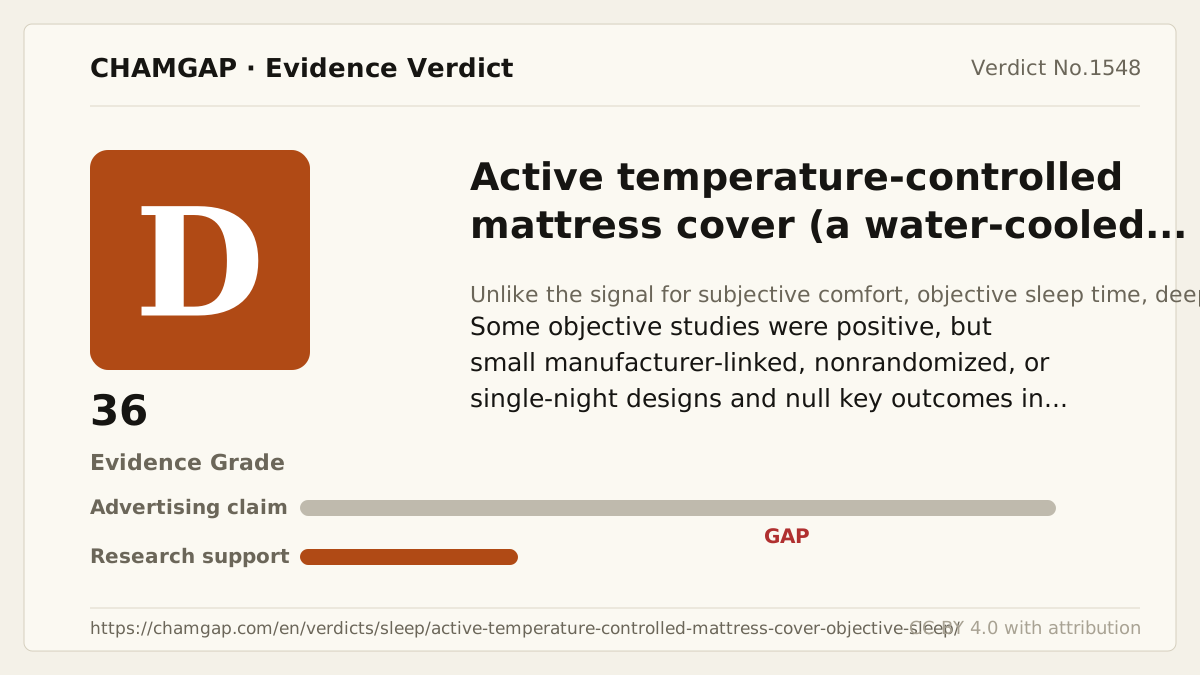
[Chamgap] Active temperature-controlled mattress cover x objective sleep time, deep sleep, and sleep efficiency — Evidence Grade D·36. 3 cited sources checked. Source: https://chamgap.com/en/verdicts/sleep/active-temperature-controlled-mattress-cover-objective-sleep/ · CC BY 4.0CC BY 4.0 — free to use with attribution; do not distort grades, numbers, or verdict meaning.
What this document does and does not do
Chamgap is an information source. It reports what research has and has not confirmed; it does not tell readers what to take or buy. That decision belongs to readers and, when needed, medical or legal professionals. This verdict reflects literature available up to the search date and may change as new research appears. Nothing here is medical advice.