
L-proline,
does it really help with Improvement of skin elasticity and wrinkles through increased collagen synthesis?
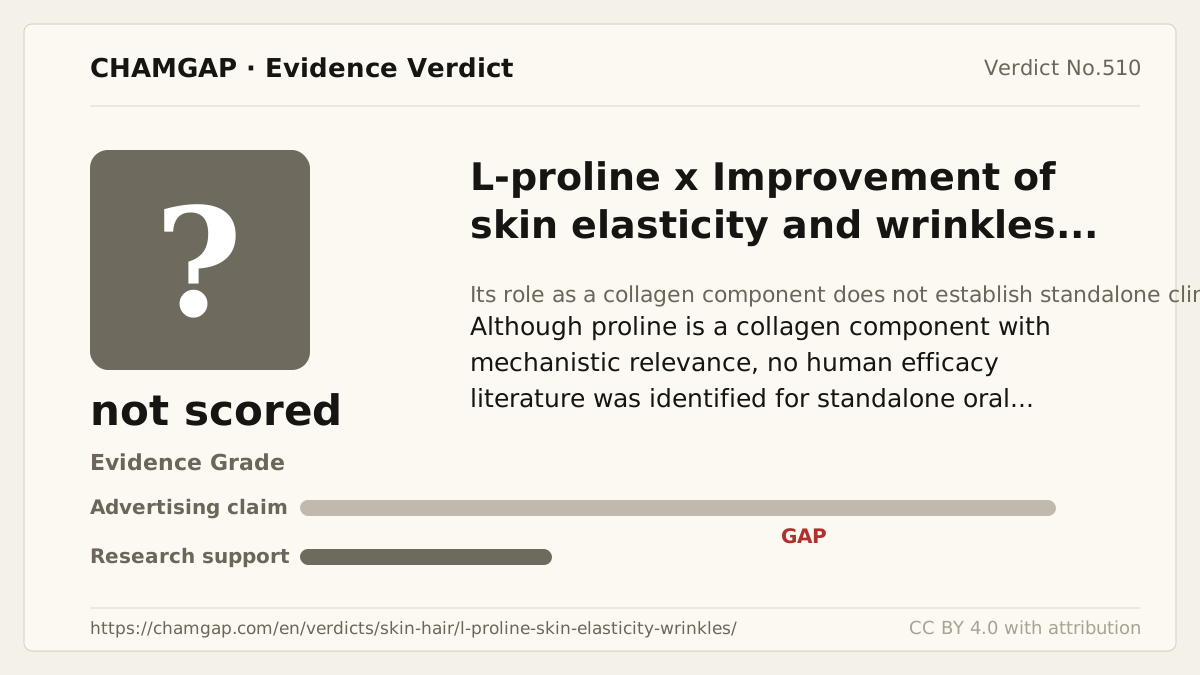
research showsProline is an amino acid in collagen, and labeled proline can be used to measure human skin collagen synthesis. However, no controlled human trial was identified that tested whether oral standalone L-proline improves skin elasticity or wrinkles. The available human studies used collagen peptides, multiple amino acids, or combinations containing CoQ10, MSM, and vitamins, so they cannot isolate the effect of proline. The rating is therefore deferred rather than forced into C or D.
ads claimMarketing can turn the true statement that proline is 'a building block of collagen' into the unsupported clinical claim that taking it increases collagen and reduces wrinkles. A structural role and a clinical effect from standalone oral supplementation are different claims.
Useful facts when choosing a product
- Standalone 500 mg L-proline capsules are available to Korean consumers through cross-border retail and are marketed for connective tissue and collagen support.
- Positive human skin studies used collagen peptides or multicomponent mixtures, not standalone 500 mg L-proline products.
- The proline and hydroxyproline content and bioactive peptide sequences in collagen peptides are not equivalent to free-form L-proline alone.
- Long-term high-dose standalone L-proline safety data for cosmetic skin use are insufficient, so safety is listed as unknown separately from efficacy.
Chamgap Semantic Classification Code
Candidate index · review held
UNK.l-proline.UNK.skin-elasticity-and-wrinkles-through-increased-collagen-synthesis.increase.placeboUnknown > L-proline > Unknown > skin elasticity and wrinkles through increased collagen synthesis > Increase claim > Placebo
An automated migration candidate, not an issued permanent code; exact claim scope remains under review. This machine-generated migration candidate helps retrieval but is not a permanent assignment. The original verdict ID and URL remain authoritative.
What the research actually shows
The 2005 study by Babraj and colleagues used stable-isotope-labeled proline and leucine to measure collagen synthesis rates in human skin and musculoskeletal tissues, but it was not a trial of L-proline supplementation. A 2022 randomized trial by Kim and colleagues tested 1 g/day of a proline-containing low-molecular-weight collagen peptide in 100 participants and reported wrinkle and elasticity signals, but the intervention was a bioactive peptide product. The 2024 study by Nobile and colleagues was an open-label study of a six-amino-acid mixture containing proline. The 2025 observational study by Dakhovnik and colleagues used a 3:1:1 glycine-proline-hydroxyproline composition plus additional ingredients. None answers the effect of isolated L-proline.
Why this is classified as ?
Mechanistic evidence and human studies of peptides and combinations exist, but no human efficacy trial was identified for isolated standalone L-proline on skin elasticity or wrinkles. Under the absent-human-literature rule, the grade is deferred with no score.
Counterpoint. The first placebo-controlled trial of standalone L-proline measuring skin collagen synthesis, elasticity, and validated wrinkle outcomes is required before assigning a grade.
Rejudgment record. New verdict — Did not attribute mechanistic, collagen-peptide, or multicomponent evidence to standalone L-proline and applied a deferred rating because isolated human trials are absent
Cross-check — AI research and Codex final gate
Evidence Table
| Study | Design | Sample | Funding | Endpoint | Result | Weight |
|---|---|---|---|---|---|---|
| Babraj JA et al. 2005 | Stable-isotope human physiology study | Academic research | Collagen synthesis rates in skin, tendon, ligament, and muscle | Measured collagen synthesis with labeled proline and leucine but did not test efficacy of L-proline supplementation. | Mechanistic | |
| Kim J et al. 2022 | Randomized double-blind placebo-controlled trial | 100 | Branded low-molecular-weight collagen peptide product | Wrinkles, hydration, elasticity, and transepidermal water loss | Reported positive signals with 1 g/day of collagen peptide, not standalone free-form L-proline. | Non-attributable |
| Nobile V et al. 2024 | Open-label single-arm study | Branded six-amino-acid mixture | Skin appearance, hair loss, and nail condition | Tested a mixture of glycine, alanine, proline, valine, leucine, and lysine, so the standalone proline effect cannot be isolated. | Non-attributable | |
| Dakhovnik A et al. 2025 | Multimodel preclinical work with a human observational study | Product-company authors and a multicomponent product | Skin features, biological age, and preclinical collagen homeostasis | Used a 3:1:1 glycine-proline-hydroxyproline composition with additional ingredients and does not answer standalone L-proline efficacy. | Non-attributable |
Receipt — 4 References
All 4 cited sources were verified for existence at the original page (as of 2026-07-18).
Final verification and publication gate: Codex · Evidence date: 2026-07-18 · Corrections: none
Cite this verdict
[Chamgap] L-proline x collagen synthesis, skin elasticity, and wrinkles — Evidence Grade ?. 4 cited sources checked. Source: https://chamgap.com/en/verdicts/skin-hair/l-proline-skin-elasticity-wrinkles/ · CC BY 4.0CC BY 4.0 — free to use with attribution; do not distort grades, numbers, or verdict meaning.
What this document does and does not do
Chamgap is an information source. It reports what research has and has not confirmed; it does not tell readers what to take or buy. That decision belongs to readers and, when needed, medical or legal professionals. This verdict reflects literature available up to the search date and may change as new research appears. Nothing here is medical advice.