
Benzoyl peroxide,
does it really help with Reduction of inflammatory and noninflammatory lesions in mild to moderate acne?
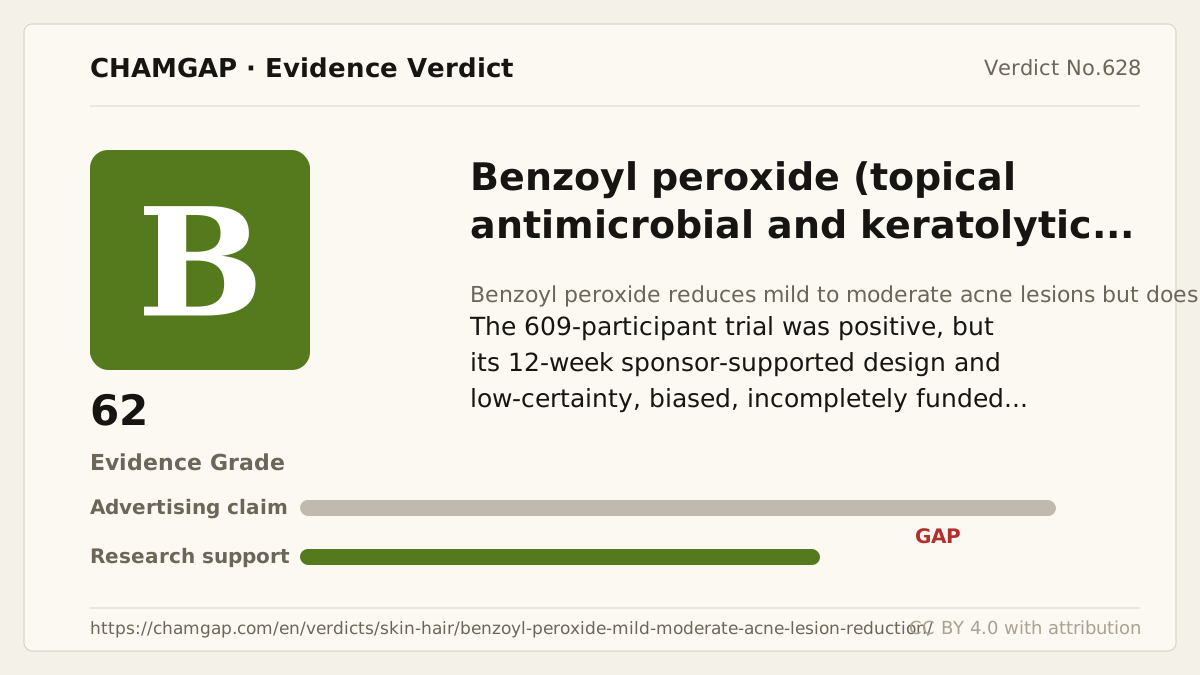
research showsTopical benzoyl peroxide is rated B because it reduces inflammatory and noninflammatory lesions in mild to moderate acne. In a 609-participant randomized double-blind placebo-controlled trial, median 12-week inflammatory-lesion reductions were 72.7% with 2.5% and 75.0% with 5% benzoyl peroxide versus 41.7% with placebo; a Cochrane review also concluded that monotherapy or add-on treatment may outperform placebo or no treatment. Lesion counts are direct clinical outcomes, but evidence certainty and formulation or combination heterogeneity remain, and monotherapy does not resolve severe nodular acne or scarring, so the evidence does not reach A. Dryness, erythema, irritation, and bleaching of fabrics are separate safety and use issues.
ads claimMarketing can expand the evidence into removing all acne, curing scars, or assuming stronger concentration is always better. Evidence mainly supports reduction of active mild to moderate lesions, and a higher concentration is not necessarily more effective or less irritating than 2.5%.
Useful facts when choosing a product
- Benzoyl peroxide reduces Cutibacterium acnes and follicular plugging as a topical treatment, with a route and mechanism distinct from oral zinc.
- Starting with a lower concentration and frequency, applying a thin layer, and increasing within label instructions as tolerated can reduce irritation. Eyes, lips, mucosa, and damaged skin should be avoided.
- Several weeks are usually needed to judge benefit. Severe nodules or cysts, rapid scarring, extensive disease, or failure of adequate use calls for dermatology assessment and combination or systemic treatment.
- The medicine can bleach hair, towels, bedding, and clothing. Severe swelling, blistering, or breathing difficulty requires immediate discontinuation and medical care.
Chamgap Semantic Classification Code
Candidate index · review held
M.benzoyl-peroxide.topical-skin.inflammatory-and-noninflammatory-lesions-in-mild-to-moderate-acne.reduce.MULTIMedicinal interventions > Benzoyl peroxide > Topical skin > inflammatory and noninflammatory lesions in mild to moderate acne > Reduction claim > Multiple: primary unresolved
An automated migration candidate, not an issued permanent code; exact claim scope remains under review. This machine-generated migration candidate helps retrieval but is not a permanent assignment. The original verdict ID and URL remain authoritative.
What the research actually shows
A Japanese multicenter phase 2/3 trial randomized 609 patients with acne to 2.5% benzoyl peroxide, 5% benzoyl peroxide, or vehicle gel and counted lesions for 12 weeks. Both active concentrations outperformed vehicle on the inflammatory primary endpoint and noninflammatory lesions were also assessed. A Cochrane review included 120 randomized trials and 29,592 participants comparing benzoyl peroxide alone or in combinations, finding possible global acne improvement over placebo or no treatment while noting certainty limitations. This is a topical antimicrobial and keratolytic pathway distinct from prior oral-zinc acne claims.
Why this is classified as B (62)
A 609-participant vehicle-controlled trial found 12-week inflammatory-lesion reductions of 72.7% to 75.0% versus 41.7%, confirming a positive direct clinical outcome. The trial was sponsor-supported, however, and the Cochrane review of 120 trials and 29,592 participants rated patient-reported efficacy as low-certainty and identified risk of bias and unreported funding. These limitations yield a low B near the C boundary, with 62 points. Dryness, irritation, bleaching, and rare hypersensitivity remain separate safety issues.
Counterpoint. It is an accessible first-line topical option for mild to moderate comedones, papules, and pustules. Moisturizer and a low starting frequency can improve tolerability, while high scarring risk warrants early specialist treatment.
Rejudgment record. New verdict — Applied a low B near the C boundary because the 609-participant vehicle-controlled trial was positive on direct lesion outcomes but lasted 12 weeks and was sponsor-supported, while the 120-trial, 29,592-participant Cochrane review rated patient-reported efficacy as low-certainty and identified bias and unreported funding
Sub-claim grades by effect
This ingredient is marketed for several effects. A single overall grade blends strong and weak claims together, so each effect is graded separately here. The overall grade reflects the strongest disconfirming or core claim.
| Effect (sub-claim) | Grade | Basis |
|---|---|---|
| Reduction of inflammatory and noninflammatory lesions in mild to moderate acne | B | A 609-participant vehicle-controlled trial and a Cochrane review support direct lesion improvement. |
| Monotherapy for severe nodular acne or acne scars | ? | Evidence for reducing active mild to moderate lesions cannot be extended to resolving nodules, cysts, or established scars. |
| Dryness, erythema, irritation, and bleaching | ? | These are local safety and use considerations calling for a low starting frequency and care around fabrics. |
Cross-check — AI research and Codex final gate
Evidence Table
| Study | Design | Sample | Funding | Endpoint | Result | Weight |
|---|---|---|---|---|---|---|
| Kawashima M et al. 2017 | Twelve-week multicenter randomized double-blind vehicle-controlled phase 2/3 trial | 609 participants with acne vulgaris | Maruho Co. Ltd covered all expenses and supplied the study drugs | Percentage reduction in inflammatory lesions and noninflammatory lesion counts | Median inflammatory-lesion reductions were 72.7% with 2.5%, 75.0% with 5%, and 41.7% with vehicle. | Pivotal direct lesion-efficacy evidence |
| Yang Z et al. 2020 Cochrane review | Systematic review and meta-analysis of randomized trials | 120 trials and 29,592 participants | Cochrane systematic review with varied funding across component trials | Participant- and investigator-rated acne improvement, lesion counts, withdrawal, and adverse events | Benzoyl peroxide monotherapy or add-on treatment may outperform placebo or no treatment, although certainty was low or moderate for many comparisons. | Broad synthesis with certainty limitations |
Receipt — 2 References
All 2 cited sources were verified for existence at the original page (as of 2026-07-19).
Final verification and publication gate: Codex · Evidence date: 2026-07-19 · Corrections: none
Cite this verdict
[Chamgap] Benzoyl peroxide x reduction of mild to moderate acne lesions — Evidence Grade B·62. 2 cited sources checked. Source: https://chamgap.com/en/verdicts/skin-hair/benzoyl-peroxide-mild-moderate-acne-lesion-reduction/ · CC BY 4.0CC BY 4.0 — free to use with attribution; do not distort grades, numbers, or verdict meaning.
What this document does and does not do
Chamgap is an information source. It reports what research has and has not confirmed; it does not tell readers what to take or buy. That decision belongs to readers and, when needed, medical or legal professionals. This verdict reflects literature available up to the search date and may change as new research appears. Nothing here is medical advice.