
School YAM programme,
does it really help with Fewer suicide attempts over 12 months in adolescents?
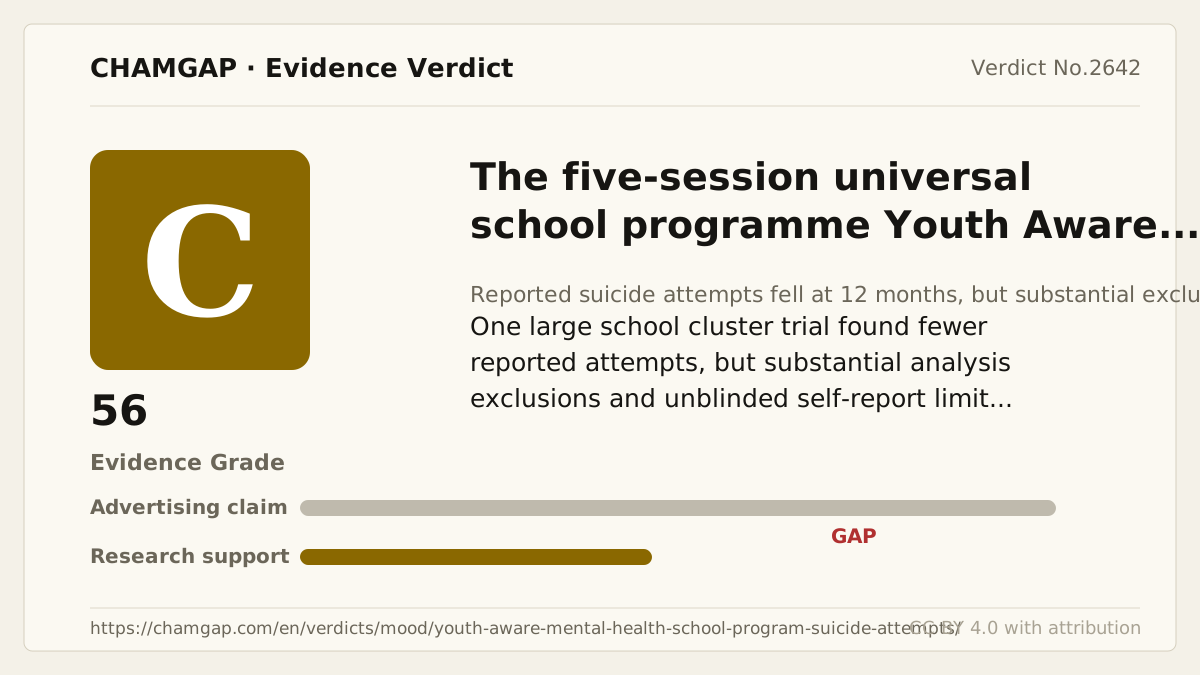
research showsThe grade is C with 56 points. In a 168-school cluster trial across ten European countries, 12-month self-reported suicide attempts were 14/1,987 (0.70%) with YAM versus 34/2,256 (1.51%) in controls, OR 0.45 (95% CI 0.24 to 0.85). The event difference was large, but the analyzed groups were substantially smaller than the 2,721 and 2,933 allocated pupils, and participants knew their programme while reporting their own attempts.
ads claimResults for a specific five-session package of role-play, lectures, booklets, and posters cannot be converted into proof for every school awareness lesson. Education also cannot replace clinical assessment and emergency referral for a pupil in crisis.
Useful facts when choosing a product
- YAM is a five-session universal programme using student role-play, lectures, booklets, and classroom posters.
- The 12-month analysis denominators were 1,987 YAM and 2,256 control pupils, distinct from randomized counts.
- DRKS00000214 and NCT00906620 are linked country records of the same SEYLE trial, not two independent trials.
Chamgap Semantic Classification Code
Candidate index · review held
UNK.five-session-universal-school-programme-youth-aware-of-mental-health.UNK.fewer-suicide-attempts-over.assess.UNKUnknown > five-session universal school programme Youth Aware of Mental Health > Unknown > Fewer suicide attempts over > Association or change assessment > Unknown
An automated migration candidate, not an issued permanent code; exact claim scope remains under review. This machine-generated migration candidate helps retrieval but is not a permanent assignment. The original verdict ID and URL remain authoritative.
What the research actually shows
SEYLE cluster-randomized 11,110 pupils in 168 schools to QPR 2,692, YAM 2,721, professional screening 2,764, or control 2,933. Schools were assigned by random-number generator. The primary outcome was suicide attempts by three and 12 months; the 12-month YAM-control comparison was 14/1,987 versus 34/2,256, OR 0.45 (95% CI 0.24 to 0.85; P=0.014). The EU Seventh Framework Programme funded the study and the paper declared no competing interests. DRKS00000214 is the main registration; NCT00906620 is a country-specific record for the Israeli site, not independent replication.
Why this is classified as C (56)
A large publicly funded cluster trial found fewer direct events, but substantial exclusions, unblinded self-report, and no independent replication give C with 56 points.
Counterpoint. This is universal school prevention and was not pooled with clinical CBT for high-risk patients after a recent attempt.
Rejudgment record. Cross-check applied — Cross-checked allocated and analyzed counts, baseline exclusions, self-reported outcomes, public funding, and registration against the Lancet report
| Endpoint | H | Hard endpoint - actual events such as death |
| Replication | R1 | Single confirmatory trial |
| Independence | I2 | Decisive evidence is publicly or non-profit funded |
| Effect size | E+ | Meets the clinically important threshold |
Stored derived and displayed grades match; this is not a current recalculation or validity check (C).
Sub-claim grades by effect
This ingredient is marketed for several effects. A single overall grade blends strong and weak claims together, so each effect is graded separately here. The overall grade reflects the strongest disconfirming or core claim.
| Effect (sub-claim) | Grade | Basis |
|---|---|---|
| Fewer suicide attempts at 12 months | C | Rates were 14/1,987 versus 34/2,256. |
| Fewer suicide attempts at three months | D | There was no significant difference at three months. |
Cross-check — AI research and Codex final gate
Evidence Table
| Study | Design | Sample | Funding | Endpoint | Result | Weight |
|---|---|---|---|---|---|---|
| Wasserman D, Hoven CW, Wasserman C, Wall M, Eisenberg R, Hadlaczky G, Kelleher I, Sarchiapone M, Apter A, Balazs J, Bobes J, Brunner R, Corcoran P, Cosman D, Guillemin F, Haring C, Iosue M, Kaess M, Kahn JP, Keeley H, Musa GJ, Nemes B, Postuvan V, Saiz P, Reiter-Theil S, Varnik A, Varnik P, Carli V. 2015 SEYLE | Multinational cluster randomized controlled trial in 168 schools | 2,721 allocated to YAM and 2,933 to control; 1,987 and 2,256 in the 12-month attempt analysis | Public EU Seventh Framework Programme funding; no competing interests declared | Primary self-reported suicide attempts at three and 12 months | At 12 months, 14/1,987 (0.70%) versus 34/2,256 (1.51%), OR 0.45 (95% CI 0.24 to 0.85), P=0.014 | Only large direct cluster trial |
Receipt — 1 References
All 1 cited sources were verified for existence at the original page (as of 2026-08-15).
Final verification and publication gate: Codex · Evidence date: 2026-08-15 · Corrections: none
Cite this verdict
[Chamgap] School YAM programme x prevention of adolescent suicide attempts — Evidence Grade C·56. 1 cited sources checked. Source: https://chamgap.com/en/verdicts/mood/youth-aware-mental-health-school-program-suicide-attempts/ · CC BY 4.0CC BY 4.0 — free to use with attribution; do not distort grades, numbers, or verdict meaning.
What this document does and does not do
Chamgap is an information source. It reports what research has and has not confirmed; it does not tell readers what to take or buy. That decision belongs to readers and, when needed, medical or legal professionals. This verdict reflects literature available up to the search date and may change as new research appears. Nothing here is medical advice.