
Lithium carbonate,
does it really help with Prevention of recurrent manic and depressive mood episodes in stabilized bipolar I disorder?
research showsLithium carbonate is rated A because it has one of the broadest evidence bases for preventing new manic and depressive mood episodes in stabilized bipolar I disorder. A meta-analysis of seven placebo-controlled trials and 1,580 participants found risk ratios of 0.66 for any mood episode and 0.52 for mania. Depression prevention was less certain: the fixed-effect analysis was significant, but the random-effects estimate was RR 0.78 with a 95% CI extending to 1.03. An independent network meta-analysis of 33 trials and 6,846 participants still retained lithium as first-line relapse prevention because of the breadth and quality of evidence across both manic and depressive recurrence. A suicide-reduction signal exists but is separated as B because it comes from rare events and mixed mood-disorder populations. Lithium has a narrow therapeutic index and requires regular serum-level, kidney, thyroid, and calcium monitoring.
ads claimClaims should not expand relapse-risk reduction into a cure, guaranteed suicide prevention, or safe use without blood tests at a low dose. Lithium does not prevent every episode, and dehydration, diarrhea, fever, a major change in salt intake, and drugs such as nonsteroidal anti-inflammatory drugs, angiotensin-converting enzyme inhibitors, angiotensin receptor blockers, and thiazide diuretics can raise lithium concentrations and cause toxicity.
Useful facts when choosing a product
- Lithium carbonate is a prescription mood stabilizer used for acute mania and maintenance treatment of bipolar disorder. During maintenance, the target serum concentration is individualized to the patient's condition and concomitant medicines.
- Because lithium has a narrow therapeutic index, serum lithium concentration, kidney function, thyroid function, electrolytes, and calcium must be checked before and regularly during treatment. Sampling time and the target range must follow the prescriber's instructions.
- Fine tremor, thirst and polyuria, nausea, diarrhea, weight gain, and hypothyroidism can occur. Coarse tremor, unsteady gait, confusion, slurred speech, or persistent vomiting and diarrhea can indicate toxicity and require urgent assessment.
- Dehydration, acute illness, an abrupt low-salt diet, nonsteroidal anti-inflammatory drugs, angiotensin-converting enzyme inhibitors, angiotensin receptor blockers, and thiazide diuretics can raise lithium concentrations. Pregnancy planning, kidney disease, and cardiovascular disease require advance specialist discussion, and patients should not stop lithium on their own.
Chamgap Semantic Classification Code
Candidate index · review held
M.lithium-carbonate.UNK.recurrent-manic-and-depressive-mood-episodes-in-stabilized-bipolar-i-disorder.prevent.placeboMedicinal interventions > Lithium carbonate > Unknown > recurrent manic and depressive mood episodes in stabilized bipolar I disorder > Occurrence-prevention claim > Placebo
An automated migration candidate, not an issued permanent code; exact claim scope remains under review. This machine-generated migration candidate helps retrieval but is not a permanent assignment. The original verdict ID and URL remain authoritative.
What the research actually shows
Geddes and colleagues in 2004 pooled five trials and 770 participants, finding RR 0.65 for any relapse and RR 0.62 for manic relapse, while the depression estimate of RR 0.72 included no effect. The 2014 update by Severus and colleagues included seven placebo-controlled trials and 1,580 participants, reconfirmed overall and manic prevention, and found model-dependent significance for depression. Miura and colleagues analyzed 33 trials and 6,846 participants and judged lithium to have the strongest combined evidence for prevention of manic and depressive recurrence. Cipriani and colleagues found an odds ratio of 0.13 for suicide versus placebo across 48 long-term randomized trials and 6,674 participants with mood disorders, but events were rare and the population was not limited to bipolar I maintenance. A toxicity meta-analysis confirmed hypothyroidism, reduced urinary concentrating ability, parathyroid and calcium changes, and weight gain.
Why this is classified as A (82)
Direct outcomes of any mood episode and manic recurrence were significantly reduced across seven placebo-controlled trials and 1,580 participants, while a non-industry 33-trial network analysis confirmed the breadth of evidence across both manic and depressive recurrence. Decades of replication beyond a single manufacturer make this evidence stronger than the corpus rating of B for lamotrigine maintenance and defend A. Model-sensitive evidence for depression, attrition, enriched designs, and the burden of serum-level, kidney, thyroid, and calcium monitoring required by the narrow therapeutic index give A with 82 points.
Counterpoint. Long-term benefit can be substantial in a patient who responds well and remains stable, but depressive polarity, comorbidities, pregnancy potential, kidney function, and preference may favor lamotrigine, valproate, or an atypical antipsychotic maintenance strategy. Any discontinuation should be gradual and supervised to reduce rebound recurrence risk.
Rejudgment record. Cross-check reflected — Retained A for direct recurrence outcomes of RR 0.66 for any mood episode and RR 0.52 for mania across seven placebo-controlled trials and for non-industry 33-trial network evidence across manic and depressive recurrence, while deducting for the model-sensitive depression estimate, attrition, enriched designs, and monitoring burden from the narrow therapeutic index, resulting in 82 points
Sub-claim grades by effect
This ingredient is marketed for several effects. A single overall grade blends strong and weak claims together, so each effect is graded separately here. The overall grade reflects the strongest disconfirming or core claim.
| Effect (sub-claim) | Grade | Basis |
|---|---|---|
| Prevention of manic or hypomanic recurrence in stabilized bipolar I disorder | A | Direct recurrence outcomes were consistent across multiple placebo-controlled trials, with pooled RR 0.52 in seven trials. |
| Prevention of depressive recurrence in stabilized bipolar I disorder | B | The direction favors prevention, but the random-effects RR of 0.78 included 1 and is less robust than the mania result. |
| Reduction of suicide risk during long-term treatment | B | Randomized-trial meta-analysis found a large reduction, but events were rare and populations mixed unipolar and bipolar disorders. |
Cross-check — AI research and Codex final gate
Evidence Table
| Study | Design | Sample | Funding | Endpoint | Result | Weight |
|---|---|---|---|---|---|---|
| Severus E et al. 2014 | Systematic review and meta-analysis of placebo-controlled randomized trials | Seven placebo-controlled trials and 1,580 participants | Academic research; no specific industry funding reported in the article | Recurrence of any, manic, and depressive mood episodes | RR was 0.66 for any episode and 0.52 for mania; depression was RR 0.78 (95% CI 0.59 to 1.03) under random effects and RR 0.73 under fixed effects. | Key synthesis of direct recurrence outcomes |
| Miura T et al. 2014 | Systematic review and network meta-analysis of randomized maintenance trials | 33 randomized trials, 6,846 participants, and 17 treatment strategies | Reported no funding | Any, manic, and depressive recurrence and discontinuation for adverse events | Lithium was retained as first-line relapse prevention because of efficacy against both manic and depressive recurrence and the quality of its evidence. | Large independent comparative synthesis |
| Cipriani A et al. 2013 | Systematic review and meta-analysis of long-term randomized trials | 48 trials and 6,674 participants with unipolar or bipolar mood disorders | United Kingdom National Institute for Health Research and academic support | Suicide, self-harm, and all-cause mortality | Versus placebo, OR was 0.13 (95% CI 0.03 to 0.66) for suicide and 0.38 for all-cause death, while self-harm was not significant. | Important supportive evidence limited by rare events and a mixed population |
Receipt — 5 References
All 5 cited sources were verified for existence at the original page (as of 2026-07-21).
Final verification and publication gate: Codex · Evidence date: 2026-07-21 · Corrections: none
Cite this verdict
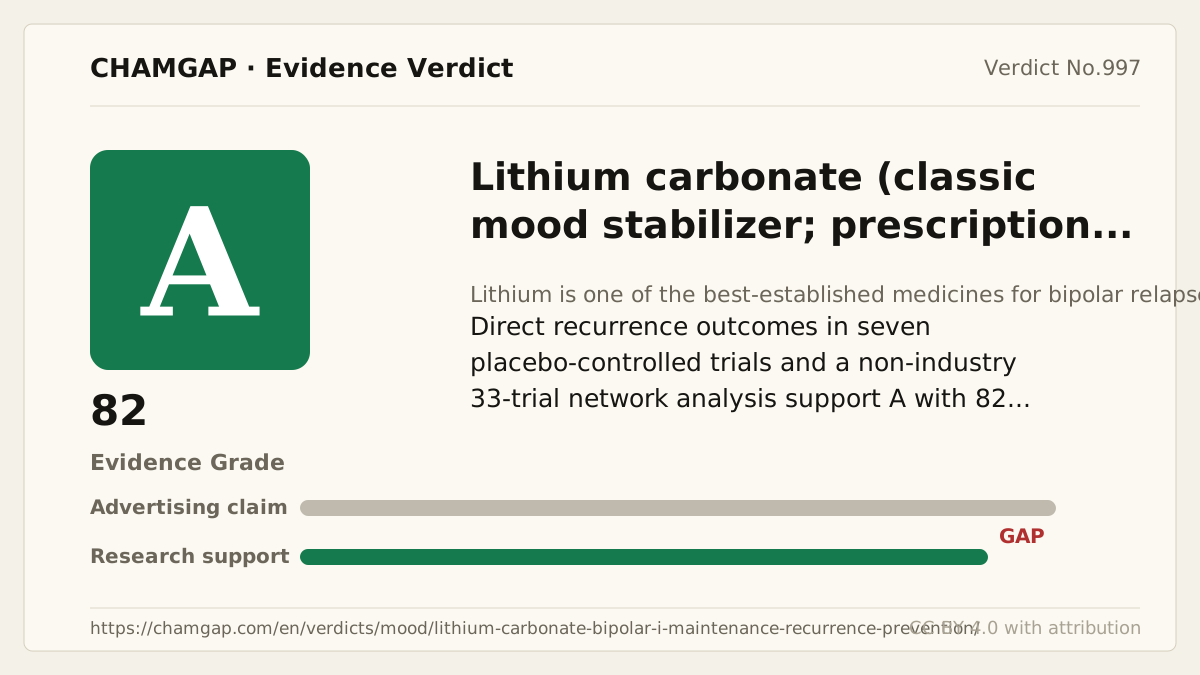
[Chamgap] Lithium carbonate x prevention of mood-episode recurrence in stabilized bipolar I disorder — Evidence Grade A·82. 5 cited sources checked. Source: https://chamgap.com/en/verdicts/mood/lithium-carbonate-bipolar-i-maintenance-recurrence-prevention/ · CC BY 4.0CC BY 4.0 — free to use with attribution; do not distort grades, numbers, or verdict meaning.
What this document does and does not do
Chamgap is an information source. It reports what research has and has not confirmed; it does not tell readers what to take or buy. That decision belongs to readers and, when needed, medical or legal professionals. This verdict reflects literature available up to the search date and may change as new research appears. Nothing here is medical advice.