
Transcranial direct current stimulation,
does it really help with Reduced depressive symptoms and increased response or remission in major depressive disorder?
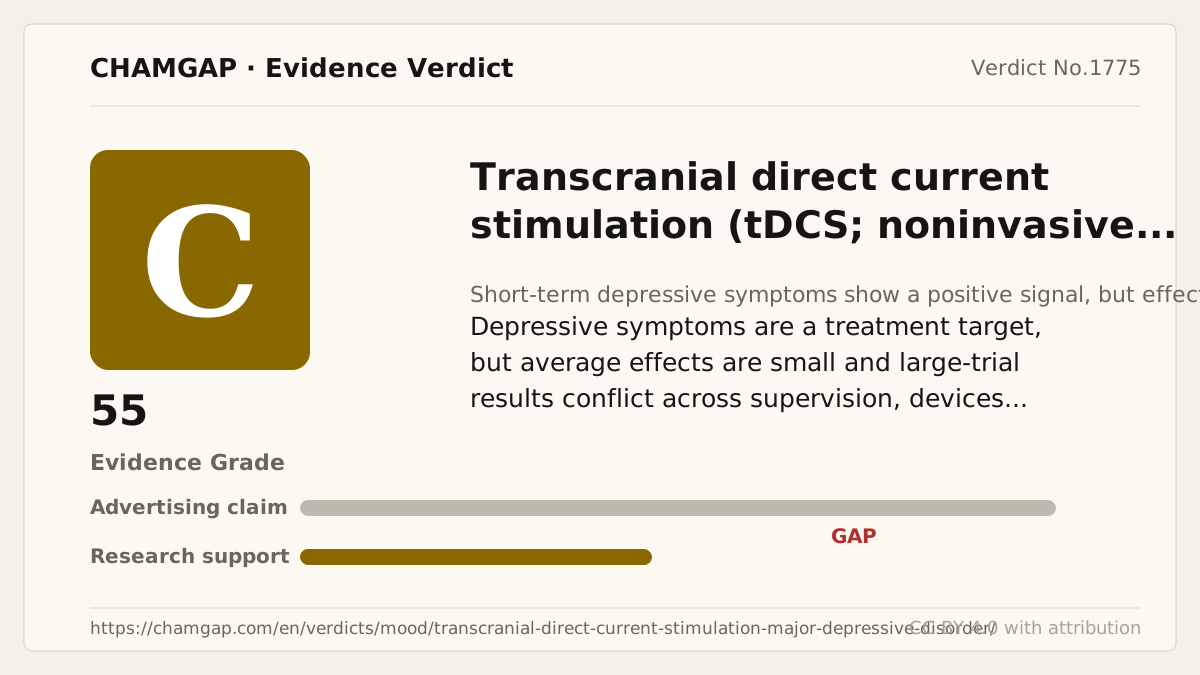
research showstDCS has a modest positive signal for short-term depressive symptoms in major depressive disorder but is rated C with 55 points. ELECT-TDCS succeeded against placebo in 245 intention-to-treat participants but failed noninferiority to escitalopram; a supervised home trial was positive, whereas a 210-participant unsupervised home trial was null. In an individual-patient-data meta-analysis of nine trials and 572 participants, remission was OR 1.94 (95% CI 1.19 to 3.16), response was OR 1.96 (1.30 to 2.95), and symptoms were beta 0.31 (0.15 to 0.47). The stimulation method differs from verdict 1486, which is C with 54 points, but the evidence structures are similar and the two verdicts appropriately sit alongside each other at C.
ads claimMarketing may present inexpensive home devices as a drug-replacing brain reset, but effects are small and dependent on supervision and protocol; the evidence does not support improvised devices or unsupervised self-treatment.
Useful facts when choosing a product
- This device treatment passes weak direct current through scalp electrodes; electrode placement, current, and session number vary across trials.
- Skin redness, burning, headache, tinnitus, and manic switching have been reported, requiring mental-health screening and follow-up.
- It does not justify stopping antidepressants or psychotherapy and does not replace suicide-risk assessment.
Chamgap Semantic Classification Code
Candidate index · review held
P.transcranial-direct-current-stimulation.device.depressive-symptoms-and-increased-response-or-remission-in-major-depressive-disorder.reduce.MULTIProcedures, devices and tests > Transcranial direct current stimulation > Device delivered > depressive symptoms and increased response or remission in major depressive disorder > Reduction claim > Multiple: primary unresolved
An automated migration candidate, not an issued permanent code; exact claim scope remains under review. This machine-generated migration candidate helps retrieval but is not a permanent assignment. The original verdict ID and URL remain authoritative.
What the research actually shows
ELECT-TDCS succeeded against placebo in all 245 intention-to-treat participants but failed noninferiority to escitalopram. Woodham randomized 174 and reported a positive 10-week endpoint in 173 modified-intention-to-treat participants, whereas Borrione found no six-week primary effect in a mixed model using all 210 participants. An individual-patient-data meta-analysis of nine trials and 572 participants found remission OR 1.94 (95% CI 1.19 to 3.16), response OR 1.96 (1.30 to 2.95), and symptoms beta 0.31 (0.15 to 0.47). For longer-term evidence, a 26-person six-month prospective continuation study reported relapse-free survival probabilities of 83.7% at three months and 51.1% at six months, and the PSYLECT maintenance phase (J Affect Disord 2026;394:120548) followed 71 participants open-label for six months. Both were preliminary uncontrolled data restricted to acute-phase responders, so long-term relapse prevention remains unproven at D.
Why this is classified as C (55)
Direct depressive-symptom primary endpoints were positive in multiple trials, but small mean differences, a large negative trial, and failed noninferiority support C with 55 points.
Counterpoint. Supervised adjunctive use may be discussed for selected patients with inadequate response or medication intolerance, but evidence must be matched to the specific device and protocol.
Rejudgment record. Cross-check applied — Accepted primary success in the 245-participant ELECT-TDCS intention-to-treat analysis and the supervised home trial while applying rule ①-ⓒ for failed noninferiority, primary failure in a 210-participant unsupervised trial, small effects, industry support, and protocol heterogeneity
Sub-claim grades by effect
This ingredient is marketed for several effects. A single overall grade blends strong and weak claims together, so each effect is graded separately here. The overall grade reflects the strongest disconfirming or core claim.
| Effect (sub-claim) | Grade | Basis |
|---|---|---|
| Reduction of depressive symptoms at 10 weeks | C | Multiple positive trials exist, but mean between-group differences are small and conflict with a large negative trial. |
| Increased treatment response and remission | C | In the nine-trial, 572-participant individual-patient-data meta-analysis, remission was OR 1.94 (1.19 to 3.16), response was OR 1.96 (1.30 to 2.95), and symptoms were beta 0.31 (0.15 to 0.47); protocol heterogeneity and industry support remain. |
| Long-term relapse prevention | D | A 26-person six-month prospective continuation study reported relapse-free survival probabilities of 83.7% at three months and 51.1% at six months, and the PSYLECT maintenance phase (J Affect Disord 2026;394:120548) followed 71 participants open-label for six months. Both were preliminary uncontrolled data restricted to acute-phase responders, so the claim is unproven and rated D. |
Cross-check — AI research and Codex final gate
Evidence Table
| Study | Design | Sample | Funding | Endpoint | Result | Weight |
|---|---|---|---|---|---|---|
| Brunoni AR et al. ELECT-TDCS 2017 | Single-center randomized double-blind noninferiority and placebo-controlled trial | 245 randomized; all 245 in the intention-to-treat primary analysis | Public and academic funding led by the São Paulo Research Foundation | Change in HDRS-17 score at 10 weeks | Primary outcome showed superiority to placebo by 3.2 points, P=0.01; noninferiority to escitalopram failed, P=0.69. | Key large comparative trial |
| Woodham RD et al. 2025 | Multisite remotely supervised home-based randomized double-blind sham-controlled phase 2 trial | 174 randomized; 173 in the modified intention-to-treat analysis | Industry funded by Flow Neuroscience, which supplied devices and performed randomization | Change in HDRS score at 10 weeks | Primary endpoint succeeded: improvement of 9.41 versus 7.14 points, about a 2.3-point difference, P=0.012. | Industry-supported positive replication |
| Borrione L et al. PSYLECT 2024 | Unsupervised home-based randomized double-blind sham-controlled trial | 210 allocated and included in mixed-model analysis; 199 completed | Public funding from the São Paulo Research Foundation; small budget and device support from Flow Neuroscience | Change in HDRS-17 score at 6 weeks | Primary endpoint failed: tDCS alone versus double sham d minus 0.25 (95% CI minus 0.76 to 0.27), P=0.35. | Large conflicting trial |
Receipt — 3 References
All 3 cited sources were verified for existence at the original page (as of 2026-07-24).
Final verification and publication gate: Codex · Evidence date: 2026-07-24 · Corrections: none
Cite this verdict
[Chamgap] Transcranial direct current stimulation x Reduced depressive symptoms and increased response or remission in major depressive disorder — Evidence Grade C·55. 3 cited sources checked. Source: https://chamgap.com/en/verdicts/mood/transcranial-direct-current-stimulation-major-depressive-disorder/ · CC BY 4.0CC BY 4.0 — free to use with attribution; do not distort grades, numbers, or verdict meaning.
What this document does and does not do
Chamgap is an information source. It reports what research has and has not confirmed; it does not tell readers what to take or buy. That decision belongs to readers and, when needed, medical or legal professionals. This verdict reflects literature available up to the search date and may change as new research appears. Nothing here is medical advice.