
Rhodiola,
does it really help with Induction of response and remission in mild-to-moderate major depressive disorder?
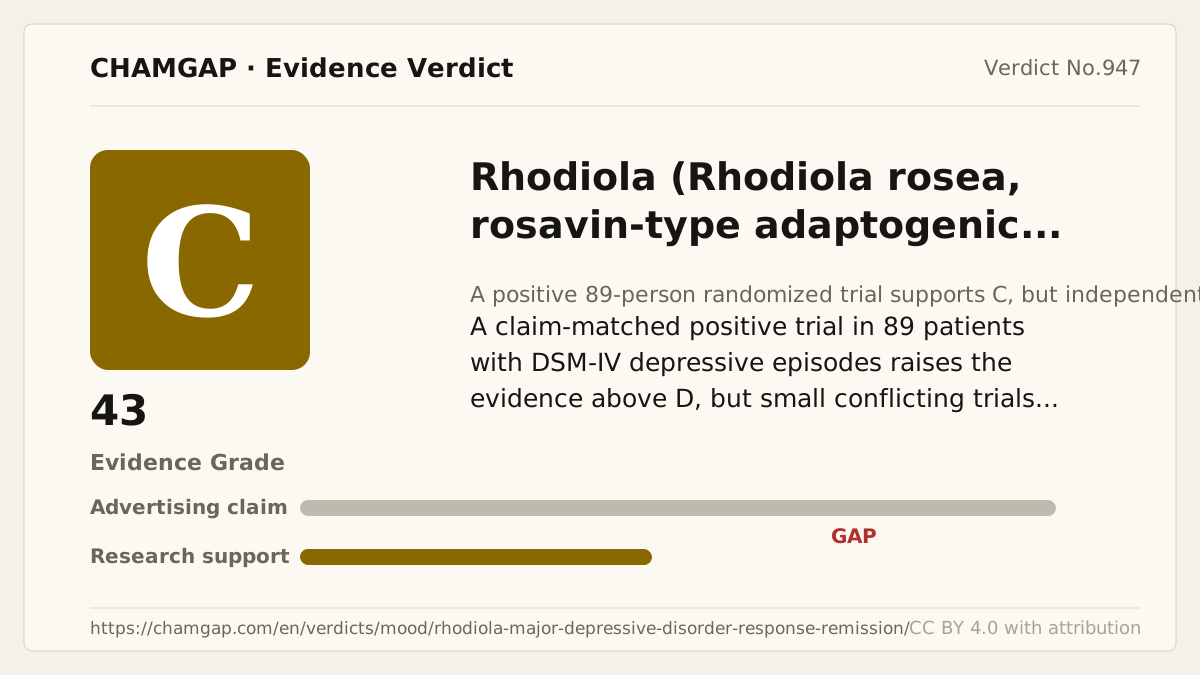
research showsRhodiola is rated C. A randomized placebo-controlled trial of SHR-5 in 89 patients with DSM-IV depressive episodes found six-week HAMD improvement, so a claim-matched positive human trial places the evidence above D. An independent 57-person trial found no significant between-group difference, although the odds ratio for improvement with rhodiola versus placebo pointed favorably at 1.39. Small samples, conflicting results, and limited independent replication place the verdict at the low end of C with 43 points. The fatigue and stress verdict in item 072 concerns a different efficacy axis.
ads claimMarketing can expand adaptogen language, cortisol or monoamine mechanisms, and fatigue findings into antidepressant response and remission. Short-term self-reported changes in stress-related fatigue or low mood are not equivalent to treatment efficacy in clinical MDD, and rhodiola is not an established substitute for standard antidepressants.
Useful facts when choosing a product
- The core depression trials used SHR-5 standardized for rosavin and rhodioloside, so their results cannot be generalized directly to plain root powder or other extracts.
- Trial dosing generally began around 340 to 680 mg/day, but the 2015 study escalated capsule counts according to response, so exposure may differ from marketed products.
- Rhodiola is generally tolerated short term, but dizziness, headache, dry mouth or excessive saliva, activation, and insomnia may occur.
- People being treated for depression should not stop or replace prescribed therapy on their own and should review possible herb-drug interactions with a clinician.
Chamgap Semantic Classification Code
Candidate index · review held
S.rhodiola.UNK.induction-of-response-and-remission-in-mild-to-moderate-major-depressive-disorder.treat.MULTISupplements and nutraceuticals > Rhodiola > Unknown > Induction of response and remission in mild-to-moderate major depressive disorder > Treatment or remission claim > Multiple: primary unresolved
An automated migration candidate, not an issued permanent code; exact claim scope remains under review. This machine-generated migration candidate helps retrieval but is not a permanent assignment. The original verdict ID and URL remain authoritative.
What the research actually shows
Darbinyan 2007 randomized 89 patients with a DSM-IV mild-to-moderate depressive episode to SHR-5 at 340 mg/day, 680 mg/day, or placebo for six weeks and reported HAMD improvement with both doses. It was a study of a specific standardized extract, sponsored by the Swedish Herbal Institute, with an industry-affiliated author. Mao 2015 was a publicly funded 12-week trial that randomized 57 diagnosed patients to SHR-5, sertraline, or placebo. Symptoms fell in all groups, but no primary or secondary scale differed significantly between groups, and the rhodiola improvement odds ratio versus placebo was 1.39 with a 95% CI of 0.38 to 5.04. The WFSBP and CANMAT guideline summarized the evidence as one positive and one null trial and did not currently recommend rhodiola as monotherapy or adjunctive therapy for MDD.
Why this is classified as C (43)
The SHR-5 trial in 89 patients with DSM-IV depressive episodes found six-week HAMD improvement, providing a claim-matched positive human randomized trial and supporting C rather than D. The independent 57-person trial was null between groups, although the improvement odds ratio versus placebo pointed favorably at 1.39. Small samples, conflicting results, and limited independent replication yield C with 43 points. The fatigue and stress verdict in item 072 is a different efficacy axis, and short-term tolerability remains separate from efficacy.
Counterpoint. A small positive randomized trial means the evidence is not repeated disproof warranting F. Adequately powered independent studies with a standardized formulation and preregistered response, remission, function, and relapse outcomes could raise the grade.
Rejudgment record. Cross-check revision — A positive SHR-5 randomized trial in 89 patients with DSM-IV major depressive disorder places the claim above D, while small samples, conflicting results, and limited independent replication keep it at the low end of C
Sub-claim grades by effect
This ingredient is marketed for several effects. A single overall grade blends strong and weak claims together, so each effect is graded separately here. The overall grade reflects the strongest disconfirming or core claim.
| Effect (sub-claim) | Grade | Basis |
|---|---|---|
| Induction of treatment response in mild-to-moderate MDD | C | The 89-person DSM-IV depressive-episode trial was positive, but the independent 57-person trial was null between groups and the improvement odds ratio of 1.39 versus placebo was highly uncertain. |
| Induction of remission in mild-to-moderate MDD | C | A claim-matched positive human randomized trial exists, but no adequately sized independent trial has repeatedly verified remission rates. |
| MDD treatment efficacy equivalent to a standard antidepressant | C | Positive human randomized evidence places the claim above D, but the 57-person trial was not designed or powered for noninferiority, so equivalent efficacy is not established. |
Cross-check — AI research and Codex final gate
Evidence Table
| Study | Design | Sample | Funding | Endpoint | Result | Weight |
|---|---|---|---|---|---|---|
| Darbinyan V et al. 2007 | Randomized double-blind placebo-controlled parallel-group trial | 89 patients with mild-to-moderate depressive episodes | Sponsored by the Swedish Herbal Institute and included an industry-affiliated author | Six-week HAMD total and subscale scores | Both 340 and 680 mg/day of SHR-5 improved depression scales versus placebo, but this was a small short-term branded-extract trial. | Positive core evidence with industry linkage |
| Mao JJ et al. 2015 | Randomized double-blind placebo- and active-controlled phase II trial | 57 patients with MDD; 20 rhodiola, 19 sertraline, and 18 placebo | United States NIH NCCAM and the University of Pennsylvania Jack Warsaw Fund | Twelve-week HAM-D, BDI, CGI/C, and odds of improvement | All between-group scale differences were null, and the odds ratio for improvement with rhodiola versus placebo was 1.39 (95% CI 0.38 to 5.04). | More independent core null evidence but underpowered |
| Sarris J et al. 2022 WFSBP/CANMAT guideline | International clinical guideline and systematic evidence assessment | Two rhodiola MDD randomized trials totaling 146 participants | International academic taskforce with individual disclosures | Recommendation for MDD monotherapy or adjunctive treatment | It did not currently recommend monotherapy or adjunctive use because one positive and one null trial had small samples and limited power. | Key clinical-applicability evidence |
Receipt — 3 References
All 3 cited sources were verified for existence at the original page (as of 2026-07-21).
Final verification and publication gate: Codex · Evidence date: 2026-07-21 · Corrections: none
Cite this verdict
[Chamgap] Rhodiola x induction of response and remission in mild-to-moderate major depressive disorder — Evidence Grade C·43. 3 cited sources checked. Source: https://chamgap.com/en/verdicts/mood/rhodiola-major-depressive-disorder-response-remission/ · CC BY 4.0CC BY 4.0 — free to use with attribution; do not distort grades, numbers, or verdict meaning.
What this document does and does not do
Chamgap is an information source. It reports what research has and has not confirmed; it does not tell readers what to take or buy. That decision belongs to readers and, when needed, medical or legal professionals. This verdict reflects literature available up to the search date and may change as new research appears. Nothing here is medical advice.