
One year of postdischarge specialized mood-disorder clinic care,
does it really help with Delayed first psychiatric readmission after hospitalization for severe unipolar depression?
research showsThe grade is D. Among 268 patients discharged after a first, second, or third psychiatric hospitalization for moderate or severe unipolar depression, first readmission occurred in 47/131 (34.3%) with the specialist clinic versus 55/137 (40.1%) with standard care; unadjusted HR 0.89 (95% CI 0.60 to 1.32). Readmission was a hard endpoint confirmed for every participant in the registry, while the interval still allowed a 40% hazard reduction. This is an imprecise null single trial, not exclusion of benefit, giving D with 34 points.
ads claimThe question overlaps Korean community mental-health centers, day hospitals, and discharge linkage, but the study assumes Denmark's registry and admission system. Different resources and admission thresholds limit transportability.
Useful facts when choosing a product
- All 268 participants entered ITT Kaplan-Meier analysis; censoring was not attrition.
- First readmission was 47/131 versus 55/137, about -5.8 points, but the time-to-event interval was wide.
- Treatment satisfaction improved, while depressive symptoms and antidepressant use did not differ significantly.
Chamgap Semantic Classification Code
Candidate index · review held
UNK.of-postdischarge-specialized-mood-disorder-clinic-care.UNK.delayed-first-psychiatric-readmission-after-hospitalization-for-severe-unipolar-depression.reduce.usual-careUnknown > of postdischarge specialized mood-disorder clinic care > Unknown > Delayed first psychiatric readmission after hospitalization for severe unipolar depression > Reduction claim > Usual care
An automated migration candidate, not an issued permanent code; exact claim scope remains under review. This machine-generated migration candidate helps retrieval but is not a permanent assignment. The original verdict ID and URL remain authoritative.
What the research actually shows
Copenhagen-area services randomized 268 participants, 131 versus 137. Allocation was described as "The Copenhagen Trial Unit conducted randomisation centrally according to a computer generated allocation sequence to secure allocation concealment," with block size 20 unknown to investigators. Analysis was ITT and registry data covered all 268. Defect name: Unblinded subjective endpoint. Listed item: Unblinded subjective endpoint. Original evidence that the requirement was met: "Blinding of patients and the treating clinicians was not possible," and the authors noted that "the decision to admit a patient in our trial were influenced by the treating physician's attitude" was possible. Avoidability: Avoidable - patient and clinician masking was impractical, but an independent blinded admission panel and prespecified objective criteria could further reduce the effect of allocation-aware clinicians on readmission decisions. Registry ascertainment and blinded analysis reduced outcome-recording bias. The Lundbeck Foundation and Capital Hospital Corporation research foundation supported the study with no funder role.
Why this is classified as D (34)
Record-confirmed readmission as a hard endpoint and independent public nonprofit support are strengths, but this single trial was null and did not exclude substantial benefit, giving D with 34 points.
Counterpoint. The absolute readmission difference favored specialist care, so a larger trial could still establish benefit. Current evidence does not prove no effect.
Rejudgment record. Direct source verification — Publicly funded central randomization, record-confirmed readmission for all 268 in ITT registry follow-up, unblinded treating clinicians, and wide HR interval
| Endpoint | H | Hard endpoint - actual events such as death |
| Replication | R1 | Single confirmatory trial |
| Independence | I2 | Decisive evidence is publicly or non-profit funded |
| Effect size | E0 | Null |
| Precision | C0 | The confidence interval leaves room for benefit |
Stored derived and displayed grades match; this is not a current recalculation or validity check (D).
Sub-claim grades by effect
This ingredient is marketed for several effects. A single overall grade blends strong and weak claims together, so each effect is graded separately here. The overall grade reflects the strongest disconfirming or core claim.
| Effect (sub-claim) | Grade | Basis |
|---|---|---|
| Delayed first psychiatric readmission | D | HR 0.89 (0.60 to 1.32) was null and did not exclude benefit. |
| Improved treatment satisfaction | C | One-year satisfaction was significantly higher but was a tertiary endpoint. |
Cross-check — AI research and Codex final gate
Evidence Table
| Study | Design | Sample | Funding | Endpoint | Result | Weight |
|---|---|---|---|---|---|---|
| Hansen HV et al. 2012 EIA unipolar-depression trial | Centrally randomized open multicenter specialist-clinic versus standard-care trial with registry outcome | 268 randomized and analyzed by ITT (131/137); primary registry data for all | Lundbeck Foundation and Capital Hospital Corporation research foundation, with no funder role | Time from discharge to first psychiatric-ward readmission, ascertained in the Danish Psychiatric Central Register | 47/131 (34.3%) versus 55/137 (40.1%); unadjusted HR 0.89 (95% CI 0.60 to 1.32), P=.6 | Independent complete-registry trial, but a clinician-dependent endpoint and imprecise null result |
Receipt — 1 References
All 1 cited sources were verified for existence at the original page (as of 2026-08-18).
Final verification and publication gate: Codex · Evidence date: 2026-08-18 · Corrections: none
Cite this verdict
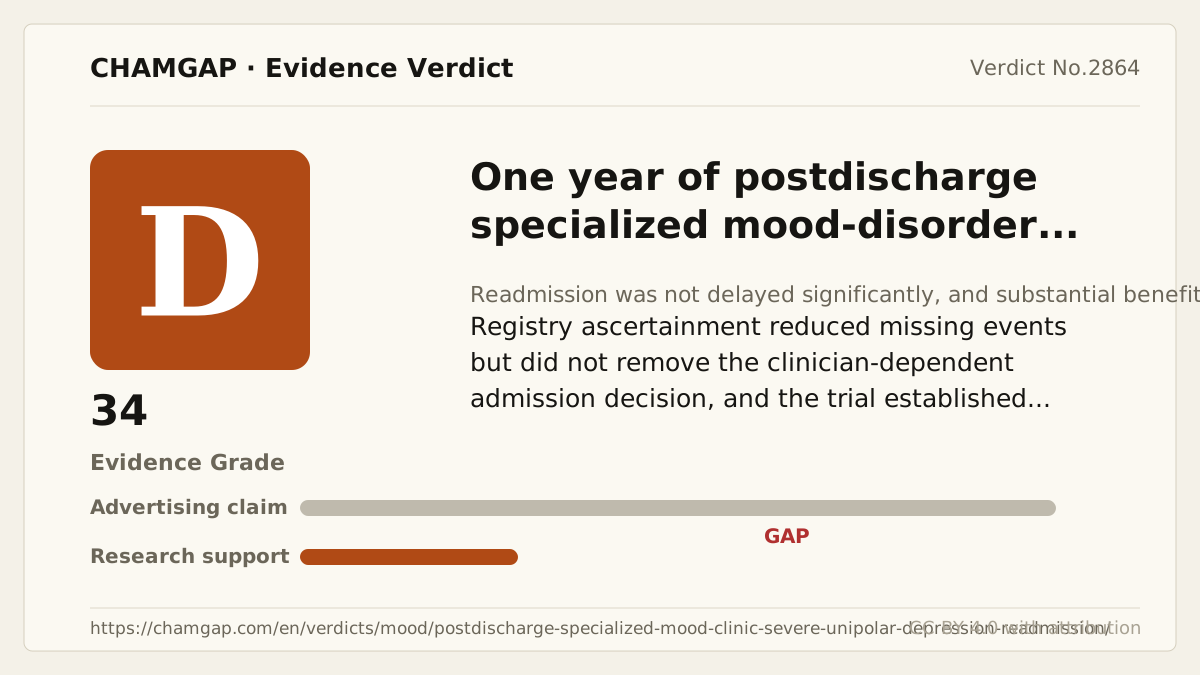
[Chamgap] Postdischarge Specialized Mood Disorder Clinic Care Is Null for Delaying Psychiatric Readmission in Severe Unipolar Depression — Evidence Grade D·34. 1 cited sources checked. Source: https://chamgap.com/en/verdicts/mood/postdischarge-specialized-mood-clinic-severe-unipolar-depression-readmission/ · CC BY 4.0CC BY 4.0 — free to use with attribution; do not distort grades, numbers, or verdict meaning.
What this document does and does not do
Chamgap is an information source. It reports what research has and has not confirmed; it does not tell readers what to take or buy. That decision belongs to readers and, when needed, medical or legal professionals. This verdict reflects literature available up to the search date and may change as new research appears. Nothing here is medical advice.