
Eight non-obligatory postcards over 12 months,
does it really help with Reduced repetition after deliberate self-poisoning?
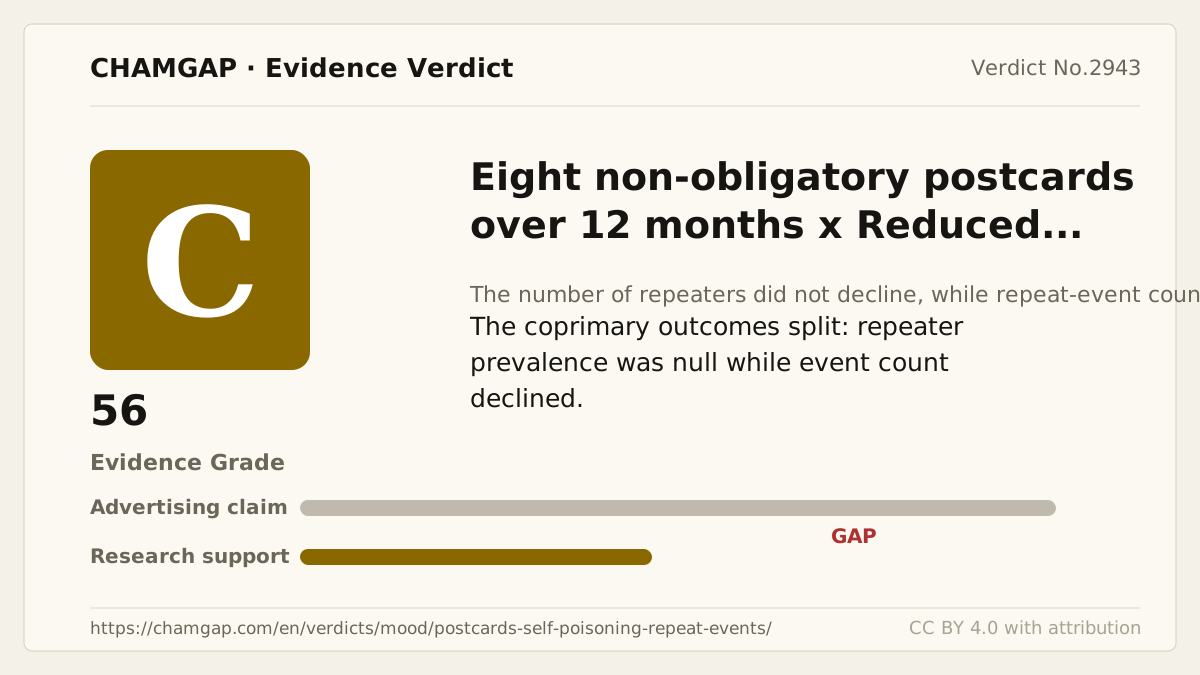
research showsThe grade is C. Any repetition occurred in 57/378 (15.1%) versus 68/394 (17.3%), difference -2 points (95% CI -7 to 3), a null result. Total repeat events were 101 versus 192, IRR 0.55 (95% CI 0.35-0.87). The number of repeaters did not fall; repeated episodes among a small group did.
ads claimClaims must say that repeater prevalence did not fall while total repeat episodes did, presenting both coprimary outcomes together.
Useful facts when choosing a product
- The intervention sent eight postcards without requiring a reply over 12 months.
- Hospital administrative data captured treated events.
- The trial did not demonstrate fewer suicide deaths.
Chamgap Semantic Classification Code
Candidate index · review held
X.non-obligatory-postcard-contact.behavioral.repeat-self-poisoning.reduce.usual-careBehaviors, exposures and policies > Non-obligatory postcard contact > Behavioral delivery > Repeat deliberate self-poisoning > Reduction claim > Usual care
An automated migration candidate, not an issued permanent code; exact claim scope remains under review. This machine-generated migration candidate helps retrieval but is not a permanent assignment. The original verdict ID and URL remain authoritative.
What the research actually shows
In Newcastle, Australia, 772 participants aged 16 or older were randomized to postcards, 378, or usual care, 394. Funding came from Hunter Area Health Service, NSW Health, and NHMRC. A 14-trial meta-analysis of letters, postcards, calls, and cards found the same pattern: any repetition OR 0.87 (95% CI 0.74-1.04), suicide OR 0.58 (0.24-1.38), and repeat-event rate IRR 0.66 (0.54-0.80). It concluded that widespread clinical implementation could not yet be recommended.
Why this is classified as C (56)
A publicly funded trial and class meta-analysis support fewer repeat events, but split coprimary outcomes give C with 56 points.
Counterpoint. Reduced repeater prevalence and suicide have not been established for widespread implementation.
Rejudgment record. Cross-check applied — A publicly funded randomized trial reduced repeat-event count but not the coprimary proportion of repeaters
| Endpoint | H | Hard endpoint - actual events such as death |
| Replication | R1 | Single confirmatory trial |
| Independence | I2 | Decisive evidence is publicly or non-profit funded |
| Effect size | E+ | Meets the clinically important threshold |
Stored derived and displayed grades match; this is not a current recalculation or validity check (C).
Sub-claim grades by effect
This ingredient is marketed for several effects. A single overall grade blends strong and weak claims together, so each effect is graded separately here. The overall grade reflects the strongest disconfirming or core claim.
| Effect (sub-claim) | Grade | Basis |
|---|---|---|
| Fewer people with any repetition | D | 15.1% versus 17.3%, with the interval including zero. |
| Fewer repeat events | C | There were 101 versus 192 events, IRR 0.55. |
Cross-check — AI research and Codex final gate
Evidence Table
| Study | Design | Sample | Funding | Endpoint | Result | Weight |
|---|---|---|---|---|---|---|
| Carter GL et al. 2005 Postcards from the EDge | Randomized usual-care-controlled trial | 772 participants, 378 versus 394 | Hunter Area Health Service, NSW Health, and NHMRC | Proportion with any repetition and number of repeat events per person | Repeaters 15.1% vs 17.3%, difference -2 points (-7 to 3); events 101 vs 192, IRR 0.55 (0.35-0.87) | Pivotal trial with split coprimary outcomes |
| Milner AJ et al. 2015 systematic review and meta-analysis | Meta-analysis of 14 brief-contact trials | 14 trials | Varied by original trial; synthesis not double-counted as another trial | Any repetition, suicide, and repeat events per person | OR 0.87 (0.74-1.04), OR 0.58 (0.24-1.38), IRR 0.66 (0.54-0.80) | Class synthesis showing the same pattern |
Receipt — 2 References
All 2 cited sources were verified for existence at the original page (as of 2026-08-26).
Final verification and publication gate: Codex · Evidence date: 2026-08-26 · Corrections: none
Cite this verdict
[Chamgap] Benefit of Non-Obligatory Postcards for Reducing Repeat Episodes of Deliberate Self-Poisoning — Evidence Grade C·56. 2 cited sources checked. Source: https://chamgap.com/en/verdicts/mood/postcards-self-poisoning-repeat-events/ · CC BY 4.0CC BY 4.0 — free to use with attribution; do not distort grades, numbers, or verdict meaning.
What this document does and does not do
Chamgap is an information source. It reports what research has and has not confirmed; it does not tell readers what to take or buy. That decision belongs to readers and, when needed, medical or legal professionals. This verdict reflects literature available up to the search date and may change as new research appears. Nothing here is medical advice.