
Polygala tenuifolia root extract,
does it really help with Treatment of depressive and anxiety symptoms with a single extract?
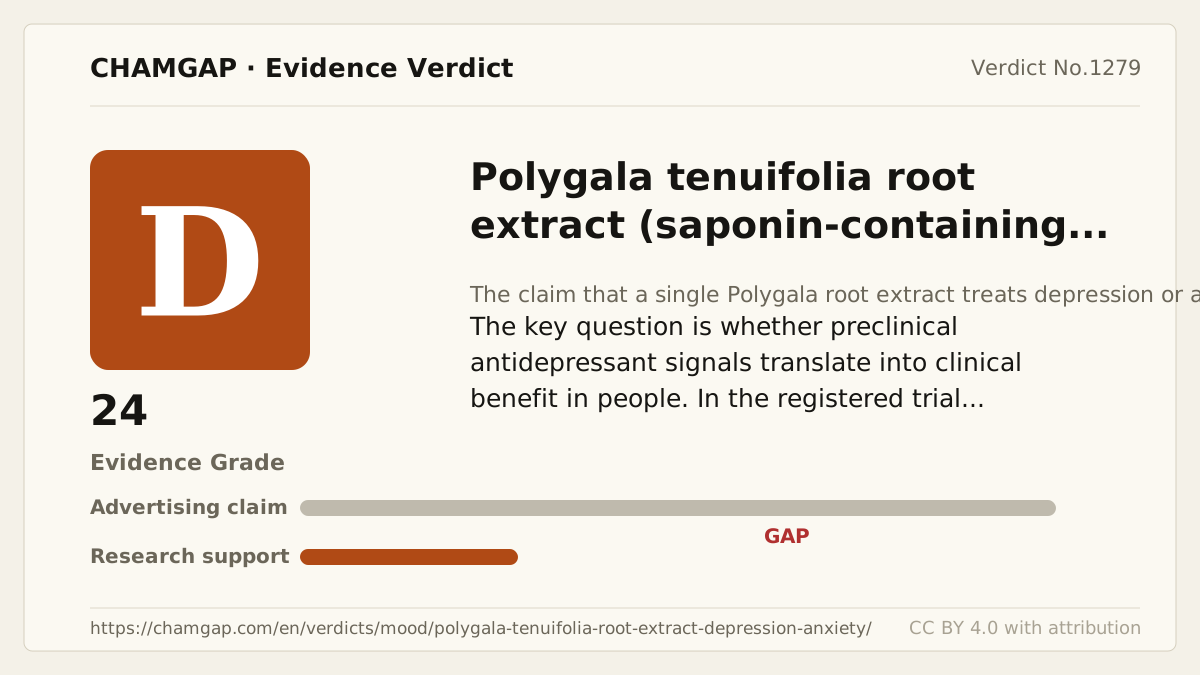
research showsD. A small placebo-controlled phase 2 trial tested the single-extract investigational product PDC-1421 in major depressive disorder, but neither the primary depression scale nor the anxiety scale improved significantly versus placebo.
ads claimMarketing may emphasize neurotransmitter or neuroplasticity mechanisms from animal studies, or the high-dose group's improvement from baseline. Neither establishes superiority over placebo, and results from the standardized investigational product PDC-1421 cannot be generalized to all retail Polygala supplements.
Useful facts when choosing a product
- PDC-1421 is a standardized water-soluble Polygala root extract developed as an investigational product and should not be assumed to be equivalent to retail supplements.
- Part II of the phase 2 trial administered 380 mg or 760 mg three times daily for 42 days; this did not establish a standard retail dosing regimen.
- Polygala products may vary by species, extraction method, and saponin content, while results from multi-herb formulas are not evidence for the single extract.
- Saponins may irritate the throat and gastrointestinal tract, and interactions with psychiatric medicines are insufficiently characterized, so professional advice is warranted before combining them.
Chamgap Semantic Classification Code
Candidate index · review held
S.polygala-tenuifolia-root-extract.UNK.treatment-of-depressive-and-anxiety-symptoms-with-a-single-extract.treat.placeboSupplements and nutraceuticals > Polygala tenuifolia root extract > Unknown > Treatment of depressive and anxiety symptoms with a single extract > Treatment or remission claim > Placebo
An automated migration candidate, not an issued permanent code; exact claim scope remains under review. This machine-generated migration candidate helps retrieval but is not a permanent assignment. The original verdict ID and URL remain authoritative.
What the research actually shows
In Part II of the PDC-1421 phase 2 trial, 60 adults with major depressive disorder were assigned to high-dose, low-dose, or placebo groups. The reported between-group p values at six weeks were 0.393 for MADRS, 0.406 for HAM-D, and 0.459 for HAM-A. No independent, adequately powered confirmatory trial was identified.
Why this is classified as D (24)
The only identified randomized placebo-controlled human trial in the claimed indication was small and negative on its main depression and anxiety endpoints, warranting D. Animal studies and human trials in other indications do not raise the grade.
Counterpoint. One small trial cannot exclude every formulation or dose. A positive claim would require independent, adequately powered follow-up trials reproducing a clinically meaningful advantage over placebo.
Rejudgment record. Cross-check applied — The assessment separated the existence of randomized placebo-controlled human evidence in the claimed indication, prespecified symptom outcomes versus placebo, sample size, independent replication, and the indirectness of preclinical or different-indication evidence.
Sub-claim grades by effect
This ingredient is marketed for several effects. A single overall grade blends strong and weak claims together, so each effect is graded separately here. The overall grade reflects the strongest disconfirming or core claim.
| Effect (sub-claim) | Grade | Basis |
|---|---|---|
| A single Polygala root extract treats depressive symptoms | D | In a 60-person placebo-controlled trial, six-week between-group differences on MADRS and HAM-D were not significant. |
| A single Polygala root extract treats anxiety symptoms | D | In the same trial, the six-week between-group comparison on HAM-A was not significant. |
| A single Polygala root extract increases clinically meaningful antidepressant response | D | The main symptom endpoint was negative, and no independent large confirmatory trial was identified. |
Cross-check — AI research and Codex final gate
Evidence Table
| Study | Design | Sample | Funding | Endpoint | Result | Weight |
|---|---|---|---|---|---|---|
| PDC-1421 Phase 2 Part II Trial in Major Depressive Disorder | Randomized, double-blind, placebo-controlled, three-arm phase 2 trial | 60 participants | Sponsored by BioLite, Inc. | Change in MADRS at six weeks was the primary efficacy endpoint, with symptom measures including HAM-D and HAM-A | Six-week between-group comparisons were nonsignificant for MADRS (p=0.393), HAM-D (p=0.406), and HAM-A (p=0.459). | Direct evidence for the single extract and claimed indication, but small and negative on the principal endpoints |
| Sakurai et al. Systematic Review of Novel Antidepressants in the Clinical-Trial Registry | Systematic review of phase 2 and 3 novel antidepressants in the US clinical-trial registry | Included the registered PDC-1421 trial | Academic literature review | Major-depression efficacy outcomes versus placebo for each candidate drug | PDC-1421 was summarized as showing no statistically significant difference from placebo on MADRS. | Independent secondary confirmation of the negative registered-trial result |
| Shin et al. Preclinical Antidepressant-Like Study of Radix Polygalae Extract | Preclinical study using mouse behavioral tests and molecular analyses | Mouse study | Korean government research funding and institutional support | Forced-swim and tail-suspension behavior plus neurochemical markers | Antidepressant-like behavioral signals were reported, but treatment effects on human depression or anxiety were not evaluated. | Indirect evidence useful for a mechanistic hypothesis but unable to establish clinical efficacy |
Receipt — 4 References
All 4 cited sources were verified for existence at the original page (as of 2026-07-24).
Final verification and publication gate: Codex · Evidence date: 2026-07-24 · Corrections: none
Cite this verdict
[Chamgap] Polygala tenuifolia Root Extract for Depressive and Anxiety Symptoms — Evidence Grade D·24. 4 cited sources checked. Source: https://chamgap.com/en/verdicts/mood/polygala-tenuifolia-root-extract-depression-anxiety/ · CC BY 4.0CC BY 4.0 — free to use with attribution; do not distort grades, numbers, or verdict meaning.
What this document does and does not do
Chamgap is an information source. It reports what research has and has not confirmed; it does not tell readers what to take or buy. That decision belongs to readers and, when needed, medical or legal professionals. This verdict reflects literature available up to the search date and may change as new research appears. Nothing here is medical advice.