
Ordinary thiamine ; the question targets an oral single ingredient, with actual salt/product unverified,
does it really help with Reduction of 12-week HDRS total when added at SSRI initiation in adult MDD inpatients?
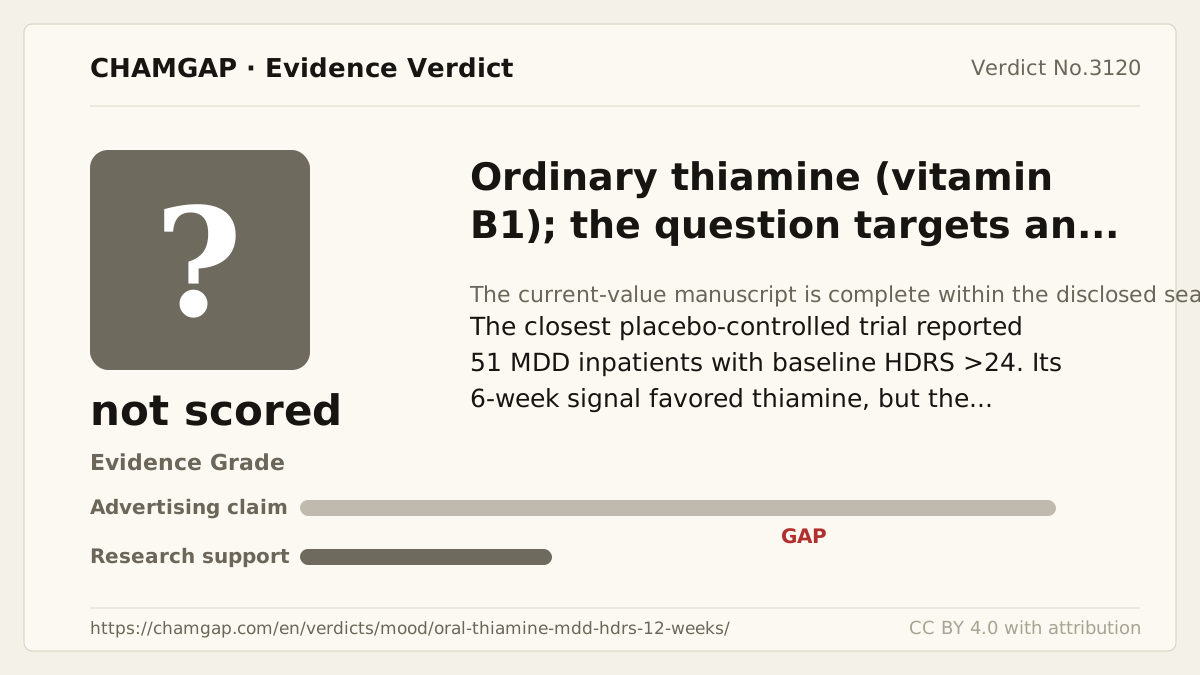
research showsThe current value is ? / score null. The accessed original reports do not verify eligibility for this exact oral, single-ingredient ordinary-thiamine comparison. This does not mean that human depression-scale research is absent or that thiamine has no effect. [S01, S03; selection_ledger]
ads claimA research question is not evidence of efficacy. Improvement in fatigue, energy, general mood or individual sleep/appetite items cannot be relabeled as improvement in total depression severity. This is a boundary on claims accepted by this page, not an exhaustive advertising survey.
Four separate assessment dimensions
| Effect direction and size | The current value is ? / score null. The accessed original reports do not verify eligibility for this exact oral, single-ingredient ordinary-thiamine comparison. This does not mean that human depression-scale research is absent or that thiamine has no effect. [S01, S03; selection_ledger] |
|---|---|
| Evidence certainty | Unscored at stage zero; not a finding of absent clinical effect |
| Applicability | Adults hospitalized with reported MDD and baseline HDRS >24; diagnostic manual, age bounds and thiamine status unverified; Incremental adjunctive symptom reduction, not monotherapy, response/remission, relapse or suicide prevention |
| Safety | Safety is Caution, separate from efficacy. Do not convert the candidate abstract’s no-adverse-effects statement into zero events per arm. A separate oral product lists GI and hypersensitivity reactions with unknown frequency; predominantly parenteral reports cannot supply an oral incidence. Separate psychiatric-worsening, suicide-related and manic-switch assessments are unverified. An absent UL is not unlimited-safety evidence. Study doses are not personal dosing advice, and this page does not recommend stopping psychiatric treatment or delaying necessary urgent care. [S01, Abstract; S05, Excessive Thiamin; S06, 4.8] |
The explicit eligibility-gap current-value instruction yields ? / null. claim_type=B; all six downstream axes remain null. no_human_study=false is preserved. The supplied calculator reports validation errors for these inputs and returns a pre-validation B, which is not adopted. [scoring/results.json; R01-044-EXC-001]
Useful facts when choosing a product
- The question concerns single-ingredient oral ordinary thiamine, excluding benfotiamine, fursultiamine/TTFD, sulbutiamine, allithiamine, phosphorylated derivatives, combinations and injections.
- The candidate MDD original does not verify salt, product source, daily or per-dose amount, frequency, meals or adherence. Review-sourced oral/dose details are not promoted to original-verified values. [S01, S07]
- The separate oral hydrochloride product label is a safety reference, not identification of either candidate trial product. [S06]
Chamgap Semantic Classification Code
Permanent code issued
S.thiamine.oral-single-ingredient-form-dose-unverified.adult-inpatients-mdd-hdrs-total-12-weeks.improve.placebo-plus-newly-initiated-standardized-ssriSubstances > Ordinary thiamine (vitamin B1) > Oral single ingredient with form/dose unverified > 12-week HDRS total in adult MDD inpatients > Improvement > Placebo plus newly initiated standardized SSRI
The current value is ? with a null score. A 6-week signal and other scales, times or populations are not substituted for this direct 12-week HDRS question. The code identifies the intervention and claim; it never contains the evidence grade, score, or safety result.
Exact Claim Classification
These independent facets prevent evidence from different forms, routes, populations, effects, and comparators from being mixed.
| Intervention class | S · Supplement or nutraceutical |
|---|---|
| Canonical ingredient or intervention | Ordinary thiamine (vitamin B1); derivatives excluded |
| Source or part used | Chemical nutrient; product/manufacturing source unverified |
| Formulation or processing | Single-ingredient target; ordinary-thiamine salt and preparation unverified in original MDD reports |
| Route | Oral target only; oral route not verified in accessible original MDD reports |
| Dose | Unverified from original MDD reports; no thiamine-equivalent conversion |
| Duration | 12 weeks (candidate study end; actual daily regimen unverified) |
| Population | Adults hospitalized with reported MDD and baseline HDRS >24; diagnostic manual, age bounds and thiamine status unverified |
| Effect or condition | Reduction of continuous depressive symptom severity |
| Primary endpoint | Clinician-rated HDRS total at 12 weeks; version, item count and range unverified |
| Comparator | Placebo plus newly introduced standardized SSRI in the candidate trial; exact drug/dose and other care unverified |
| Duplicate-detection key | S|thiamine|oral-single-ingredient-form-dose-unverified|adult-inpatients-reported-mdd-hdrs-gt24|hdrs-total-12-weeks|placebo-plus-newly-initiated-standardized-ssri |
What the research actually shows
The candidate report gives a mean age of 35.2 years and 53% female participants. A standardized SSRI was newly introduced and maintained at therapeutic levels: this is neither thiamine monotherapy nor verified augmentation of a pre-existing stable antidepressant dose. The precise DSM/ICD framework, episode/treatment-resistance status, baseline thiamine testing, nutrition, alcohol use, arm-specific drugs/psychotherapy and analysis denominators are unresolved. The PCOS/IVF GHQ depression-domain result is separated as indirect evidence with a different population, scale and visit. [S01, Abstract; S04, Methods and Tables 2–3]
Why this is classified as ?
The explicit eligibility-gap current-value instruction yields ? / null. claim_type=B; all six downstream axes remain null. no_human_study=false is preserved. The supplied calculator reports validation errors for these inputs and returns a pre-validation B, which is not adopted. [scoring/results.json; R01-044-EXC-001]
Counterpoint. This is not a page about diagnosis, response/remission, relapse or suicide-related events. Correction of confirmed deficiency is separate from additional supplementation in thiamine-replete depressive adults; the candidate cohort is not presumed deficient or replete.
Rejudgment record. Direct-eligibility verification gap, not a consensus of no effect — Explicit current-value instruction with disclosed original rubric/calculator exception
Review performed and remaining limitations
Primary verification of oral ordinary single ingredient, scale version, effect/CI/P, arm denominators, registration and bias details remains incomplete
Preliminary RoB 2-informed review — not a complete formal assessment
| Randomization | Unscored: primary eligibility and methods not fully verified |
|---|---|
| Deviations from assigned interventions | Unscored: primary eligibility and methods not fully verified |
| Missing outcome data | Unscored: primary eligibility and methods not fully verified |
| Outcome measurement | Unscored: primary eligibility and methods not fully verified |
| Selection of the reported result | Unscored: primary eligibility and methods not fully verified |
Reasons for the certainty judgment — not formal GRADE
| Risk of bias | Unscored; no borrowing from other populations, forms or scales |
|---|---|
| Inconsistency | Unscored; no borrowing from other populations, forms or scales |
| Indirectness | Unscored; no borrowing from other populations, forms or scales |
| Imprecision | Unscored; no borrowing from other populations, forms or scales |
| Publication bias | Unscored; no borrowing from other populations, forms or scales |
Search scope and limitations. research/search_log.json; research/native_search_log.json; research/access_log.json
Evidence Table
| Study | Design | Sample | Funding | Endpoint | Result | Weight |
|---|---|---|---|---|---|---|
| Ghaleiha et al. 2016 placebo-controlled adjunctive thiamine trial in MDD inpatients | 51 MDD inpatients with baseline HDRS >24; thiamine or placebo plus a newly initiated standardized SSRI | 51 total; randomized, analyzed and completed counts by arm unverified | No external funding and no author conflicts declared; internal support and product provision unverified | Clinician-rated HDRS total at 12 weeks; version unverified | The 6-week signal favored thiamine, but the 12-week between-group mean difference was nonsignificant; exact difference, CI and P were unavailable. | Unscored at stage zero because route, ordinary salt/single-ingredient composition, dose and scale version were unverified |
| Wattanathamrak et al. 2019 controlled adjunctive thiamine study in MDD | 50 adults with MDD; thiamine 300 mg/day plus standard treatment versus standard treatment | 50 total; arm denominators unverified | Funding, product provision and conflicts unverified | HRSD; version and principal time unverified | The abstract reports greater improvement after week 4, but this is not the same verified 12-week placebo-controlled effect. | Route, form, scale version, background care and time unresolved; not counted as verified replication |
| Moti et al. 2024 oral thiamine trial in women with PCOS undergoing IVF | 70 randomized and 64 analyzed; oral thiamine 300 mg/day for four weeks versus placebo | 70 randomized, 64 analyzed | IUMS grant and Sarem research center; no conflicts declared | GHQ-28 depression domain at four weeks, not MDD HDRS | Retained only as indirect evidence because population, scale and time differ from the locked question | Indirect evidence; excluded from efficacy grading |
Receipt — 21 References
Evidence access cutoff: 2026-09-16. Each citation states its actual access level (full-text transcription, abstract, index, or other) and remaining limitations. Bibliographic checking does not certify the study results or treatment efficacy.

Technical integration by: Codex · Evidence date: 2026-09-16 · Corrections: none
Cite this verdict
[Chamgap] Does adding oral thiamine reduce 12-week depression severity in MDD? — Evidence Grade ?. 21 cited sources checked. Source: https://chamgap.com/en/verdicts/mood/oral-thiamine-mdd-hdrs-12-weeks/ · CC BY 4.0CC BY 4.0 — free to use with attribution; do not distort grades, numbers, or verdict meaning.
What this document does and does not do
Chamgap is an information source. It reports what research has and has not confirmed; it does not tell readers what to take or buy. That decision belongs to readers and, when needed, medical or legal professionals. This verdict reflects literature available up to the search date and may change as new research appears. Nothing here is medical advice.