
Does oral single-ingredient vitamin B6 improve anxiety symptoms in adults?
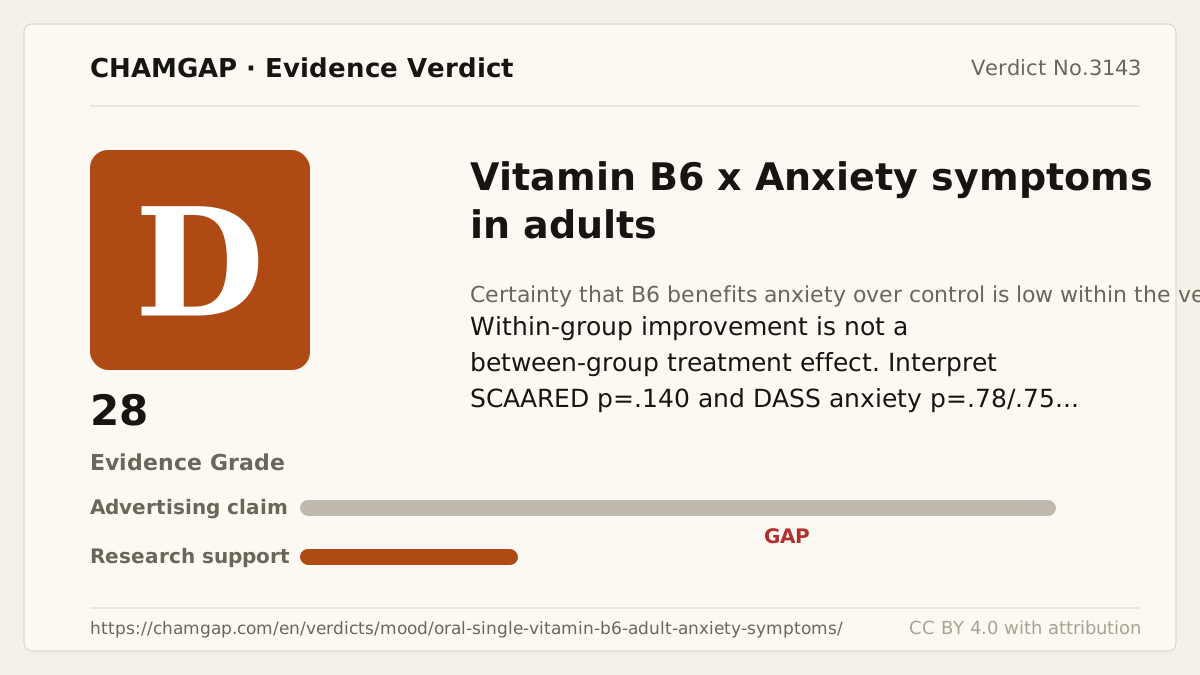
research showsCurrent verified evidence does not establish that oral single-ingredient vitamin B6 reduces anxiety more than control in adults with anxiety symptoms. A SCAARED within-group reduction was not accompanied by a significant placebo-controlled time-by-group interaction, and the DASS anxiety analysis of the same cohort also did not support a between-group difference. This is not proof of zero effect or equivalence; stand-alone treatment efficacy for diagnosed GAD, panic or social anxiety and a clinically important magnitude of benefit remain unestablished.
ads claimNeurotransmitter involvement or a within-group anxiety decrease cannot establish placebo-controlled anxiety efficacy or risk-free P5P.
Four separate assessment dimensions
| Effect direction and size | The within-B6 SCAARED decrease is separated from the placebo-controlled time-by-group p=.140. DASS anxiety p=.78/.75 in the same cohort and adjusted HADS-A p=.943 in fibromyalgia also did not establish superiority. This does not imply numeric zero effect or equivalence. |
|---|---|
| Evidence certainty | Certainty that B6 benefits anxiety over control is low within the verified scope. Overlapping Reading reports, post-hoc subgroups, high-score exclusions/completer analyses, small symptomatic samples and unverified contrast CIs limit inference. This is not an official GRADE assessment. |
| Applicability | Young general-population questionnaire symptoms are separated from fibromyalgia with antidepressant co-treatment. Results are not generalized to diagnosed GAD, panic or social anxiety, PLP-deficiency correction, older/pregnant/hepatic/renal populations or drug-free monotherapy. |
| Safety | Caution. Peripheral neuropathy and total B6 exposure across products matter. Short trials and missing adverse-event reporting do not establish long-term safety. Research doses are not instructions for personal supplementation or treatment changes. |
Supplied axes B/P/R1/I1/E0/B2/CX yield 0 strengths, calculator grade D and fixed score 28. E0 codes the observed comparison result; it is not a numeric zero effect or equivalence declaration. Document quality A is separate from efficacy grade.
Useful facts when choosing a product
- Study-specific oral pyridoxine/HCl 100 mg and labeled B6 80 mg/day are separated; these are not personal recommended doses.
- PLP, pyridoxamine, combination products and salt/active equivalence are not automatically pooled.
Chamgap Semantic Classification Code
Permanent code issued
S.vitamin-b6-anxiety-study-specific-single.oral.adult-anxiety-symptoms-anxiety-scales.anxiety-symptom-improvement.study-specific-placebo-separate-b12-common-treatmentSupplements and nutraceuticals > B6-only oral tablets; study-specific pyridoxine/HCl verification and unreported salt/active equivalence retained > Adults with questionnaire anxiety symptoms; general population, diagnosed anxiety, fibromyalgia and deficiency separated > Whether anxiety symptoms improve > Study-specific placebo, separate B12 arm and common ongoing treatment; not pooled > Oral; intravenous and animal dosing excluded
Technical binding of unchanged ChatGPT D/28, Caution and study-specific boundaries/uncertainties. The code identifies the intervention and claim; it never contains the evidence grade, score, or safety result.
Exact Claim Classification
These independent facets prevent evidence from different forms, routes, populations, effects, and comparators from being mixed.
| Intervention class | S · Supplement or nutraceutical |
|---|---|
| Canonical ingredient or intervention | Vitamin B6 |
| Source or part used | Isolated nutrient; plant species/part not applicable; manufacturing origin unreported by study |
| Formulation or processing | B6-only oral tablets; study-specific pyridoxine/HCl verification and unreported salt/active equivalence retained |
| Route | Oral; intravenous and animal dosing excluded |
| Dose | Main reports 100 mg/day; fibromyalgia 80 mg/day in a separate co-treatment context; not personal dosing advice |
| Duration | SCAARED 30-35 days; DASS 30-40 days; HADS-A 60 days, retained separately |
| Population | Adults with questionnaire anxiety symptoms; general population, diagnosed anxiety, fibromyalgia and deficiency separated |
| Effect or condition | Whether anxiety symptoms improve |
| Primary endpoint | Page anxiety-scale endpoint; actual SCAARED/DASS-42 anxiety/HADS-A; registered-primary hierarchy kept separate |
| Comparator | Study-specific placebo, separate B12 arm and common ongoing treatment; not pooled |
| Duplicate-detection key | vitamin-b6|single-ingredient|oral|adults-with-anxiety-symptoms|anxiety-scale-change|study-specific-controls |
What the research actually shows
SCAARED, DASS-42 anxiety and HADS-A were assessed separately. Overlapping reports count as one program; fibromyalgia remains a distinct co-treatment setting.
Why this is classified as D (28)
The supplied calculator returns D for B/P/R1/I1/E0/B2/CX. None of H/R2/I2/E+/C1/B0/big_hard_rct applies, yielding 0 strengths and the fixed D/28 anchor. Proposed and final grades agree; there is no override. Repeated disconfirmation in the same indication plus CI exclusion of clinically important benefit, required for F, was not established. Document quality A is separate; the score is not a treatment-success probability, official GRADE rating or journal certification.
Counterpoint. Remaining issues include Reading 2026 counts 267/268/254 and exclusion arithmetic, conflicting SCAARED textual/table degrees of freedom, and unverified baseline PLP, total exposure, co-treatment, registration plans, contrast CIs and MCIDs. No invented numbers filled these gaps.
Rejudgment record. calculator_matches_final — The supplied calculator returns D for B/P/R1/I1/E0/B2/CX. None of H/R2/I2/E+/C1/B0/big_hard_rct applies, yielding 0 strengths and the fixed D/28 anchor. Proposed and final grades agree; there is no override. Repeated disconfirmation in the same indication plus CI exclusion of clinically important benefit, required for F, was not established. Document quality A is separate; the score is not a treatment-success probability, official GRADE rating or journal certification.
| Endpoint | P | Symptom or function itself is the target - including patient reports and performance tests |
| Replication | R1 | Single confirmatory trial |
| Independence | I1 | Mixed funding sources |
| Effect size | E0 | Null |
| Precision | CX | No pooled confidence interval could be confirmed |
Stored derived and displayed grades match; this is not a current recalculation or validity check (D).
Review performed and remaining limitations
Remaining issues include Reading 2026 counts 267/268/254 and exclusion arithmetic, conflicting SCAARED textual/table degrees of freedom, and unverified baseline PLP, total exposure, co-treatment, registration plans, contrast CIs and MCIDs. No invented numbers filled these gaps.
Evidence Table
| Study | Design | Sample | Funding | Endpoint | Result | Weight |
|---|---|---|---|---|---|---|
| Field 2022, SCAARED | Double-blind randomized 3-arm research program; general-population opportunity sample | 478 recruited; paired SCAARED B6 88/B12 90/placebo 87; B6-placebo contrast 175 | Innopure supplied tablets; separate monetary funding unverified in this report; no conflicts declared | Adult SCAARED total at 30-35 days; registered-primary status unverified | Within-B6 p<.001,d=.37; between-group time-by-treatment p=.140. Rounded-mean change contrast -2.1 points is descriptive; CI unverified | Main program, not anxiety-selected, with no demonstrated placebo superiority; overlaps the 2026 report |
| Field 2026, DASS anxiety | Exploratory/post-hoc symptom-group analysis of the same Reading program; not independent replication | 325 recruited; main text 268/abstract 267; analyzed table 254; anxious B6 21/placebo 18/B12 16 | University of Reading research-employment support and Innopure tablet provision; this report declares no conflicts | DASS-42 anxiety, 0-42 points; baseline >=8 subgroup; 30-40 days | 3-arm treatment p=.78 and status-by-treatment p=.75; anxious-subgroup descriptive B6-placebo change contrast +0.9 points; adjusted pairwise CI unverified | Symptom-subgroup evidence with small samples, denominator conflicts and post-hoc/multiplicity limitations; depression results excluded |
| Ghavidel-Parsa 2022, fibromyalgia | Randomized double-blind placebo-controlled B6 add-on to common ongoing care | 90 randomized 45/45; analyzed B6 31/placebo 29; 30 not analyzed | Guilan University of Medical Sciences funding and pharmacy-faculty placebo preparation; manufacturer name does not prove donation | HADS-A 0-21 points, 60 +/-3 days; native registry history unverified | Change -1.70 versus -1.03,p=.39; adjusted means 8.60 versus 8.66,p=.943. Adjusted contrast CI unverified | Independent but indirect adjunctive evidence in fibromyalgia with high antidepressant use; not replication of general-anxiety monotherapy |
Receipt — 12 References
Evidence access cutoff: 2026-09-17. Each citation states its actual access level (full-text transcription, abstract, index, or other) and remaining limitations. Bibliographic checking does not certify the study results or treatment efficacy.
Technical integration by: Codex · Evidence date: 2026-09-17 · Corrections: none
Cite this verdict
[Chamgap] Does oral single-ingredient vitamin B6 improve anxiety symptoms in adults? — Evidence Grade D·28. 12 cited sources checked. Source: https://chamgap.com/en/verdicts/mood/oral-single-vitamin-b6-adult-anxiety-symptoms/ · CC BY 4.0CC BY 4.0 — free to use with attribution; do not distort grades, numbers, or verdict meaning.
What this document does and does not do
Chamgap is an information source. It reports what research has and has not confirmed; it does not tell readers what to take or buy. That decision belongs to readers and, when needed, medical or legal professionals. This verdict reflects literature available up to the search date and may change as new research appears. Nothing here is medical advice.