
Lurasidone,
does it really help with Improvement of major depressive episodes associated with bipolar I disorder?
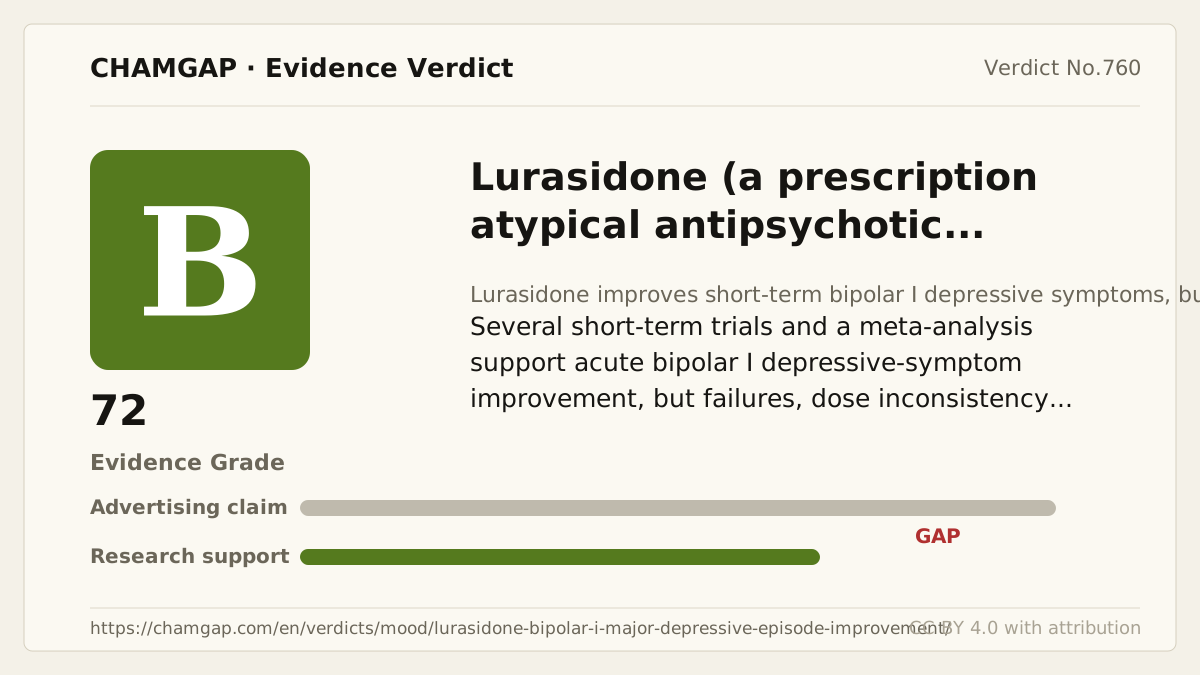
research showsLurasidone is rated B because it reduces acute major-depressive-episode symptoms in bipolar I disorder. In a six-week adult monotherapy trial, MADRS improvement was about 4.7 points greater than placebo with both 20 to 60 mg and 80 to 120 mg, with an effect size of 0.51. One adjunctive trial with lithium or valproate was also positive, but a separate adjunctive trial missed its week-6 primary endpoint, and a later international monotherapy study was significant only for 20 to 60 mg, not the higher range. A five-trial meta-analysis supports 40 to 60 mg, but manufacturer concentration, short symptom-scale outcomes, and gaps in maintenance and bipolar II evidence produce B.
ads claimMarketing can combine bipolar depression into equal benefit at every dose, extrapolation to bipolar II or unipolar depression, and long-term relapse prevention. The strongest evidence is improvement of symptoms during about six weeks of a current major depressive episode in bipolar I disorder.
Useful facts when choosing a product
- Lurasidone is a prescription atypical antipsychotic used alone or adjunctive to lithium or valproate for depressive episodes associated with bipolar I disorder, with approved ages and doses determined by the national label.
- It must be taken each day with at least 350 kcal of food because fasting administration can substantially reduce exposure.
- Akathisia, nausea, somnolence, parkinsonism, and other extrapyramidal symptoms are common, and driving, falls, and temperature regulation require caution.
- Weight, lipid, and glucose effects were generally smaller than with some atypical antipsychotics but are not absent, and strong CYP3A4 inhibitors or inducers must not be combined with lurasidone.
Chamgap Semantic Classification Code
Candidate index · review held
M.lurasidone.UNK.major-depressive-episodes-associated-with-bipolar-i-disorder.improve.MULTIMedicinal interventions > Lurasidone > Unknown > major depressive episodes associated with bipolar I disorder > Improvement claim > Multiple: primary unresolved
An automated migration candidate, not an issued permanent code; exact claim scope remains under review. This machine-generated migration candidate helps retrieval but is not a permanent assignment. The original verdict ID and URL remain authoritative.
What the research actually shows
The PREVAIL monotherapy study randomized 505 adults with bipolar I depression for six weeks and improved MADRS and CGI-BP in both dose ranges. The 348-person PREVAIL adjunctive trial was also positive when lurasidone was added to lithium or valproate. A separate 356-person adjunctive trial separated at weeks 2 through 5 but failed its week-6 primary endpoint. An international 525-person monotherapy study including Japan was positive for 20 to 60 mg with an effect size of 0.33, while 80 to 120 mg was not significant. An independent 2024 dose-response meta-analysis of five randomized trials found about 40 to 60 mg reasonable. Randomized maintenance and bipolar II evidence remain substantially weaker than the acute bipolar I evidence.
Why this is classified as B (72)
Several large short-term randomized trials and a five-trial meta-analysis support direct MADRS symptom improvement in bipolar I depression. One adjunctive primary endpoint failed, high-dose findings were inconsistent, funding is manufacturer-concentrated, and evidence centers on six weeks with a maintenance gap, producing B with 72 points. Akathisia, somnolence, extrapyramidal, metabolic, and interaction risks remain separate safety issues.
Counterpoint. Bipolar depression treatment also requires monitoring mania, suicidality, sleep, anxiety, prior response, and concomitant medicines. Demonstrated efficacy does not make lurasidone suitable for self-treatment as if every depressive episode were unipolar depression.
Rejudgment record. New verdict — Accepted multiple six-week placebo-controlled trials and a meta-analysis showing direct MADRS symptom improvement in acute major depressive episodes associated with bipolar I disorder, while accounting for an adjunctive primary-endpoint failure, high-dose inconsistency, manufacturer funding concentration, and limited maintenance evidence
Sub-claim grades by effect
This ingredient is marketed for several effects. A single overall grade blends strong and weak claims together, so each effect is graded separately here. The overall grade reflects the strongest disconfirming or core claim.
| Effect (sub-claim) | Grade | Basis |
|---|---|---|
| Acute symptom improvement in a major depressive episode associated with bipolar I disorder | B | Several six-week trials and a meta-analysis support direct MADRS improvement, although some comparisons failed. |
| Adjunctive treatment with lithium or valproate | B | One trial was positive and another missed its week-6 primary endpoint, producing mixed results. |
| Extension to bipolar II disorder or unipolar major depressive disorder | ? | The bipolar I randomized evidence in this verdict cannot be generalized to those diagnoses without direct efficacy literature. |
| Long-term maintenance and relapse prevention | C | Open-label extensions and limited maintenance data exist, but there is no independent placebo-controlled confirmation comparable to the acute trials. |
Cross-check — AI research and Codex final gate
Evidence Table
| Study | Design | Sample | Funding | Endpoint | Result | Weight |
|---|---|---|---|---|---|---|
| Loebel A et al. 2014 monotherapy | Randomized double-blind placebo-controlled six-week phase 3 trial | 505 adults with bipolar I depression | Sunovion | Week-6 MADRS and CGI-BP depression | MADRS changed by -15.4 in both lurasidone ranges versus -10.7 with placebo, with effect size 0.51. | Pivotal direct positive monotherapy evidence |
| Loebel A et al. 2014 adjunctive | Six-week randomized double-blind placebo-controlled adjunctive trial with lithium or valproate | 348 participants | Sunovion | Week-6 MADRS and CGI-BP depression | Lurasidone was superior, with MADRS -17.1 versus -13.5 and effect size 0.34. | Direct positive adjunctive evidence |
| Suppes T et al. 2016 | Randomized double-blind placebo-controlled adjunctive trial with lithium or valproate | 356 participants | Sunovion with employee coauthors | Week-6 MADRS primary endpoint | The primary endpoint failed, with -11.8 versus -10.4 and P=.176. | Important direct inconsistency |
| Lin YW et al. 2024 | Systematic review and dose-response meta-analysis | Five randomized trials and 2,032 participants | Academic meta-analysis with pharmaceutical conflicts for some authors | Depression, anxiety, function, dropout, and adverse events | The 40-to-60-mg range was optimal for depression and function, with more adverse effects at higher doses. | Independent synthesis |
Receipt — 5 References
All 5 cited sources were verified for existence at the original page (as of 2026-07-20).
Final verification and publication gate: Codex · Evidence date: 2026-07-20 · Corrections: none
Cite this verdict
[Chamgap] Lurasidone x improvement of major depressive episodes associated with bipolar I disorder — Evidence Grade B·72. 5 cited sources checked. Source: https://chamgap.com/en/verdicts/mood/lurasidone-bipolar-i-major-depressive-episode-improvement/ · CC BY 4.0CC BY 4.0 — free to use with attribution; do not distort grades, numbers, or verdict meaning.
What this document does and does not do
Chamgap is an information source. It reports what research has and has not confirmed; it does not tell readers what to take or buy. That decision belongs to readers and, when needed, medical or legal professionals. This verdict reflects literature available up to the search date and may change as new research appears. Nothing here is medical advice.