
Lavender oil,
does it really help with Anxiety?
research showsStandardized oral lavender oil Silexan has relatively clear RCT signals on anxiety symptom scales. In Kasper 2014 (539 people with GAD), Silexan 160 mg lowered HAMA more than placebo (-14.1 vs -9.5), and Woelk 2010 showed a reduction similar to lorazepam. However, the positive evidence is concentrated on a single product, Silexan, and its manufacturer, so the maximum grade is C.
ads claimAdvertisements broadly mention 'lavender,' 'natural calming,' and 'anxiety/sleep.' The evidence that is relatively good is for standardized oral Silexan, not all lavender products.
Useful facts when choosing a product
- Research doses are mainly Silexan 80 mg/day, with some studies using 160 mg/day.
- Common adverse reactions are belching, gastrointestinal symptoms, and lavender-smelling reflux.
- Clinician confirmation is needed with sedatives, antidepressants, pregnancy/lactation, and pediatric use.
- Drinking arbitrary essential oil carries poisoning risk and should be distinguished from the research product.
Chamgap Semantic Classification Code
Candidate index · review held
UNK.lavender-oil.UNK.anxiety.assess.MULTIUnknown > Lavender oil > Unknown > Anxiety > Association or change assessment > Multiple: primary unresolved
An automated migration candidate, not an issued permanent code; exact claim scope remains under review. This machine-generated migration candidate helps retrieval but is not a permanent assignment. The original verdict ID and URL remain authoritative.
What the research actually shows
Kasper 2014 reported that in 539 people with GAD, Silexan 160 mg lowered HAMA more than placebo (-14.1 vs -9.5). Woelk 2010 reported that in 77 patients with GAD, HAMA reductions were similar with Silexan 80 mg/day and lorazepam 0.5 mg/day. Kasper 2010/2014 RCTs and meta-analyses summarize that Silexan lowers anxiety scores, but the evidence axis is concentrated on standardized oral Silexan and the manufacturer Dr. Willmar Schwabe, leaving the limitation of absent independent replication.
Why this is classified as C (58)
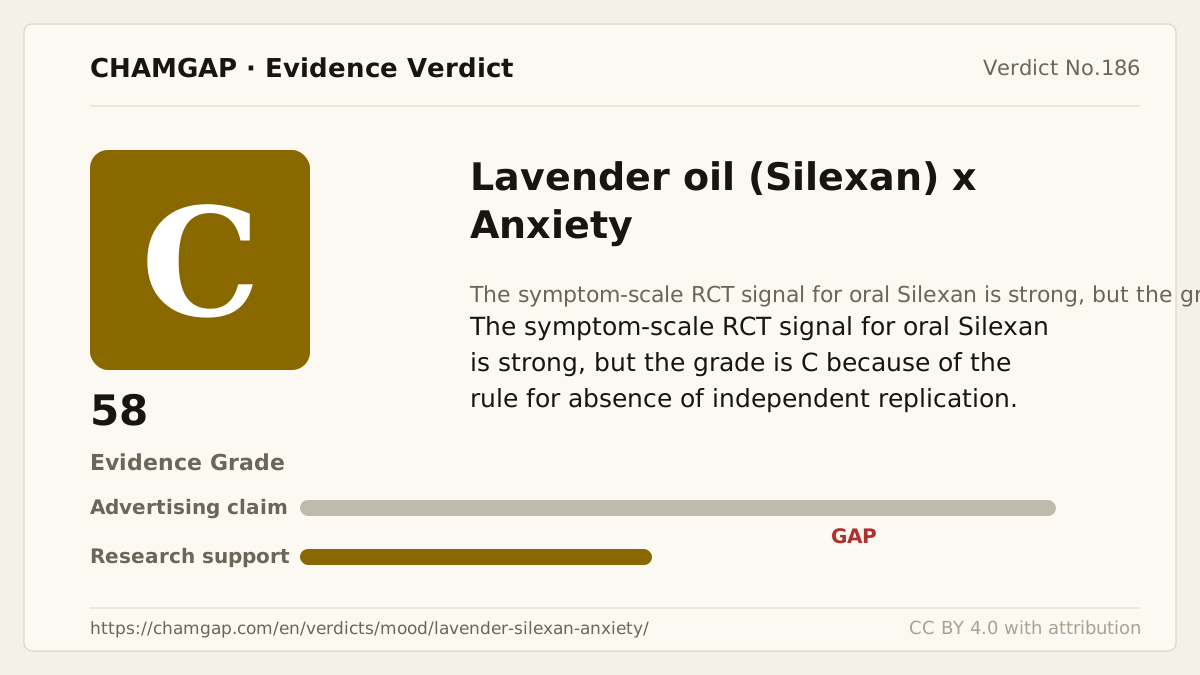
The direct symptom-scale RCT signal is strong, but the positive evidence is concentrated on a single Silexan product and manufacturer, so under methodology ②-b the grade is C, 58 points.
Counterpoint. This is adjunctive evidence for mild-to-moderate anxiety symptoms and should not be interpreted as evidence to replace mental-health treatment.
Rejudgment record. Draft — The direct symptom-scale RCT signal is strong, but the positive evidence is concentrated on a single Silexan product and manufacturer, so under methodology ②-b the grade is C, 58 points.
Cross-check — AI research and Codex final gate
Evidence Table
| Study | Design | Sample | Funding | Endpoint | Result | Weight |
|---|---|---|---|---|---|---|
| Woelk H & Schlaefke S 2010 | Double-blind randomized comparative trial | 77 | Manufacturer-related | HAMA | HAMA reductions with Silexan 80 mg and lorazepam 0.5 mg were similar. | Core |
| Kasper S et al. 2014 | Randomized placebo- and active-controlled trial | 539 | Schwabe-related | HAMA total score | Silexan 80/160 mg lowered HAMA more than placebo. | Core |
| Generoso MB et al. 2017 | Systematic review and meta-analysis | Silexan RCT | Academic | Anxiety scales | It reported improvement in anxiety scores with Silexan. | Core |
Receipt — 4 References
All 4 cited sources were verified for existence at the original page (as of 2026-07-10).
Final verification and publication gate: Codex · Evidence date: 2026-07-10 · Corrections: none
Cite this verdict
[Chamgap] Lavender Oil (Silexan) × Anxiety — Evidence Grade C·58. 4 cited sources checked. Source: https://chamgap.com/en/verdicts/mood/lavender-silexan-anxiety/ · CC BY 4.0CC BY 4.0 — free to use with attribution; do not distort grades, numbers, or verdict meaning.
What this document does and does not do
Chamgap is an information source. It reports what research has and has not confirmed; it does not tell readers what to take or buy. That decision belongs to readers and, when needed, medical or legal professionals. This verdict reflects literature available up to the search date and may change as new research appears. Nothing here is medical advice.