
L-theanine,
does it really help with Reduction of stress and tension and promotion of subjective relaxation?
research showsL-theanine is rated D for stress and tension relief. The prespecified primary endpoint in NCT05808595, change in salivary cortisol, was a surrogate and failed. The between-group PSS result was also null, while DASS-21 stress favored placebo (P=0.012). The remaining positive signal is STAI-T from a 30-person crossover trial sponsored and supplied by Taiyo Kagaku with company employees as coauthors. Rule ①-ⓑ is only a ceiling of C, not a guarantee of C; primary-endpoint failure plus an outcome favoring placebo support D with 35 points.
ads claimWithin-group change or an alpha-wave mechanism must not be converted into confirmed placebo-controlled calming or anti-anxiety efficacy.
Useful facts when choosing a product
- Trials commonly used 200 to 400 mg daily, while product purity and composition vary.
- A cup of tea generally contains far less L-theanine than supplement trial doses.
- Persistent anxiety, depression, or functional impairment requires assessment rather than substitution with a supplement.
Chamgap Semantic Classification Code
Candidate index · review held
S.l-theanine.UNK.stress-and-tension-and-promotion-of-subjective-relaxation.reduce.placeboSupplements and nutraceuticals > L-theanine > Unknown > stress and tension and promotion of subjective relaxation > Reduction claim > Placebo
An automated migration candidate, not an issued permanent code; exact claim scope remains under review. This machine-generated migration candidate helps retrieval but is not a permanent assignment. The original verdict ID and URL remain authoritative.
What the research actually shows
NCT05808595 assigned 30 moderately stressed healthy adults to AlphaWave 400 mg daily or placebo for 28 days. Its prespecified salivary-cortisol primary endpoint and between-group PSS effect failed, while DASS-21 stress favored placebo (P=0.012). Hidese 2019 reported improved STAI-T (P=0.006) in a 30-person four-week crossover trial sponsored and supplied by Taiyo Kagaku with company employees as coauthors.
Why this is classified as D (35)
The prespecified surrogate cortisol primary endpoint and between-group PSS failed, while DASS-21 stress favored placebo. The only remaining positive signal is STAI-T from a 30-person manufacturer-sponsored, supplied, and coauthored trial. The C ceiling under rule ①-ⓑ does not guarantee C, so primary-endpoint failure plus an outcome favoring placebo support D with 35 points.
Counterpoint. Some people may perceive short-term relaxation, but the average placebo-controlled effect remains uncertain.
Rejudgment record. Cross-check applied — The prespecified primary endpoint in NCT05808595, change in salivary cortisol, was a surrogate and failed; between-group PSS was null and DASS-21 stress favored placebo (P=0.012). The remaining positive signal is STAI-T from a 30-person crossover trial sponsored and supplied by Taiyo Kagaku with company employees as coauthors. Rule ①-ⓑ is only a ceiling of C, not a guarantee of C, so primary-endpoint failure plus an outcome favoring placebo support D
Sub-claim grades by effect
This ingredient is marketed for several effects. A single overall grade blends strong and weak claims together, so each effect is graded separately here. The overall grade reflects the strongest disconfirming or core claim.
| Effect (sub-claim) | Grade | Basis |
|---|---|---|
| Reduction in perceived stress over 28 days | D | The newest trial found no between-group difference versus placebo. |
| Reduction in trait anxiety and tension | D | Only a positive STAI-T signal from a 30-person industry-funded crossover trial exists. |
| Attenuation of acute stress response | D | The registered primary endpoint failed, and DASS-21 stress favored placebo. |
Cross-check — AI research and Codex final gate
Evidence Table
| Study | Design | Sample | Funding | Endpoint | Result | Weight |
|---|---|---|---|---|---|---|
| Moulin M et al. 2024; NCT05808595 | Randomized double-blind placebo-controlled 28-day trial | 30 randomized and actually analyzed (15 per group) | Sponsored with product supplied by AlphaWave maker Ethical Naturals; conducted by KGK Science with a manufacturer employee as coauthor | Prespecified primary between-group change in salivary cortisol, a surrogate | Primary endpoint failed (P>0.05), between-group PSS was null, and DASS-21 stress favored placebo (P=0.012). | Newest pivotal counterevidence |
| Hidese S et al. 2019 | Randomized double-blind placebo-controlled crossover trial | 30 randomized and included in crossover analysis | Funded and supplied by manufacturer Taiyo Kagaku; two manufacturer employees were coauthors | SDS, STAI, and PSQI clinical scales | STAI-T was positive (P=0.006), but other stress and biomarker results were inconsistent. | Small industry-supported positive signal |
Receipt — 2 References
All 2 cited sources were verified for existence at the original page (as of 2026-07-24).
Final verification and publication gate: Codex · Evidence date: 2026-07-24 · Corrections: none
Cite this verdict
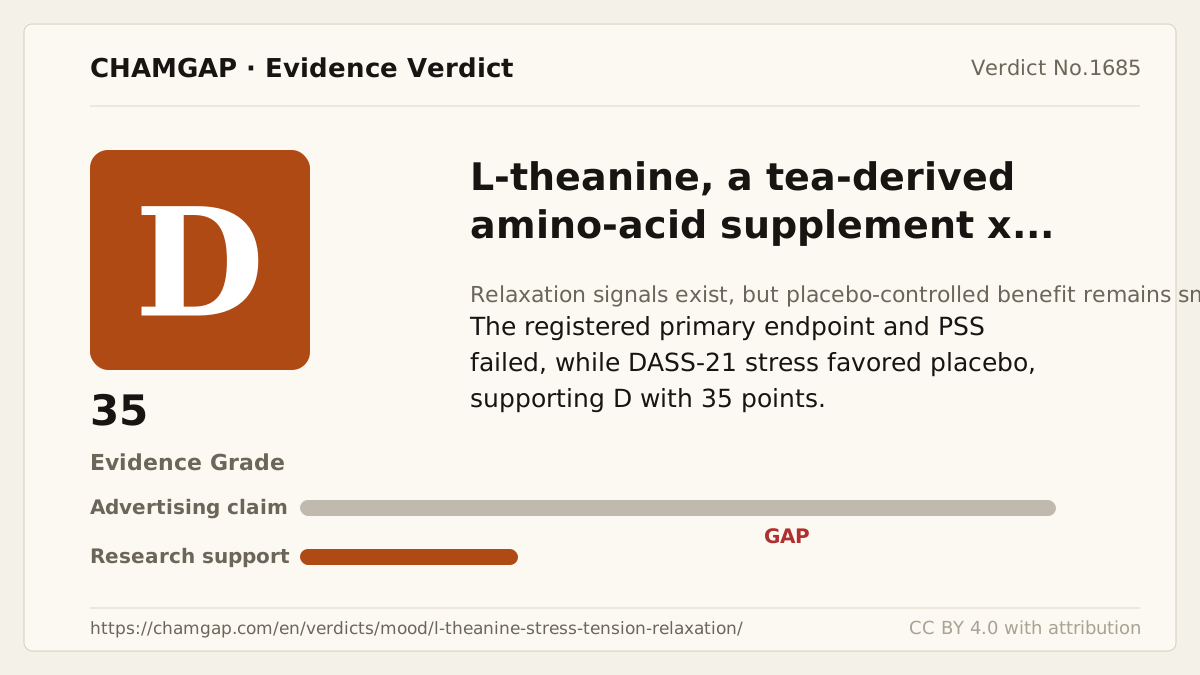
[Chamgap] L-theanine x stress and tension relief — Evidence Grade D·35. 2 cited sources checked. Source: https://chamgap.com/en/verdicts/mood/l-theanine-stress-tension-relaxation/ · CC BY 4.0CC BY 4.0 — free to use with attribution; do not distort grades, numbers, or verdict meaning.
What this document does and does not do
Chamgap is an information source. It reports what research has and has not confirmed; it does not tell readers what to take or buy. That decision belongs to readers and, when needed, medical or legal professionals. This verdict reflects literature available up to the search date and may change as new research appears. Nothing here is medical advice.