
iTBS,
does it really help with Induction of symptomatic response and remission in treatment-resistant major depressive disorder?
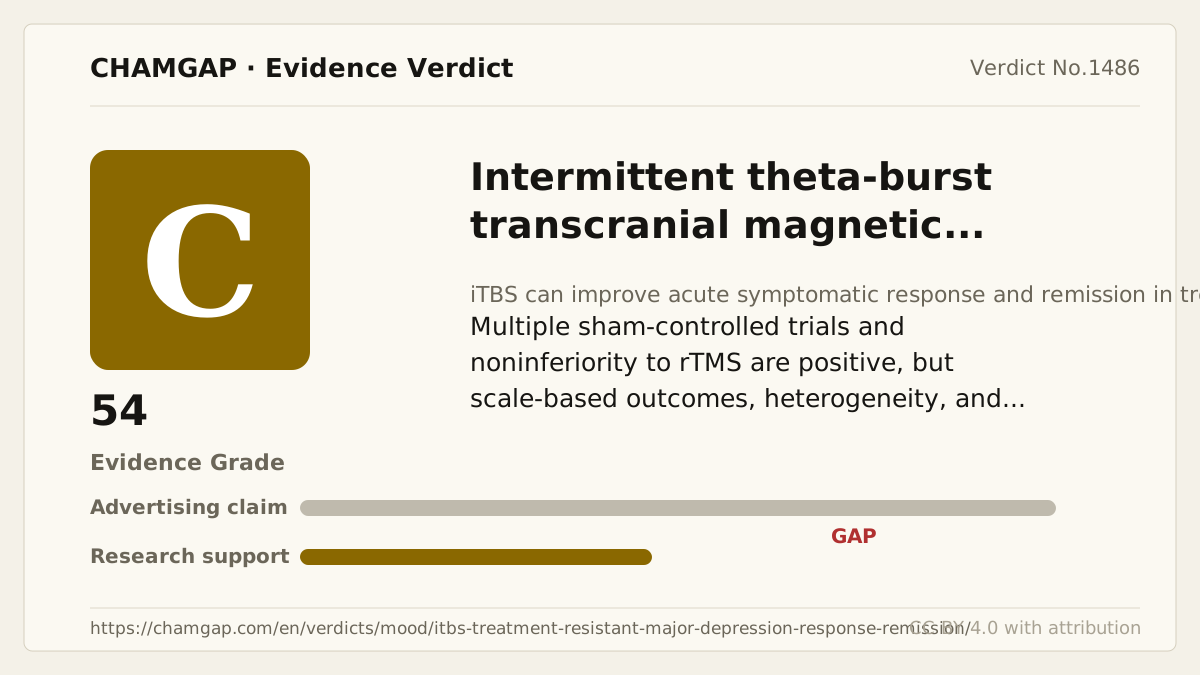
research showsClinician-delivered left-prefrontal iTBS is rated C because evidence supports higher probabilities of symptomatic response and remission. A 2024 network meta-analysis of 23 randomized trials and 960 participants found left-DLPFC iTBS superior to sham for response and remission, and the 414-participant THREE-D trial found it noninferior to standard 10-Hz rTMS. The evidence is nevertheless dominated by depression rating scales, heterogeneous populations and protocols, and limited maintenance, suicide, and hospitalization data, limiting the score to 54.
ads claimMarketing can turn a three-minute session into claims of a three-minute cure, medication-free permanent remission, or a one-time treatment. The studies evaluated repeated courses in clinically selected patients and do not establish a one-session or permanent effect.
Useful facts when choosing a product
- iTBS uses a coil on the scalp to induce cortical electrical currents with rapidly changing magnetic fields; it does not require surgery or implanted electrodes.
- A common left-DLPFC session lasts about three minutes, but treatment is generally repeated on weekdays for several weeks and parameters vary by device and clinic.
- Scalp discomfort, facial-muscle contraction, headache, and dizziness can occur; seizure is rare but potentially serious.
- Magnetic or electronic implants near the head, seizure risk factors, and interacting medicines require screening. Unlike electroconvulsive therapy, iTBS does not deliberately induce a seizure under anesthesia.
Chamgap Semantic Classification Code
Candidate index · review held
P.intermittent-theta-burst-transcranial-magnetic-stimulation.device.induction-of-symptomatic-response-and-remission-in-treatment-resistant-major-depressive-disorder.treat.MULTIProcedures, devices and tests > Intermittent theta-burst transcranial magnetic stimulation > Device delivered > Induction of symptomatic response and remission in treatment-resistant major depressive disorder > Treatment or remission claim > Multiple: primary unresolved
An automated migration candidate, not an issued permanent code; exact claim scope remains under review. This machine-generated migration candidate helps retrieval but is not a permanent assignment. The original verdict ID and URL remain authoritative.
What the research actually shows
Kishi and colleagues synthesized 23 randomized trials with 960 participants and found left-DLPFC iTBS favorable to sham for response and remission. Only about 70% of trials enrolled exclusively major depressive disorder, and several targets and accelerated protocols were mixed. Blumberger and colleagues randomized 414 patients with treatment-resistant major depression in THREE-D and demonstrated noninferiority of iTBS to 10-Hz rTMS for depression-scale improvement, but the trial did not include sham. The evidence therefore supports acute symptomatic response and remission, not established durable or hard clinical outcomes.
Why this is classified as C (54)
The positive sham-controlled response and remission findings across 23 randomized trials and noninferiority to standard rTMS in THREE-D were accepted. Rating-scale endpoints, clinical and protocol heterogeneity, and limited maintenance, suicide, and hospitalization evidence invoke the rule ① ceiling, yielding C with 54 points.
Counterpoint. For treatment-resistant major depression, iTBS can be considered in a specialist setting after assessment of medication and psychotherapy history, bipolarity, and suicide risk. ECT has a different procedure and evidence base and should not be conflated with this verdict.
Rejudgment record. New verdict — Accepted positive response and remission findings versus sham in the 23-trial network meta-analysis and noninferiority to standard rTMS in THREE-D, while applying the rule ① ceiling of C for rating-scale-dominated outcomes, protocol heterogeneity, and limited maintenance and hard-outcome evidence
Sub-claim grades by effect
This ingredient is marketed for several effects. A single overall grade blends strong and weak claims together, so each effect is graded separately here. The overall grade reflects the strongest disconfirming or core claim.
| Effect (sub-claim) | Grade | Basis |
|---|---|---|
| Higher depressive-symptom response rate | C | The pooled sham-controlled signal is positive, but response is an acute rating-scale definition. |
| Higher depressive-symptom remission rate | C | Left-DLPFC iTBS shows a remission signal versus sham, but durability is uncertain. |
| Reduced suicide or hospitalization | ? | No evidence designed and powered to establish these hard outcomes was identified. |
Cross-check — AI research and Codex final gate
Evidence Table
| Study | Design | Sample | Funding | Endpoint | Result | Weight |
|---|---|---|---|---|---|---|
| Kishi T et al. 2024 | Systematic review with network and pairwise meta-analysis of randomized trials | 23 randomized trials and 960 participants | Japanese public and academic grants; some authors reported industry relationships | Depression response, symptom score, remission, discontinuation, switch to mania, and headache or site discomfort | Left-DLPFC iTBS was favorable to sham for response, symptom improvement, and remission, with heterogeneous protocols and diagnoses. | Key sham-controlled synthesis |
| Blumberger DM et al. 2018 THREE-D | Multicenter randomized assessor-blinded noninferiority trial | 414 participants with treatment-resistant major depressive disorder | Canadian Institutes of Health Research | Change in 17-item Hamilton Depression Rating Scale plus response and remission | Symptom improvement with iTBS was noninferior to 10-Hz rTMS with a much shorter session, but there was no sham arm. | Large active-comparator effectiveness evidence |
Receipt — 2 References
All 2 cited sources were verified for existence at the original page (as of 2026-07-23).
Final verification and publication gate: Codex · Evidence date: 2026-07-23 · Corrections: none
Cite this verdict
[Chamgap] iTBS x symptomatic response and remission in treatment-resistant major depressive disorder — Evidence Grade C·54. 2 cited sources checked. Source: https://chamgap.com/en/verdicts/mood/itbs-treatment-resistant-major-depression-response-remission/ · CC BY 4.0CC BY 4.0 — free to use with attribution; do not distort grades, numbers, or verdict meaning.
What this document does and does not do
Chamgap is an information source. It reports what research has and has not confirmed; it does not tell readers what to take or buy. That decision belongs to readers and, when needed, medical or legal professionals. This verdict reflects literature available up to the search date and may change as new research appears. Nothing here is medical advice.