
Headspace mindfulness app,
does it really help with Reduced stress among patient-facing NHS workers?
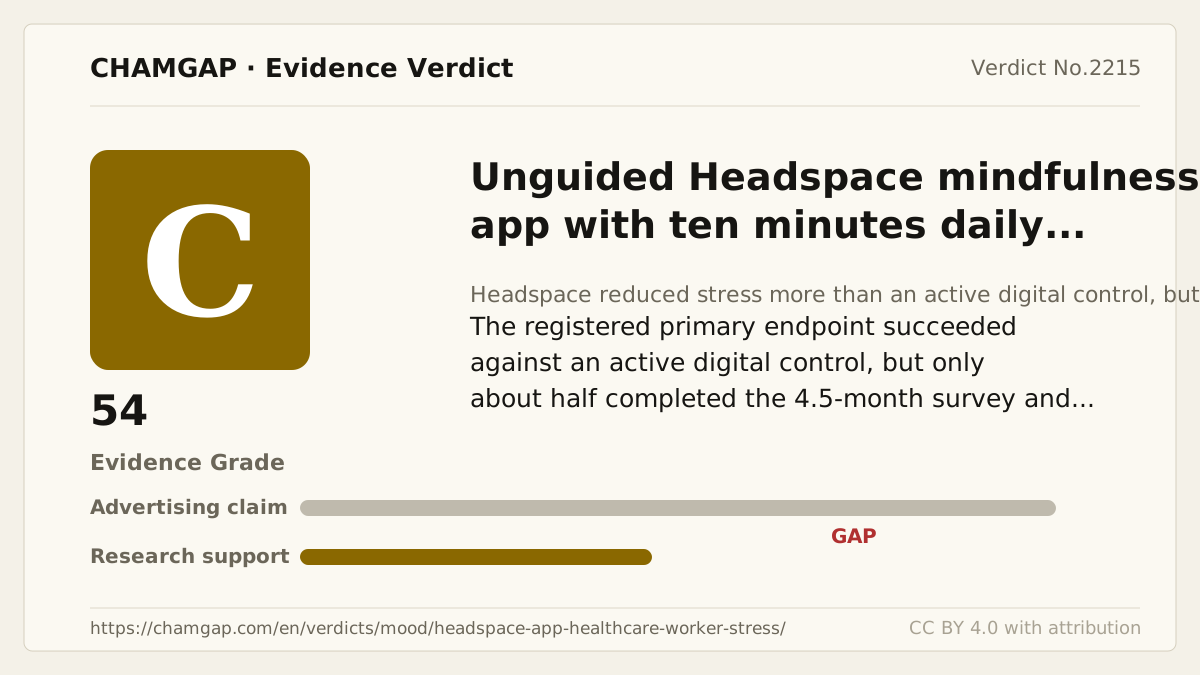
research showsThe grade is C with 46 points. In a prospectively registered trial of 2,182 NHS workers, the registered primary endpoint, 4.5-month DASS-21 Stress, was 2.00 points lower than the active NHS Moodzone control (SE 0.42), Hedges g=0.26. The endpoint was statistically successful, but the effect was small and complete 4.5-month stress data existed for only 1,123/2,182 participants (51.5%).
ads claimA 'twice the improvement' framing obscures absolute size. Baseline reductions were about 2.42 points with Headspace and 1.03 with Moodzone, but the 4.5-month between-arm difference was 2.00 points on a 42-point scale with g=0.26.
Useful facts when choosing a product
- Headspace participants were encouraged to practice ten minutes daily for the first 30 days and received 12 months of free access.
- The active Moodzone control was an NHS workplace-stress advice and exercise website also assigned for ten minutes daily.
- Complete 4.5-month data covered 1,123/2,182, while the main analysis used multiple imputation for all randomized participants.
- No serious adverse events were reported.
Chamgap Semantic Classification Code
Candidate index · review held
UNK.unguided-headspace-mindfulness-app-with-encouraged-and-of-study-access.UNK.stress-facing-nhs-workers.reduce.activeUnknown > Unguided Headspace mindfulness app with encouraged and of study access > Unknown > stress -facing NHS workers > Reduction claim > Active comparator
An automated migration candidate, not an issued permanent code; exact claim scope remains under review. This machine-generated migration candidate helps retrieval but is not a permanent assignment. The original verdict ID and URL remain authoritative.
What the research actually shows
ISRCTN15424185 was prospectively registered on February 17, 2017 and designated 125-day DASS-21 Stress as primary. Headspace received 1,095 assignments and Moodzone 1,087. Complete 4.5-month stress data were available for 571 and 552, totaling 1,123, while multiple imputation included all 2,182. The 4.5-month between-arm difference was 2.00 points (SE 0.42), g=0.26. Among complete-data respondents, formal Headspace use averaged 3.56 days per week initially and fell to 2.16 days per week later. ESRC and Headspace jointly funded the work, and Headspace studentship, research, and consultancy relationships were disclosed.
Why this is classified as C (46)
A large prospectively registered active-control trial met its primary endpoint, but g=0.26, approximately half missing complete data, and manufacturer cofunding give C with 46 points.
Counterpoint. Burnout and sickness absence did not improve. A small stress-score difference cannot replace organizational workplace changes.
Rejudgment record. Cross-check applied — Credited prospective registration, primary-endpoint success, and an active control while accounting for g 0.26, 48.5% missing complete data, self-report, and Headspace cofunding
| Endpoint | P | Symptom or function itself is the target - including patient reports and performance tests |
| Replication | R1 | Single confirmatory trial |
| Independence | I1 | Mixed funding sources |
| Effect size | E~ | Statistically positive but below the threshold |
Stored derived and displayed grades match; this is not a current recalculation or validity check (C).
Sub-claim grades by effect
This ingredient is marketed for several effects. A single overall grade blends strong and weak claims together, so each effect is graded separately here. The overall grade reflects the strongest disconfirming or core claim.
| Effect (sub-claim) | Grade | Basis |
|---|---|---|
| Reduction in worker stress at 4.5 months | C | The registered primary endpoint succeeded, but g was 0.26. |
| Reduced burnout | D | No significant benefit appeared on the three burnout subscales. |
| Reduced sickness absence | D | The sickness-absence result was null. |
Cross-check — AI research and Codex final gate
Evidence Table
| Study | Design | Sample | Funding | Endpoint | Result | Weight |
|---|---|---|---|---|---|---|
| Taylor et al. MindSHINE 3 RCT 2022 | Prospectively registered multisite randomized active-control superiority trial | 2,182 randomized and included with multiple imputation; 1,123 had complete 4.5-month stress data | Joint support from ESRC and Headspace Meditation Ltd | Registered primary endpoint of DASS-21 Stress at 4.5 months | 2.00-point difference versus Moodzone (SE 0.42), P<.001, Hedges g=0.26. | Pivotal large registered trial |
Receipt — 2 References
All 2 cited sources were verified for existence at the original page (as of 2026-08-04).
Final verification and publication gate: Codex · Evidence date: 2026-08-04 · Corrections: none
Cite this verdict
[Chamgap] Headspace mindfulness app x reduced worker stress — Evidence Grade C·46. 2 cited sources checked. Source: https://chamgap.com/en/verdicts/mood/headspace-app-healthcare-worker-stress/ · CC BY 4.0CC BY 4.0 — free to use with attribution; do not distort grades, numbers, or verdict meaning.
What this document does and does not do
Chamgap is an information source. It reports what research has and has not confirmed; it does not tell readers what to take or buy. That decision belongs to readers and, when needed, medical or legal professionals. This verdict reflects literature available up to the search date and may change as new research appears. Nothing here is medical advice.