
Haloperidol,
does it really help with Relief of distressing behavioral, communication, and perceptual delirium symptoms?
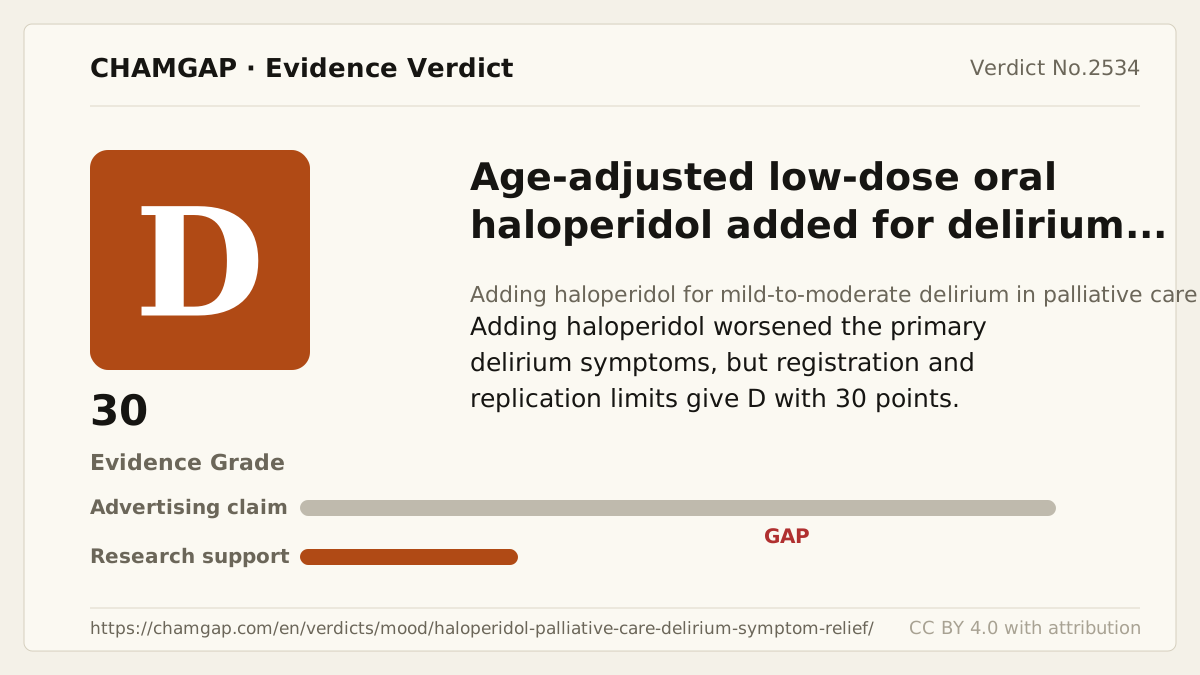
research showsThe grade is D. In an 11-site double-blind RCT including all 247 participants in intention-to-treat analysis, comparison of 81 assigned haloperidol with 84 assigned placebo found a 72-hour delirium symptom score 0.24 points higher, therefore worse, with haloperidol (95% CI 0.06-0.42; P=0.009). Extrapyramidal symptoms and survival were also unfavorable. Exact agreement between the prespecified primary outcome and original registration was not established, and no same-question repeat refutation exists, giving D with 30 points.
ads claimAppearing sedated or having agitation suppressed is not the same as relief of distressing delirium symptoms. In this trial, adding haloperidol to supportive care made the target symptoms worse.
Useful facts when choosing a product
- Participants aged 65 or younger started with 0.5 mg and 0.5 mg every 12 hours, titrated to 4 mg/day; doses were halved above age 65.
- The primary 0-6 score summed three NuDESC items: inappropriate behavior, inappropriate communication, and illusions or hallucinations.
- Survival was a prespecified secondary outcome and the haloperidol-versus-placebo HR was 1.73, although the authors called for confirmation.
- No duplicate verdict for this mild-to-moderate palliative-care delirium relief claim or reuse of PMID 27918778 and DOI 10.1001/jamainternmed.2016.7491 was found.
Chamgap Semantic Classification Code
Candidate index · review held
UNK.age-adjusted-low-dose-oral-haloperidol-added.oral.distressing-behavioral-communication-and-perceptual-delirium-symptoms.relieve.placeboUnknown > Age-adjusted low-dose oral haloperidol added > Oral > distressing behavioral, communication, and perceptual delirium symptoms > Symptom-relief claim > Placebo
An automated migration candidate, not an issued permanent code; exact claim scope remains under review. This machine-generated migration candidate helps retrieval but is not a permanent assignment. The original verdict ID and URL remain authoritative.
What the research actually shows
The multicenter double-blind placebo-controlled trial ACTRN12607000562471 included all 247 participants in intention-to-treat analysis: 81 haloperidol, 82 risperidone, and 84 placebo. An independent central registry generated randomization, sealed opaque envelopes concealed allocation, identical bottles preserved masking, and missing scores used 50-fold multiple imputation. However, the original prospective registry version was not shown to match the paper's detailed primary analysis of the last two day-3 scores with baseline adjustment. Funding came from the Australian Government and NHMRC.
Why this is classified as D (30)
A publicly funded double-blind intention-to-treat trial found a 0.24-point worsening opposite to the claim in the primary efficacy outcome. Because exact prospective registry agreement was not established and there is no repeated refutation in the same population, dose, and endpoint, this is D rather than F, with 30 points.
Counterpoint. D does not imply identical effects in every delirium or agitation setting. It is restricted to 72-hour symptom relief in mild-to-moderate delirium receiving palliative supportive care.
Rejudgment record. Cross-check applied — We confirmed concealment, double masking, intention-to-treat multiple imputation, public funding, and harm outcomes, while recording that exact prospective primary-outcome agreement with the original registry was not established.
| Endpoint | P | Symptom or function itself is the target - including patient reports and performance tests |
| Replication | R1 | Single confirmatory trial |
| Independence | I2 | Decisive evidence is publicly or non-profit funded |
| Effect size | E- | Harm increased in the trials |
| Precision | C0 | The confidence interval leaves room for benefit |
Stored derived and displayed grades match; this is not a current recalculation or validity check (D).
Sub-claim grades by effect
This ingredient is marketed for several effects. A single overall grade blends strong and weak claims together, so each effect is graded separately here. The overall grade reflects the strongest disconfirming or core claim.
| Effect (sub-claim) | Grade | Basis |
|---|---|---|
| Haloperidol relieves distressing mild-to-moderate delirium symptoms in palliative care. | D | The primary efficacy symptom score was significantly worse by 0.24 points versus placebo. |
| Haloperidol has safety equivalent to placebo in this setting. | D | Extrapyramidal effects increased significantly and survival showed an unfavorable signal. |
Cross-check — AI research and Codex final gate
Evidence Table
| Study | Design | Sample | Funding | Endpoint | Result | Weight |
|---|---|---|---|---|---|---|
| Agar et al., palliative-care delirium trial 2017 | Randomized double-blind placebo-controlled dose-titrated trial at 11 Australian sites | 247 in intention-to-treat analysis (81 haloperidol/82 risperidone/84 placebo) | Australian Government Department of Health National Palliative Care Strategy and NHMRC grant 480476 | Baseline-adjusted average of the last two delirium symptom scores on day 3 | Haloperidol versus placebo worsened symptoms by 0.24 points (95% CI 0.06-0.42), P=0.009; extrapyramidal effects +0.79 (95% CI 0.17-1.41), P=0.01; survival HR 1.73 (95% CI 1.20-2.50), P=0.003 | Publicly funded evidence showing harm in the primary efficacy outcome; detailed prospective registry agreement not established |
Receipt — 1 References
All 1 cited sources were verified for existence at the original page (as of 2026-08-14).
Final verification and publication gate: Codex · Evidence date: 2026-08-14 · Corrections: none
Cite this verdict
[Chamgap] Haloperidol x relief of delirium symptoms in palliative care — Evidence Grade D·30. 1 cited sources checked. Source: https://chamgap.com/en/verdicts/mood/haloperidol-palliative-care-delirium-symptom-relief/ · CC BY 4.0CC BY 4.0 — free to use with attribution; do not distort grades, numbers, or verdict meaning.
What this document does and does not do
Chamgap is an information source. It reports what research has and has not confirmed; it does not tell readers what to take or buy. That decision belongs to readers and, when needed, medical or legal professionals. This verdict reflects literature available up to the search date and may change as new research appears. Nothing here is medical advice.