
Folic acid,
does it really help with Reduction of BDI-II depression severity as an antidepressant adjunct?
research showsAdding folic acid 5 mg/day for 12 weeks to common antidepressant care in FolATED did not demonstrate improvement in the time-weighted mean BDI-II over 0–25 weeks. Adjusted difference +1.09 points (95% CI −0.48 to 2.66; P=0.173). D/30 represents failure to demonstrate improvement in this narrow comparison, not an exact zero effect.
ads claimFolic acid, L-methylfolate, B-vitamin combinations and biochemical folate increases cannot be substituted for one another or for improvement in depression symptoms.
Four separate assessment dimensions
| Effect direction and size | In the FolATED modified-ITT primary analysis of 440 participants, the adjusted folic-acid-minus-placebo difference was +1.09 BDI-II points (95% CI −0.48 to 2.66; P=0.173). Added improvement was not demonstrated on a lower-is-better scale, but neither exact zero effect nor equivalence was established. |
|---|---|
| Evidence certainty | The confirmed axes are B / P / R1 / I2 / E0 / B1 / C0. The decisive direct evidence is one trial family and verified public funding is a strength, but 35 of 475 randomized participants with no follow-up BDI-II were excluded from the primary analysis, and an applicable AUC MCID was not verified. |
| Applicability | The claim is limited to antidepressant adjunct treatment in adults with clinician-diagnosed moderate-to-severe unipolar MDD. Pregnancy and planned pregnancy were excluded, lactation status was not explicitly verified, and results are not generalized to other doses, durations, scales, populations or L-methylfolate. |
| Safety | Adverse events, serious adverse events and MINI suicide-risk categories are reported separately from efficacy. The page retains the potential masking of B12 deficiency and antiepileptic/methotrexate contexts. The study dose is not an individual dosing or antidepressant-change instruction. |
E0 means improvement was not demonstrated for the fixed comparison. Verified independent public funding supplies 1 strength, yielding the rubric's fixed D-band anchor of 30. F was not assigned because this is not repeated refutation and no validated clinical-importance threshold for the AUC mean was available.
Useful facts when choosing a product
- The trial used folic acid 5 mg tablets overencapsulated in opaque hard gelatin with lactose BP filler and a visually matched placebo. The exact salt, manufacturing source, base-tablet manufacturer, lot and purity remain unverified.
- Study treatment was taken once daily for 12 weeks, with follow-up through 25 weeks after randomization. Both arms shared an optimized-antidepressant and usual-care policy, but not necessarily an identical drug and dose for every participant.
- The page's primary endpoint is the final-analysis-plan 0-to-25-week time-weighted mean BDI-II. The single 25-week endpoint, other doses, durations and scales, and L-methylfolate results remain separate.
Chamgap Semantic Classification Code
Permanent code issued
M.folic-acid.oral-5mg-once-daily-12weeks.major-depressive-disorder-bdi-ii-auc-0to25weeks.decrease.matched-placebo-optimized-antidepressant-careMedicinal interventions > Folic acid as the sole added active ingredient > Oral 5 mg once daily for 12 weeks > 0-to-25-week time-weighted mean BDI-II in major depressive disorder > Decrease > Matched placebo under the same optimized antidepressant care
Scope is fixed to the FolATED modified-ITT primary analysis. The single 25-week endpoint, other doses, scales and durations, and L-methylfolate results remain separate. The code identifies the intervention and claim; it never contains the evidence grade, score, or safety result.
Exact Claim Classification
These independent facets prevent evidence from different forms, routes, populations, effects, and comparators from being mixed.
| Intervention class | M · Medicine |
|---|---|
| Canonical ingredient or intervention | Folic acid: sole randomized additional active ingredient |
| Source or part used | Manufacturing source unverified; distinct from dietary folate, L-methylfolate and folinic acid |
| Formulation or processing | 5 mg folic acid tablet overencapsulated in opaque hard gelatin, with lactose BP filler; salt, original tablet manufacturer, lot and purity unverified |
| Route | Oral |
| Dose | Folic acid 5 mg once daily; common optimized antidepressant treatment |
| Duration | 12 weeks of trial treatment; follow-up through25weeks from randomization |
| Population | Adults with clinician-diagnosed moderate-to-severe unipolar MDD; screened for folate/B12 deficiency; pregnancy/planned pregnancy excluded. Page use restricted to nonlactating adults, but trial lactation status unverified |
| Effect or condition | Reduction of depressive symptom severity as an antidepressant adjunct |
| Primary endpoint | BDI-II total-score time-weighted AUC average over0–25weeks: baseline/stratification-adjusted between-group difference; lower is better |
| Comparator | Matching lactose placebo on the same antidepressant optimization policy and usual care; individual antidepressants and doses were not identical in all participants |
| Duplicate-detection key | folic-acid|oral-overencapsulated-tablet|5mg-once-daily-12weeks|adult-clinician-unipolar-mdd|screened-folate-b12|optimized-antidepressant-background|bdi-ii-auc-mean-0to25weeks|matched-lactose-placebo |
What the research actually shows
The page primary outcome is the time-weighted BDI-II AUC average in the final analysis plan. The area between baseline and weeks 4, 12 and 25 is divided by the actual observation period; units are BDI-II points, not point-weeks or a simple baseline change. It is separated from the initial single-visit effect at week 25. The final report describes a plan before unblinding, but the exact amendment approval date and complete registry history remain unverified. The original plan and correction are disclosed rather than portrayed as an unchanged initial estimand.
Why this is classified as D (30)
The original-rule 7 axes are B / P / R1 / I2 / E0 / B1 / C0. E0 means improvement was not demonstrated in this fixed comparison, not an effect of exactly 0. Verified public funding I2 supplies 1 strength, giving the fixed D-band anchor of 30 points. There is no RX repeated-refutation classification or verified clinical-importance threshold for the AUC mean, so F was not assigned. The original 3-point power target was not treated as a minimum clinically important difference.
Counterpoint. FolATED's time-weighted SF-12 mental component mean favored placebo: folic acid minus placebo −1.97 points (95% CI −3.49 to −0.44; P=0.012). This is a nominal secondary-scale comparison, not BDI-II worsening or established clinical harm. Small low-folate, genotype and sex subgroups, response/remission and biochemical findings do not replace the overall primary outcome.
| Endpoint | P | Symptom or function itself is the target - including patient reports and performance tests |
| Replication | R1 | Single confirmatory trial |
| Independence | I2 | Decisive evidence is publicly or non-profit funded |
| Effect size | E0 | Null |
| Precision | C0 | The confidence interval leaves room for benefit |
Review performed and remaining limitations
Lactation status, salt, base-tablet manufacturer, lot and purity, complete registration history and AUC-change approval date, an applicable AUC MCID and complete individual concomitant-treatment histories remain unverified. The Table 13 SE mismatch and unadjusted AUC sign conflict are preserved.
Evidence Table
| Study | Design | Sample | Funding | Endpoint | Result | Weight |
|---|---|---|---|---|---|---|
| FolATED primary trial | Multicenter individually randomized matched-placebo parallel trial under a common optimized-antidepressant policy | 475 valid randomized participants (237 versus 238); modified ITT 440 (223 versus 217) | Public NIHR HTA funding; author advisory/shareholder relationship and product supply disclosed separately | Adjusted between-group difference in the 0-to-25-week time-weighted mean BDI-II total score | Folic acid minus placebo was +1.09 points (95% CI −0.48 to 2.66; P=0.173). Added improvement was not demonstrated on a lower-is-better scale; this is not proof of zero effect or equivalence. | One decisive directly applicable trial family |
| Coppen and Bailey 2000 | Randomized matched-placebo trial under common fluoxetine 20 mg/day | 127 total; exact female-subgroup denominator unverified | Funding not verified in the accessed abstract | 10-week HDRS-17 total and response; female subgroup | Female-subgroup endpoint HDRS-17 was 6.8 (SD 4.1) versus 11.7 (SD 6.7), P<0.001. Different dose, scale and duration prevent counting it as replication of the fixed estimand. | Positive adjacent evidence; not direct replication |
| Resler et al. 2008 candidate | Candidate human folic-acid-plus-fluoxetine trial; full results were inaccessible | Exact denominator unverified | Unverified | Exact regimen, denominator and effect estimate unverified | Retained only as a metadata candidate and not counted toward replication or scoring. | Evidence-map candidate |
| Sepehrmanesh et al. trial | Randomized double-blind trial under common citalopram 20 mg/day; uncorrected author proof | 45 versus 45 | Reported grant 92003; final-version verification limited | 8-week BDI-II endpoint with folic acid 2.5 mg/day | Endpoint BDI-II was 13.31 (SD 6.57) versus 19.11 (SD 8.59), P<0.001. Its different dose and duration make it nonreplicating for the FolATED primary estimand. | Positive adjacent evidence; not direct replication |
| Karbasi Amel and Haghshenas 2025 | Fluoxetine adjunct trial in participants younger than 18 years | Not included in the adult-MDD page denominator | Not used to determine funding of the direct trial for this page | Pediatric and adolescent depressive symptoms | Excluded because the population falls outside the fixed boundary. | Population-exclusion evidence |
Receipt — 19 References
Evidence access cutoff: 2026-09-15. Each citation states its actual access level (full-text transcription, abstract, index, or other) and remaining limitations. Bibliographic checking does not certify the study results or treatment efficacy.
Technical integration by: Codex · Evidence date: 2026-09-15 · Corrections: none
Cite this verdict
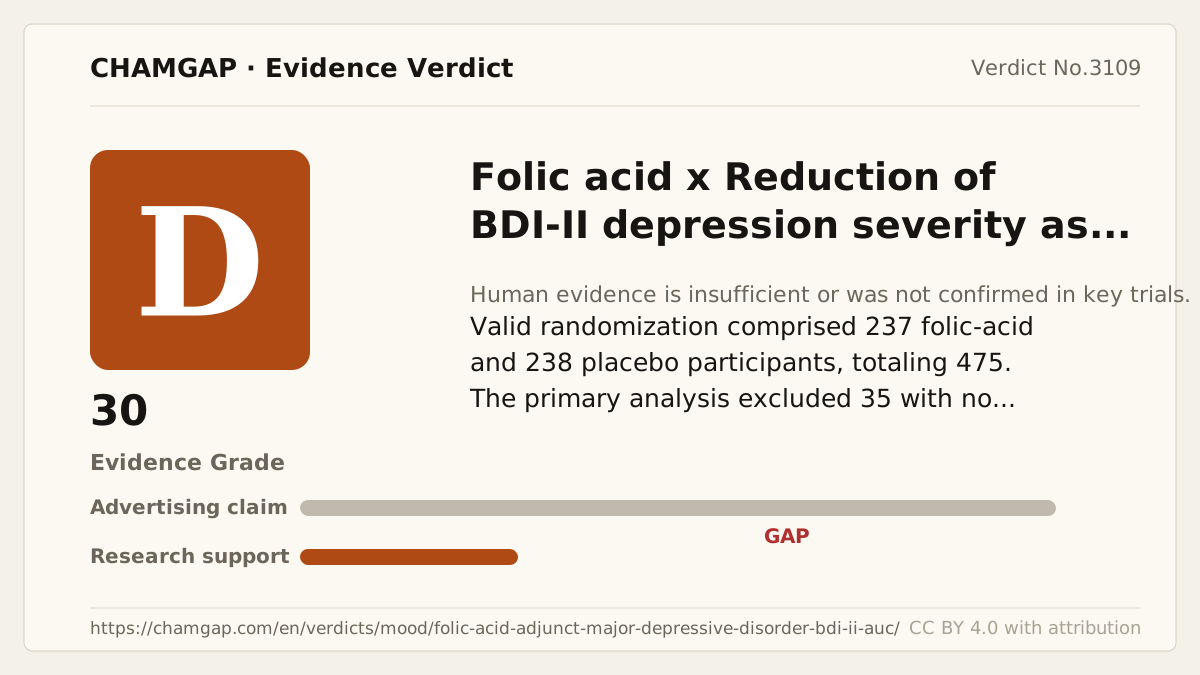
[Chamgap] Does added folic acid 5 mg lower the 25-week time-weighted mean BDI-II in MDD? — Evidence Grade D·30. 19 cited sources checked. Source: https://chamgap.com/en/verdicts/mood/folic-acid-adjunct-major-depressive-disorder-bdi-ii-auc/ · CC BY 4.0CC BY 4.0 — free to use with attribution; do not distort grades, numbers, or verdict meaning.
What this document does and does not do
Chamgap is an information source. It reports what research has and has not confirmed; it does not tell readers what to take or buy. That decision belongs to readers and, when needed, medical or legal professionals. This verdict reflects literature available up to the search date and may change as new research appears. Nothing here is medical advice.