
Divalproex,
does it really help with Improved symptoms and treatment response in adults with an acute manic episode of bipolar I disorder?
research showsDivalproex is rated B because it improves symptoms and treatment response in adults with acute mania in bipolar I disorder. In the 2019 Cochrane review, four adult placebo-controlled trials involving 869 participants found a three-week response rate of 45% with valproate and 29% with placebo, OR 2.05 (95% CI 1.32 to 3.20), with high-certainty evidence. A 1994 trial in 179 hospitalized patients found at least 50% improvement in 48% with divalproex and 25% with placebo, and a small YMRS trial was also positive. However, one 225-person extended-release trial found no significant difference on its primary Mania Rating Scale change, and trials were largely short, symptom-scale studies embedded in manufacturer development programs. Repeated direct symptom and response outcomes support efficacy, while inconsistency and short duration limit the grade to B with 74 points.
ads claimThe term mood stabilizer can expand evidence for acute mania into equally strong claims for bipolar depression, long-term relapse prevention, or ordinary emotional regulation. This verdict is limited to a current acute manic episode in an adult with bipolar I disorder.
Useful facts when choosing a product
- Divalproex is a prescription medicine converted to valproate in the body. Enteric-coated and extended-release products have different release characteristics and should not be switched or crushed without instructions; a clinician adjusts the dose according to symptoms, body weight, serum concentration, and tolerability.
- Liver function, platelets and blood counts, weight, and clinical symptoms should be assessed before and during treatment. Severe abdominal pain or vomiting, jaundice, unusual bleeding or bruising, or altered consciousness requires urgent evaluation.
- Valproate is a major established teratogen that can cause neural-tube defects and neurodevelopmental harm. Use for bipolar disorder should be avoided during pregnancy, and anyone who could become pregnant requires strict specialist counseling on contraception and alternatives.
- Severe hepatotoxicity, pancreatitis, hyperammonemia, and thrombocytopenia can occur, while weight gain, tremor, somnolence, nausea, and hair loss are also possible. Abrupt discontinuation can increase the risk of a mood episode or seizure.
Chamgap Semantic Classification Code
Candidate index · review held
M.divalproex-or-valproate.UNK.symptoms-and-treatment-response-with-an-acute-manic-episode-of-bipolar-i-disorder.improve.placeboMedicinal interventions > Divalproex or valproate > Unknown > symptoms and treatment response with an acute manic episode of bipolar I disorder > Improvement claim > Placebo
An automated migration candidate, not an issued permanent code; exact claim scope remains under review. This machine-generated migration candidate helps retrieval but is not a permanent assignment. The original verdict ID and URL remain authoritative.
What the research actually shows
Bowden and colleagues randomized 179 hospitalized patients with acute mania under double masking to 21 days of divalproex, lithium, or placebo. At least 50% improvement occurred in 48% with divalproex versus 25% with placebo. Pope and colleagues studied 36 patients with acute mania who had not responded to or tolerated lithium and reported a median YMRS reduction of 54% with valproate versus 5% with placebo. The Jochim Cochrane review synthesized four adult placebo-controlled trials involving 869 participants and estimated an OR of 2.05 for response, with high certainty. In contrast, the 225-person extended-release trial reported by Hirschfeld found no significant primary Mania Rating Scale difference over 21 days and more than 80% early discontinuation in both groups. The average effect is positive but is not uniform across formulations and trials.
Why this is classified as B (74)
High-certainty pooled evidence from four adult placebo-controlled trials involving 869 participants showed three-week response of 45% versus 29%, OR 2.05, and individual trials used direct clinical mania scales. One 225-person extended-release trial nevertheless had a negative primary endpoint, and the evidence is mostly short term with substantial manufacturer-development involvement. Consistent with the B grades for lurasidone bipolar depression verdict 760 and lamotrigine maintenance verdict 971, but on the distinct acute-mania axis, the score is B74. Hepatotoxicity, pancreatitis, teratogenicity, weight gain, and thrombocytopenia remain separate safety concerns.
Counterpoint. Acute mania can involve impulsivity, little sleep, psychosis, and danger to self or others, so this is not a self-treatment medicine. Severe or slow-to-respond episodes may require hospitalization, an antipsychotic combination, or another acute intervention, with serum levels and adverse effects monitored.
Rejudgment record. New verdict — Applied B after accepting high-certainty adult placebo-controlled response evidence from four trials and 869 participants, OR 2.05, plus repeated improvement on direct clinical mania scales, while accounting for a negative primary Mania Rating Scale endpoint in a 225-person extended-release trial, predominantly three-week follow-up, and concentration in manufacturer development programs. Maintained prescription-drug randomized-trial parity with lurasidone verdict 760 and lamotrigine verdict 971 while limiting this verdict to the distinct acute-mania axis
Sub-claim grades by effect
This ingredient is marketed for several effects. A single overall grade blends strong and weak claims together, so each effect is graded separately here. The overall grade reflects the strongest disconfirming or core claim.
| Effect (sub-claim) | Grade | Basis |
|---|---|---|
| Improved symptom-scale scores in adult bipolar I acute mania | B | Repeated placebo-controlled trials were positive, but one 225-person extended-release trial had a negative primary endpoint. |
| Increased likelihood of at least 50% treatment response in adult acute mania | B | The Cochrane three-week response rate was 45% versus 29%, OR 2.05; maintenance and depressive episodes are separate claims. |
| Stabilization of acute mania during the first three weeks of treatment | B | Benefit emerges after therapeutic exposure is reached, and dosing must be adjusted to serum concentration and tolerability. |
Cross-check — AI research and Codex final gate
Evidence Table
| Study | Design | Sample | Funding | Endpoint | Result | Weight |
|---|---|---|---|---|---|---|
| Jochim J et al. 2019 Cochrane review | Systematic review and meta-analysis of randomized trials | Twenty-five trials and 3,252 participants overall; four adult three-week placebo-controlled trials with 869 participants | Supported by the Cochrane Common Mental Disorders Group and the United Kingdom NIHR | Three-week mania response and adverse events | Adult response was 45% with valproate and 29% with placebo, OR 2.05 (95% CI 1.32 to 3.20), with high-certainty evidence. | Key independent synthesis |
| Bowden CL et al.; Depakote Mania Study Group. 1994 | Nine-center randomized double-blind placebo- and lithium-controlled trial | One hundred seventy-nine hospitalized patients with acute mania | Product-development study; specific funding not stated in the indexed abstract | Twenty-one-day Mania Rating Scale change and at least 50% improvement | At least 50% improvement occurred in 48% with divalproex, 49% with lithium, and 25% with placebo. | Large direct symptom and response randomized trial |
| Pope HG Jr et al. 1991 | Randomized double-blind placebo-controlled trial | Thirty-six patients with acute mania who had not responded to or tolerated lithium | Academic and public-research context; specific product sponsorship not stated in the indexed abstract | Seven-to-21-day YMRS and global functioning | Median YMRS reduction was 54% with valproate and 5% with placebo, with greater improvement in global functioning. | Small but direct placebo-controlled replication |
| Hirschfeld RMA et al. 2010 | Randomized double-blind placebo-controlled multicenter trial | Two hundred twenty-five adults with bipolar I acute mania | Abbott Laboratories development program | Twenty-one-day change in Mania Rating Scale score | The primary Mania Rating Scale change did not differ significantly between divalproex ER and placebo, with early discontinuation of 83% and 82%. | Important large negative trial and inconsistency evidence |
Receipt — 4 References
All 4 cited sources were verified for existence at the original page (as of 2026-07-21).
Final verification and publication gate: Codex · Evidence date: 2026-07-21 · Corrections: none
Cite this verdict
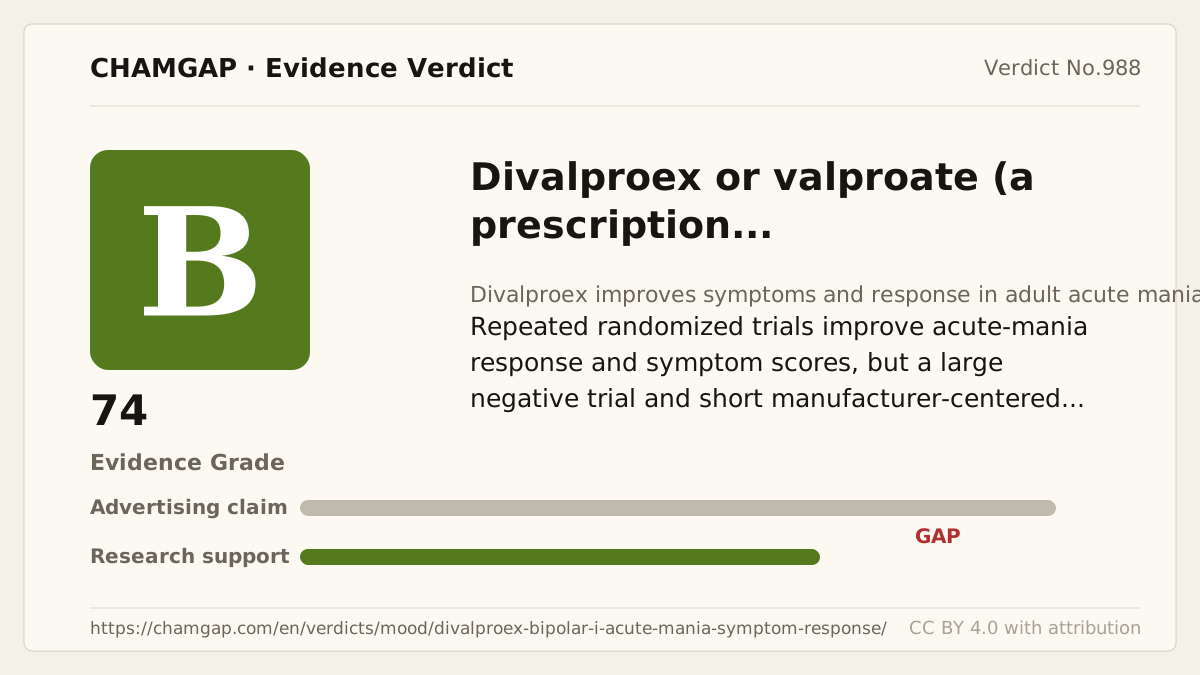
[Chamgap] Divalproex x improved symptoms and treatment response in adult bipolar I acute mania — Evidence Grade B·74. 4 cited sources checked. Source: https://chamgap.com/en/verdicts/mood/divalproex-bipolar-i-acute-mania-symptom-response/ · CC BY 4.0CC BY 4.0 — free to use with attribution; do not distort grades, numbers, or verdict meaning.
What this document does and does not do
Chamgap is an information source. It reports what research has and has not confirmed; it does not tell readers what to take or buy. That decision belongs to readers and, when needed, medical or legal professionals. This verdict reflects literature available up to the search date and may change as new research appears. Nothing here is medical advice.