
Contingency management,
does it really help with Increased sustained abstinence and treatment retention during treatment for stimulant use disorder?
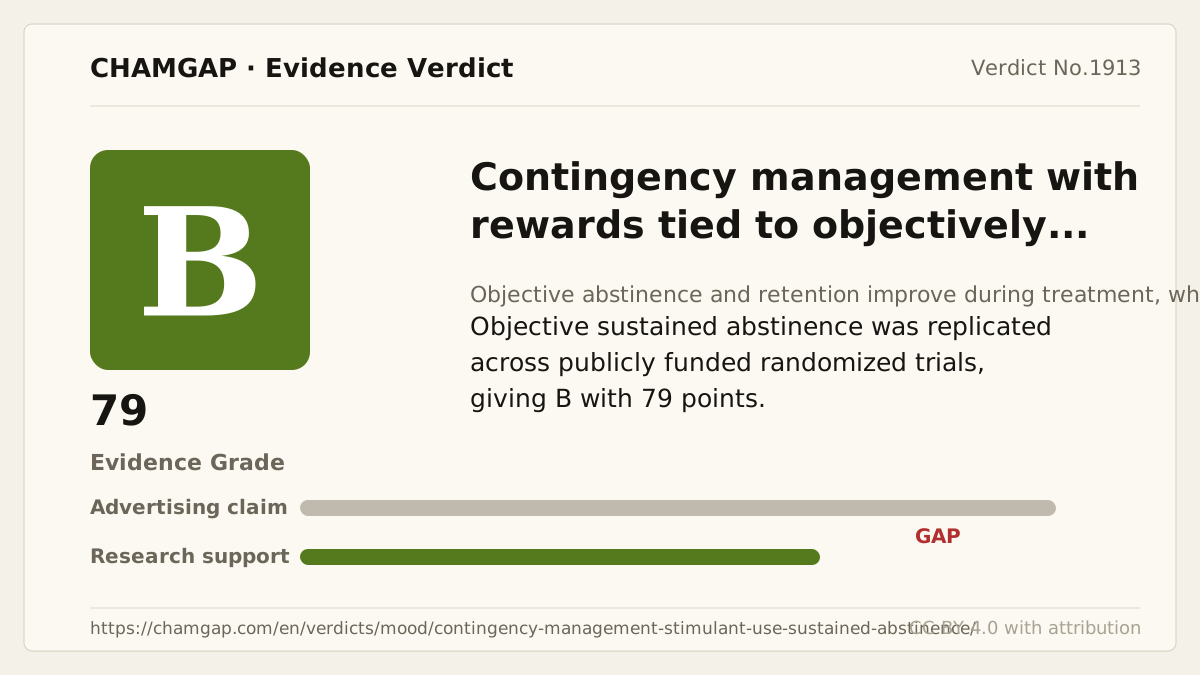
research showsThe grade is B. Petry randomized 445 participants and analyzed 415 after eligibility verification, 209 with contingency management and 206 with usual care. Twelve-week continuous abstinence was 18.7% versus 4.9%, OR 4.48 (95% CI 2.17 to 9.23). Trials across multiple teams replicated objective abstinence during treatment, giving B with 76 points.
ads claimThis is not evidence that prizes alone cure addiction. The tested intervention coupled frequent objective testing with immediate escalating rewards as an addition to usual care.
Useful facts when choosing a product
- The pivotal trial randomized 445 and reported 415 after excluding 30 retrospectively ineligible participants.
- Rewards used escalating prize draws, with a mean prize value of $203 per contingency-management participant.
- The measured benefits were objective abstinence and retention, a different indication from existing verdicts.
Chamgap Semantic Classification Code
Candidate index · review held
UNK.contingency-management-with-rewards-tied-to-objectively-verified-abstinence.UNK.sustained-abstinence-and-treatment-retention-during-treatment-for-stimulant-use-disorder.increase.usual-careUnknown > Contingency management with rewards tied to objectively verified abstinence > Unknown > sustained abstinence and treatment retention during treatment for stimulant use disorder > Increase claim > Usual care
An automated migration candidate, not an issued permanent code; exact claim scope remains under review. This machine-generated migration candidate helps retrieval but is not a permanent assignment. The original verdict ID and URL remain authoritative.
What the research actually shows
Petry randomized 445 and reported an eligibility-verified analysis of 415, with 209 assigned to contingency management and 206 to usual care. The longest continuous negative-testing result was 8.6 versus 5.2 consecutive visits or tests, retained in the source unit rather than converted to weeks. NIDA's Clinical Trials Network funded the study. McDonell randomized 176 and was supported by NIDA R01 DA022476. The lead teams and sites differed—Petry/UConn and CTN versus McDonell/University of Washington—but John M. Roll coauthored both and both used NIDA funding. Replication is justified by the broader randomized contingency-management evidence across multiple teams, not by treating these two trials as wholly independent pairs.
Why this is classified as B (76)
The broader publicly funded randomized evidence across multiple teams replicated objective stimulant abstinence during treatment, and the absolute 12-week abstinence difference was substantial, giving B with 76 points.
Counterpoint. Effects depend on reward magnitude, testing frequency, and implementation, and the follow-up meta-analysis found no maintained benefit at six months.
Rejudgment record. Cross-check applied — Accepted repeated objectively verified abstinence and retention during treatment across the broader publicly funded randomized contingency-management evidence
| Endpoint | P | Symptom or function itself is the target - including patient reports and performance tests |
| Replication | R2 | Independently replicated across trials |
| Independence | I2 | Decisive evidence is publicly or non-profit funded |
| Effect size | E+ | Meets the clinically important threshold |
Stored derived and displayed grades match; this is not a current recalculation or validity check (B).
Sub-claim grades by effect
This ingredient is marketed for several effects. A single overall grade blends strong and weak claims together, so each effect is graded separately here. The overall grade reflects the strongest disconfirming or core claim.
| Effect (sub-claim) | Grade | Basis |
|---|---|---|
| Increased sustained abstinence during treatment | B | Objective specimen outcomes improved across multiple randomized trials. |
| Long-term abstinence after incentives end | ? | The pivotal evidence primarily covers the 12-week treatment period. |
Cross-check — AI research and Codex final gate
Evidence Table
| Study | Design | Sample | Funding | Endpoint | Result | Weight |
|---|---|---|---|---|---|---|
| Petry et al. 2005 NIDA CTN | Randomized usual-care-controlled trial at eight community clinics | 445 randomized; 415 in the reported eligibility-verified primary analysis, 209 versus 206 | US National Institute on Drug Abuse Clinical Trials Network | Retention and objectively verified longest continuous abstinence | Longest continuous negative visits or tests 8.6 versus 5.2, P<0.001; 12-week continuous abstinence 18.7% versus 4.9%, OR 4.48 (95% CI 2.17 to 9.23). | Pivotal community-treatment trial |
| McDonell et al. 2013 | Randomized controlled trial in outpatients with co-occurring serious mental illness | 176 randomized | NIDA R01 DA022476 | Stimulant-negative urine tests | The contingency-management group was 2.4 times as likely to submit a negative specimen (95% CI 1.9 to 3.0). | Objective replication by a different lead team and setting; John M. Roll and NIDA funding overlap |
Receipt — 2 References
All 2 cited sources were verified for existence at the original page (as of 2026-08-01).
Final verification and publication gate: Codex · Evidence date: 2026-08-01 · Corrections: none
Cite this verdict
[Chamgap] Contingency management x sustained abstinence during stimulant-use treatment — Evidence Grade B·76. 2 cited sources checked. Source: https://chamgap.com/en/verdicts/mood/contingency-management-stimulant-use-sustained-abstinence/ · CC BY 4.0CC BY 4.0 — free to use with attribution; do not distort grades, numbers, or verdict meaning.
What this document does and does not do
Chamgap is an information source. It reports what research has and has not confirmed; it does not tell readers what to take or buy. That decision belongs to readers and, when needed, medical or legal professionals. This verdict reflects literature available up to the search date and may change as new research appears. Nothing here is medical advice.