
Cognitive behavioral therapy,
does it really help with Reduced social anxiety, avoidance, and functional impairment with increased response and remission?
research showsIndividual cognitive behavioral therapy is rated B because it meaningfully improves social anxiety symptoms and treatment response. In a publicly funded 495-person trial, all 495 randomized participants were included in intention-to-treat analyses; both masked-rater coprimary outcomes succeeded, with CBT response and remission of 60% and 36% versus 15% and 9% on the waiting list (P<0.001). A network meta-analysis of 101 trials and 13,164 analyzed participants found SMD -1.19 versus waiting list and -0.56 versus psychological placebo.
ads claimClaims that a brief course eliminates social anxiety for everyone overstate the evidence. The evidence most directly concerns structured individual CBT for diagnosed adults, and response varies with therapist competence, homework engagement, and comorbidity.
Useful facts when choosing a product
- The pivotal intervention was manual-guided individual CBT, with a mean treatment duration of about 38.7 weeks.
- The principal efficacy assessments used the LSAS and raters masked to treatment assignment.
- Verdict 1784, which is B with 72 points, evaluates CBT for panic disorder and was not pooled into this evidence.
Chamgap Semantic Classification Code
Candidate index · review held
X.cognitive-behavioral-therapy.behavioral.social-anxiety-avoidance-and-functional-impairment-with-increased-response-and-remission.reduce.placeboBehaviors, exposures and policies > Cognitive behavioral therapy > Behavioral delivery > social anxiety, avoidance, and functional impairment with increased response and remission > Reduction claim > Placebo
An automated migration candidate, not an issued permanent code; exact claim scope remains under review. This machine-generated migration candidate helps retrieval but is not a permanent assignment. The original verdict ID and URL remain authoritative.
What the research actually shows
Leichsenring 2013 randomized 495 outpatients with social anxiety disorder and included all 495 in intention-to-treat analyses. Masked-rater LSAS response and remission were coprimary outcomes, and CBT significantly beat waiting list on both, so the primary endpoints succeeded. Mayo-Wilson 2014 analyzed 13,164 of 14,229 randomized participants across 101 trials; individual CBT produced SMD -1.19 versus waiting list and -0.56 versus psychological placebo. This verdict concerns social anxiety disorder; verdict 1784, which is B with 72 points, concerns panic disorder and different trials.
Why this is classified as B (76)
Both coprimary outcomes succeeded in a large publicly funded trial, and an independent 101-trial synthesis confirmed benefit against psychological placebo. Nonmasking and waiting-list inflation keep the grade at B with 76 points.
Counterpoint. The psychological-placebo comparison is a more conservative expectation than the waiting-list comparison. Access, therapist competence, preferences, and comorbidity matter in treatment choice.
Rejudgment record. Cross-check applied — Success of both coprimary outcomes in a large publicly funded randomized trial plus replication against psychological placebo in an independent network meta-analysis
| Endpoint | P | Symptom or function itself is the target - including patient reports and performance tests |
| Replication | R2 | Independently replicated across trials |
| Independence | I2 | Decisive evidence is publicly or non-profit funded |
| Effect size | E+ | Meets the clinically important threshold |
Stored derived and displayed grades match; this is not a current recalculation or validity check (B).
Sub-claim grades by effect
This ingredient is marketed for several effects. A single overall grade blends strong and weak claims together, so each effect is graded separately here. The overall grade reflects the strongest disconfirming or core claim.
| Effect (sub-claim) | Grade | Basis |
|---|---|---|
| Increased treatment response in social anxiety disorder | B | Response was 60% with CBT versus 15% on waiting list. |
| Increased remission in social anxiety disorder | B | Remission was 36% versus 9% in the pivotal trial. |
| Reduced social anxiety symptoms | B | The 101-trial synthesis estimated SMD -0.56 versus psychological placebo. |
Cross-check — AI research and Codex final gate
Evidence Table
| Study | Design | Sample | Funding | Endpoint | Result | Weight |
|---|---|---|---|---|---|---|
| Leichsenring F et al. 2013 | Multicenter randomized waiting-list- and active-treatment-controlled trial with masked raters | 495 randomized and 495 analyzed by intention to treat: CBT 209, psychodynamic therapy 207, waiting list 79 | Public funding from the German Federal Ministry of Education and Research SOPHO-NET program | Coprimary LSAS-based response and remission | CBT 60% response and 36% remission versus 15% and 9% on waiting list; both coprimary outcomes succeeded at P<0.001. | Pivotal large publicly funded trial |
| Mayo-Wilson E et al. 2014 | Systematic review and network meta-analysis | 101 trials; 14,229 randomized and 13,164 analyzed | Public funding from the United Kingdom National Institute for Health and Care Excellence | Social anxiety symptoms | Individual CBT produced SMD -1.19 versus waiting list (95% CrI -1.56 to -0.81) and -0.56 versus psychological placebo. | Large independent replication |
Receipt — 2 References
All 2 cited sources were verified for existence at the original page (as of 2026-07-24).
Final verification and publication gate: Codex · Evidence date: 2026-07-24 · Corrections: none
Cite this verdict
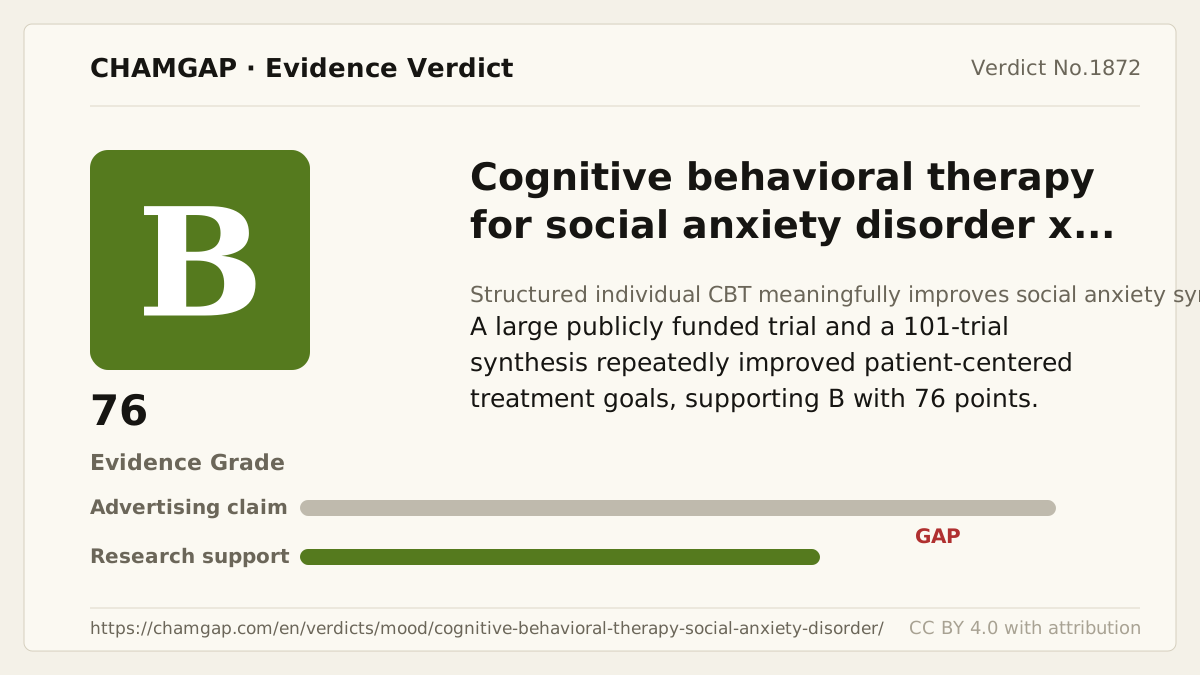
[Chamgap] Cognitive behavioral therapy x symptoms and treatment response in social anxiety disorder — Evidence Grade B·76. 2 cited sources checked. Source: https://chamgap.com/en/verdicts/mood/cognitive-behavioral-therapy-social-anxiety-disorder/ · CC BY 4.0CC BY 4.0 — free to use with attribution; do not distort grades, numbers, or verdict meaning.
What this document does and does not do
Chamgap is an information source. It reports what research has and has not confirmed; it does not tell readers what to take or buy. That decision belongs to readers and, when needed, medical or legal professionals. This verdict reflects literature available up to the search date and may change as new research appears. Nothing here is medical advice.