
Cognitive behavioral therapy,
does it really help with Reduced panic-disorder severity and improved treatment response?
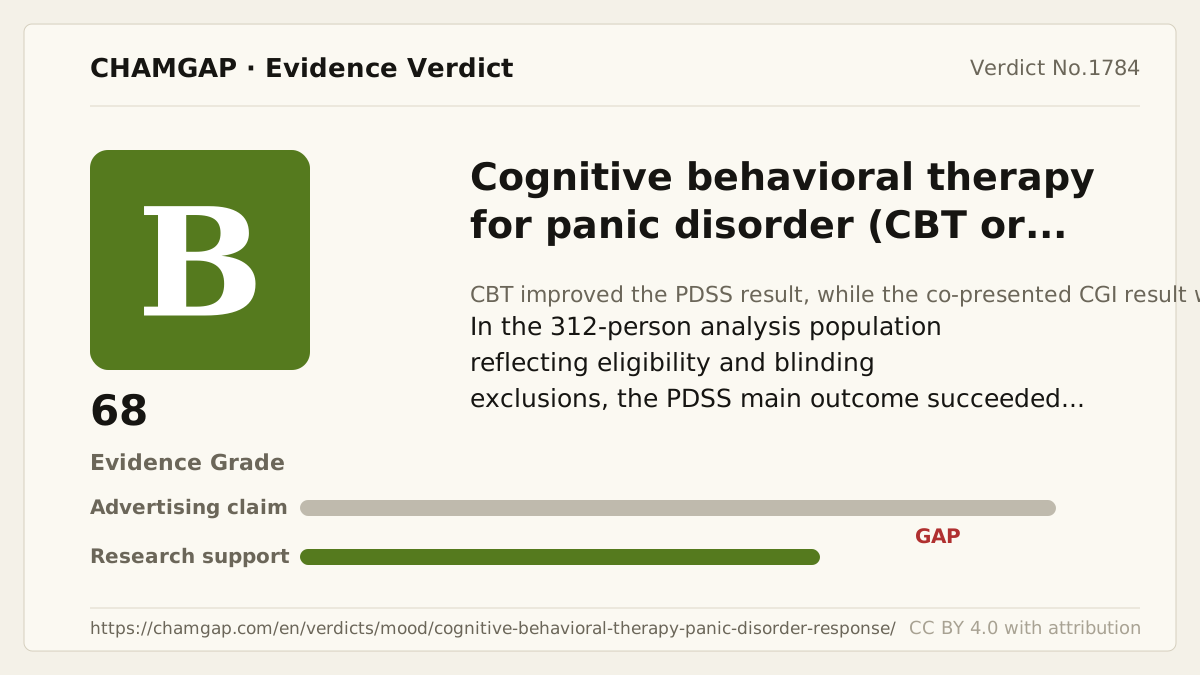
research showsThe grade is B. Barlow 2000 randomized 326 patients; the 312-person analysis population reflected exclusions for ineligibility and blinding problems. PDSS and CGI were both main outcomes. PDSS response succeeded at 48.7% with CBT versus 21.7% with pill placebo, P=.03, and maintenance response was 39.5% versus 13.0%, P=.02. Acute CGI response was nonsignificant at 53.9% versus 37.5%. Pill-placebo control is a design strength compared with verdict 1782, which is B with 72 points, but psychotherapy cannot be fully blinded, preventing A.
ads claimPromotion can promise rapid elimination of all panic attacks and permanent relapse prevention. Response varied by measure and time, some patients dropped out or did not respond, and skilled exposure-based delivery matters.
Useful facts when choosing a product
- The trial CBT combined interoceptive exposure, cognitive restructuring, and breathing retraining in eleven sessions over twelve weeks.
- Acute responders received six additional monthly maintenance sessions.
- Interoceptive exposure can temporarily increase anxiety, so medical mimics and acute psychiatric risk should be assessed.
Chamgap Semantic Classification Code
Candidate index · review held
X.cognitive-behavioral-therapy.behavioral.panic-disorder-severity-and-improved-treatment-response.reduce.MULTIBehaviors, exposures and policies > Cognitive behavioral therapy > Behavioral delivery > panic-disorder severity and improved treatment response > Reduction claim > Multiple: primary unresolved
An automated migration candidate, not an issued permanent code; exact claim scope remains under review. This machine-generated migration candidate helps retrieval but is not a permanent assignment. The original verdict ID and URL remain authoritative.
What the research actually shows
Barlow et al. randomized 326 patients across five groups; the 312-person analysis population reflected exclusions for ineligibility and blinding problems. PDSS and CGI were both main outcomes. PDSS response favored CBT over placebo and remained positive at maintenance, while acute CGI response was nonsignificant. NIMH provided public grant funding and Teva supplied imipramine and matching placebo. The Pompoli Cochrane review quantitatively analyzed 54 trials with 3,021 participants and supported psychological therapy while noting bias and uncertainty between therapies.
Why this is classified as B (72)
The PDSS main outcome succeeded in the 312-person analysis population reflecting eligibility and blinding exclusions; pill-placebo control, maintenance response, and replicated trials support B. The co-presented CGI main outcome was null, and inability to blind therapy plus limited generalizability yield 68 points.
Counterpoint. The PDSS main outcome succeeded, but the co-presented acute categorical CGI main outcome was null.
Rejudgment record. Cross-check applied — Distinguished 326 randomized from the 312-person analysis population reflecting eligibility and blinding exclusions, and considered the successful PDSS and null CGI main outcomes together
| Endpoint | P | Symptom or function itself is the target - including patient reports and performance tests |
| Replication | R2 | Independently replicated across trials |
| Independence | I2 | Decisive evidence is publicly or non-profit funded |
| Effect size | E+ | Meets the clinically important threshold |
Stored derived and displayed grades match; this is not a current recalculation or validity check (B).
Sub-claim grades by effect
This ingredient is marketed for several effects. A single overall grade blends strong and weak claims together, so each effect is graded separately here. The overall grade reflects the strongest disconfirming or core claim.
| Effect (sub-claim) | Grade | Basis |
|---|---|---|
| Reduced panic-disorder severity | B | The continuous PDSS main outcome and PDSS response succeeded versus placebo. |
| Improved six-month maintenance response | B | PDSS maintenance response was 39.5% versus 13.0%, P=.02. |
| Improved acute categorical CGI response | D | The contrast of 53.9% versus 37.5% was not statistically significant. |
Cross-check — AI research and Codex final gate
Evidence Table
| Study | Design | Sample | Funding | Endpoint | Result | Weight |
|---|---|---|---|---|---|---|
| Barlow DH et al. 2000 | Multicenter randomized pill-placebo and active-controlled trial | 326 randomized; 312-person analysis population reflecting exclusions for ineligibility and blinding problems | Public United States NIMH grants MH45963 through MH45966 and MH00416; Teva supplied drug and matching placebo | Main outcomes of continuous PDSS and categorical CGI response | PDSS response succeeded at 48.7% versus 21.7%, P=.03; acute CGI response of 53.9% versus 37.5% was nonsignificant. | Pivotal public-funded placebo-controlled randomized trial |
| Pompoli A et al. 2016 Cochrane review | Network meta-analysis of randomized psychotherapy trials | 60 studies included; 54 trials and 3,021 participants quantitatively analyzed | Academic Cochrane review with no dedicated manufacturer funding | Short-term response, remission, dropout, and long-term effects | Supported response and remission with CBT approaches, while comparative evidence between therapies was low or very low quality. | Supportive replication and generalizability evidence |
Receipt — 2 References
All 2 cited sources were verified for existence at the original page (as of 2026-07-24).
Final verification and publication gate: Codex · Evidence date: 2026-07-24 · Corrections: none
Cite this verdict
[Chamgap] Cognitive behavioral therapy x symptoms and response in panic disorder — Evidence Grade B·72. 2 cited sources checked. Source: https://chamgap.com/en/verdicts/mood/cognitive-behavioral-therapy-panic-disorder-response/ · CC BY 4.0CC BY 4.0 — free to use with attribution; do not distort grades, numbers, or verdict meaning.
What this document does and does not do
Chamgap is an information source. It reports what research has and has not confirmed; it does not tell readers what to take or buy. That decision belongs to readers and, when needed, medical or legal professionals. This verdict reflects literature available up to the search date and may change as new research appears. Nothing here is medical advice.