
Clomipramine,
does it really help with Reduction of obsessions and compulsions and increased treatment response in adults with obsessive-compulsive disorder?
research showsThe grade is B. Two manufacturer-program 10-week trials totaling 520 participants found Y-BOCS reductions of 38% and 44% versus 3% and 5% with placebo. A separate NIMH-funded 12-week trial found response in 42% versus 8% among 122 treatment entrants. Large symptom and response differences were replicated by different investigators and funding, but brief duration and attrition limit the grade to B with 70 points.
ads claimClaims that clomipramine eliminates OCD overstate the evidence. Short-term symptom response is established, but residual symptoms were common, high-dose prescribing needs monitoring, and exposure-based therapy had a higher response rate.
Useful facts when choosing a product
- A 5-point or 25% to 35% Y-BOCS reduction is an individual-response or within-person-change criterion, not a validated between-group threshold.
- Direct SSRI comparisons showed no clear superiority: fluvoxamine, four RCTs and 175 participants, 1.23 points (95% CI -1.11 to 3.56); fluoxetine, one RCT and 55 participants, 1.40 (-5.74 to 2.94); paroxetine, one RCT and 300 participants, 0.00 (-1.94 to 1.94).
- Post-randomization pretreatment exclusions mean the Foa study was not a complete 149-person intention-to-treat analysis.
Chamgap Semantic Classification Code
Candidate index · review held
M.clomipramine.UNK.obsessions-and-compulsions-and-increased-treatment-response-with-obsessive-compulsive-disorder.reduce.placeboMedicinal interventions > Clomipramine > Unknown > obsessions and compulsions and increased treatment response with obsessive-compulsive disorder > Reduction claim > Placebo
An automated migration candidate, not an issued permanent code; exact claim scope remains under review. This machine-generated migration candidate helps retrieval but is not a permanent assignment. The original verdict ID and URL remain authoritative.
What the research actually shows
The Ciba-Geigy Collaborative Study Group ran two 10-week double-blind trials of 239 and 281 participants, 520 total. Mean Y-BOCS reduction was 38% and 44% with clomipramine versus 3% and 5% with placebo; Ciba-Geigy led and funded the program. The NIMH-funded Foa trial randomized 149 but excluded 27 before treatment, leaving 122 starters. Among 36 clomipramine and 26 placebo starters, Y-BOCS changed 26.3 to 18.2 versus 25.0 to 22.2; response was 42% versus 8% among starters and 48% versus 10% among completers.
Why this is classified as B (70)
Multiple placebo-controlled trials with independent funding replication found large symptom and response differences, but short duration and attrition give B with 70 points.
Counterpoint. Exposure and ritual prevention had a higher response rate than clomipramine in the same independent trial.
Rejudgment record. Cross-check applied — Large symptom reductions in two industry-funded trials supported by the independent NIMH trial binary response of 42% versus 8%, with pretreatment exclusions, short duration, and no demonstrated SSRI superiority
| Endpoint | P | Symptom or function itself is the target - including patient reports and performance tests |
| Replication | R2 | Independently replicated across trials |
| Independence | I1 | Mixed funding sources |
| Effect size | E+ | Meets the clinically important threshold |
Stored derived and displayed grades match; this is not a current recalculation or validity check (B).
Sub-claim grades by effect
This ingredient is marketed for several effects. A single overall grade blends strong and weak claims together, so each effect is graded separately here. The overall grade reflects the strongest disconfirming or core claim.
| Effect (sub-claim) | Grade | Basis |
|---|---|---|
| Reduced adult OCD symptoms | B | Multiple placebo-controlled trials and an independent NIMH trial replicated a large reduction. |
| Superior to exposure and ritual prevention | D | Exposure and ritual prevention had the higher response rate in the same trial. |
Cross-check — AI research and Codex final gate
Evidence Table
| Study | Design | Sample | Funding | Endpoint | Result | Weight |
|---|---|---|---|---|---|---|
| Clomipramine Collaborative Study Group 1991 | Two 21-center double-blind placebo-controlled 10-week randomized trials | 520 randomized and included in efficacy reporting | Ciba-Geigy manufacturer program | Principal Y-BOCS and NIMH Global OCD Scale outcomes | Y-BOCS reductions of 38% and 44% versus 3% and 5%, P<0.001 in both trials | Large direct efficacy evidence |
| Foa et al. 2005 | Three-center randomized placebo- and active-treatment 12-week trial | 149 randomized and 122 entered treatment; 36 clomipramine and 26 placebo entrants | US NIMH grants MH-45404 and MH-45436 | Primary Y-BOCS; CGI treatment response | Response in 42% versus 8% of treatment entrants and 48% versus 10% of completers | Independent publicly funded replication |
Receipt — 3 References
All 3 cited sources were verified for existence at the original page (as of 2026-08-02).
Final verification and publication gate: Codex · Evidence date: 2026-08-02 · Corrections: none
Cite this verdict
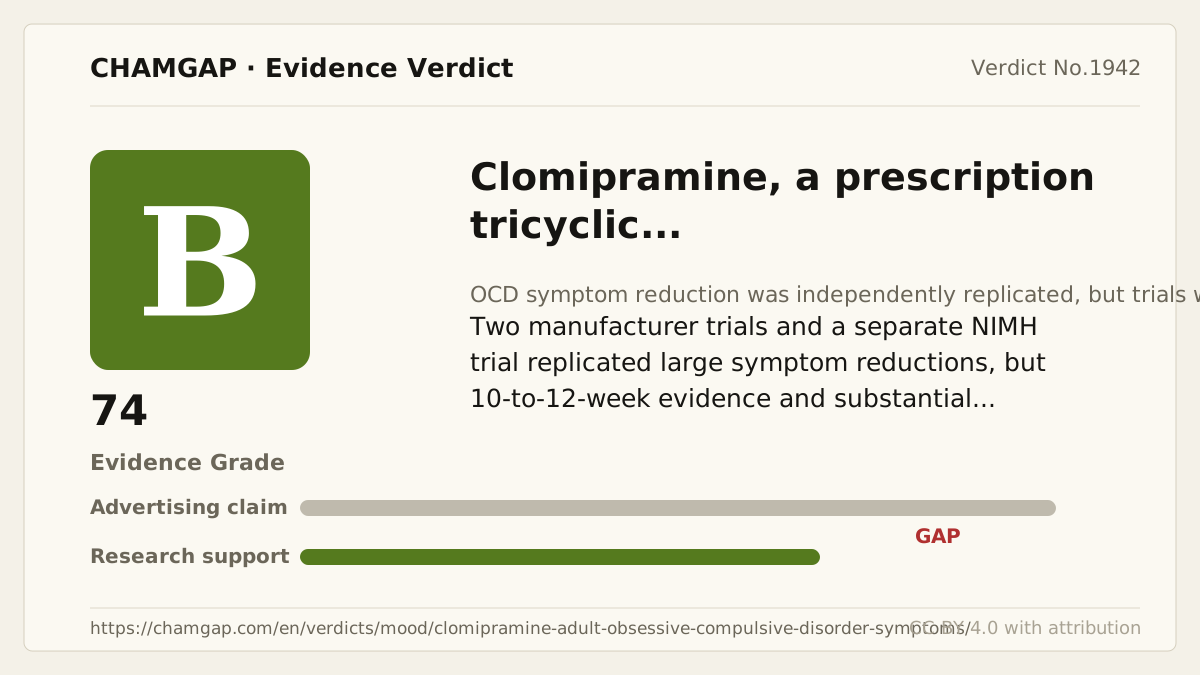
[Chamgap] Clomipramine x reduced adult OCD symptoms — Evidence Grade B·70. 3 cited sources checked. Source: https://chamgap.com/en/verdicts/mood/clomipramine-adult-obsessive-compulsive-disorder-symptoms/ · CC BY 4.0CC BY 4.0 — free to use with attribution; do not distort grades, numbers, or verdict meaning.
What this document does and does not do
Chamgap is an information source. It reports what research has and has not confirmed; it does not tell readers what to take or buy. That decision belongs to readers and, when needed, medical or legal professionals. This verdict reflects literature available up to the search date and may change as new research appears. Nothing here is medical advice.