
CBT-BN,
does it really help with Cessation of binge eating and purging and increased remission?
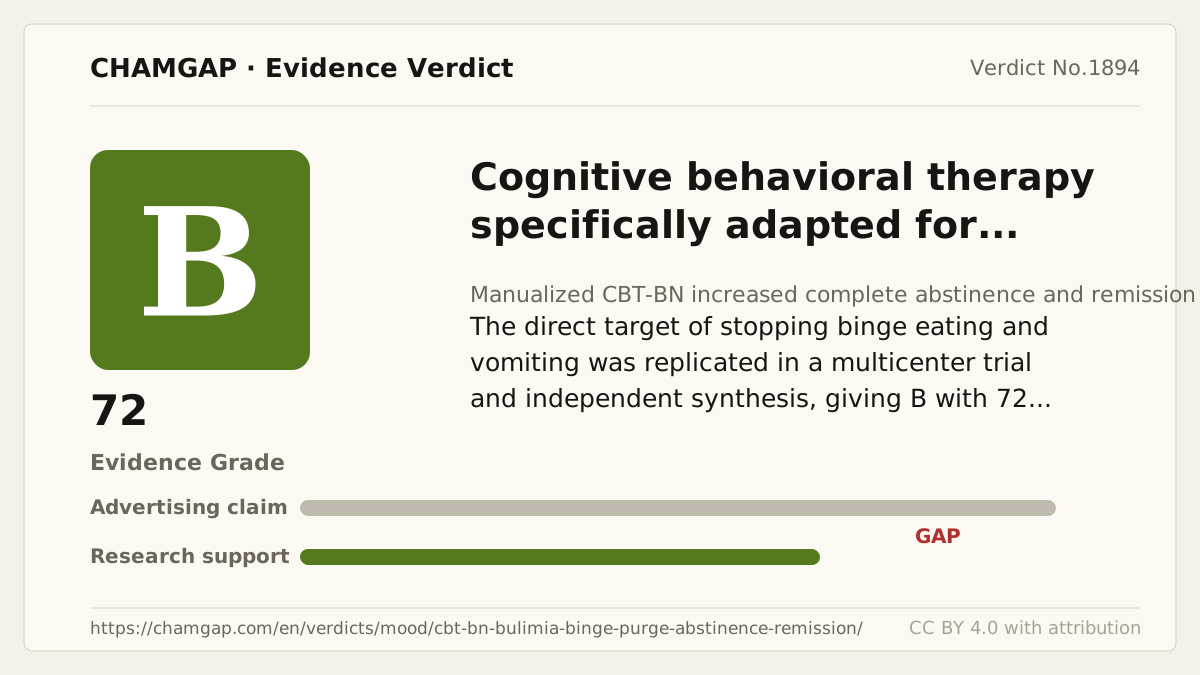
research showsThe grade is B. The trial randomized 110 participants to CBT-BN and 110 to interpersonal psychotherapy and analyzed all 220 using baseline-value carry-forward. Complete 28-day abstinence from binge eating and vomiting was 32 of 110 (29%) versus 7 of 110 (6%), P<0.001, and remission was 53 of 110 (48%) versus 31 of 110 (28%), P=0.003. Beating active psychotherapy is a strength, but only 162 had observed end-of-treatment data, giving B with 72 points.
ads claimThe evidence concerns manualized CBT-BN delivered by trained therapists. Generic positive-thinking counseling, weight-loss coaching, and therapy for binge-eating disorder are not automatically the same intervention.
Useful facts when choosing a product
- Cessation of binge eating and compensatory behavior and remission are graded.
- The pivotal trial compared CBT-BN with interpersonal psychotherapy, and 162 observed completers must be distinguished from the 220-participant intention-to-treat analysis.
- Severe electrolyte disturbance, fainting, cardiac symptoms, or suicide risk requires urgent medical assessment rather than psychotherapy alone.
Chamgap Semantic Classification Code
Candidate index · review held
X.cognitive-behavioral-therapy-specifically-adapted.behavioral.cessation-of-binge-eating-and-purging-and-increased-remission.increase.noneBehaviors, exposures and policies > Cognitive behavioral therapy specifically adapted > Behavioral delivery > Cessation of binge eating and purging and increased remission > Increase claim > No intervention
An automated migration candidate, not an issued permanent code; exact claim scope remains under review. This machine-generated migration candidate helps retrieval but is not a permanent assignment. The original verdict ID and URL remain authoritative.
What the research actually shows
At two centers, 220 women were randomized to CBT-BN, 110, or interpersonal psychotherapy, 110. Observed end-of-treatment data were available for 78 and 84 participants, 162 total, while the primary analysis carried baseline values forward for all 220. Blinded assessment found complete 28-day abstinence in 32 of 110 (29%) versus 7 of 110 (6%) and remission in 53 of 110 (48%) versus 31 of 110 (28%). A Cochrane review of 48 studies and 3,054 participants adds independent evidence.
Why this is classified as B (72)
The direct binary outcome of complete abstinence improved against active psychotherapy and in independent evidence, but 26% missing end-of-treatment data give B with 72 points.
Counterpoint. CBT-BN does not produce recovery for everyone. Strict 28-day complete abstinence was 29% in the pivotal trial, and many patients need additional care.
Rejudgment record. Cross-check applied — Blinded assessors found improvement in direct binary treatment targets against active psychotherapy, with independent evidence, but 26% of end-of-treatment observations were missing
| Endpoint | P | Symptom or function itself is the target - including patient reports and performance tests |
| Replication | R2 | Independently replicated across trials |
| Independence | I2 | Decisive evidence is publicly or non-profit funded |
| Effect size | E+ | Meets the clinically important threshold |
Stored derived and displayed grades match; this is not a current recalculation or validity check (B).
Sub-claim grades by effect
This ingredient is marketed for several effects. A single overall grade blends strong and weak claims together, so each effect is graded separately here. The overall grade reflects the strongest disconfirming or core claim.
| Effect (sub-claim) | Grade | Basis |
|---|---|---|
| Complete 28-day abstinence from binge eating and vomiting | B | Rates were 29% with CBT-BN and 6% with interpersonal psychotherapy. |
| Increased remission of bulimia nervosa | B | The pivotal trial found 48% versus 28%. |
| Reduced frequency of binge eating and compensatory behavior | B | A 48-study synthesis supported the same direction. |
Cross-check — AI research and Codex final gate
Evidence Table
| Study | Design | Sample | Funding | Endpoint | Result | Weight |
|---|---|---|---|---|---|---|
| Agras WS et al. 2000 | Multicenter randomized active-psychotherapy-controlled trial | 220 randomized; actual primary ITT included 220, with 162 observed at treatment completion | Public support from the United States National Institute of Mental Health and the United Kingdom Wellcome Trust | Recovery with 28 days free of binge eating and vomiting, and remission, at treatment completion | Complete abstinence was 32/110 (29%) versus 7/110 (6%), P<0.001; remission was 53/110 (48%) versus 31/110 (28%), P=0.003. End-of-treatment observations numbered 78/110 versus 84/110. | Pivotal multicenter randomized trial on direct outcomes |
| Hay PPJ et al. 2009 Cochrane | Systematic review and meta-analysis of randomized psychotherapy trials | 48 studies and 3,054 participants | Cochrane review; authors reported no commercial study funding | Remission, binge and compensatory-behavior frequency, and dropout | CBT, particularly CBT-BN, improved remission and binge reduction versus waiting list or no treatment. | Independent synthesis supporting replication |
Receipt — 2 References
All 2 cited sources were verified for existence at the original page (as of 2026-07-24).
Final verification and publication gate: Codex · Evidence date: 2026-07-24 · Corrections: none
Cite this verdict
[Chamgap] CBT-BN x cessation of binge eating and compensatory behavior in bulimia nervosa — Evidence Grade B·72. 2 cited sources checked. Source: https://chamgap.com/en/verdicts/mood/cbt-bn-bulimia-binge-purge-abstinence-remission/ · CC BY 4.0CC BY 4.0 — free to use with attribution; do not distort grades, numbers, or verdict meaning.
What this document does and does not do
Chamgap is an information source. It reports what research has and has not confirmed; it does not tell readers what to take or buy. That decision belongs to readers and, when needed, medical or legal professionals. This verdict reflects literature available up to the search date and may change as new research appears. Nothing here is medical advice.