
CBT-based tinnitus care,
does it really help with Reduced tinnitus-related distress and functional impairment?
research showsThe grade is C. In a 492-person Dutch trial, specialized CBT-based care produced TQ -8.062 and THI -7.506 versus usual care, with standardized effects of 0.43 to 0.45. A 158-person US internet-CBT trial found TFI 36.57 versus 46.31, d=0.46. The trials were independent but used different scales and estimands, so strict replication was not claimed; effects also fell just below the conventional medium magnitude of 0.5. Consistent modest improvement gives C with 50 points.
ads claimReduced distress is not disappearance of tinnitus. The result of multidisciplinary stepped care also should not be relabeled as the isolated effect of CBT alone.
Useful facts when choosing a product
- TQ, THI, and TFI measure patient-reported distress and functional burden rather than the physical loudness of tinnitus.
- The Beukes program comprised 22 audiologist-guided internet modules.
- No duplicate of CBT-based tinnitus care by distress or handicap was found in the existing verdict list.
Chamgap Semantic Classification Code
Candidate index · review held
X.stepped-or-internet-cbt-based-tinnitus-care-combining-education.environmental.tinnitus-related-distress-and-functional-impairment.reduce.usual-careBehaviors, exposures and policies > Stepped or internet CBT-based tinnitus care combining education > Environmental exposure > tinnitus-related distress and functional impairment > Reduction claim > Usual care
An automated migration candidate, not an issued permanent code; exact claim scope remains under review. This machine-generated migration candidate helps retrieval but is not a permanent assignment. The original verdict ID and URL remain authoritative.
What the research actually shows
Cima tested multidisciplinary stepped care combining CBT, tinnitus retraining, and audiological elements against standardized audiological usual care. Beukes tested eight-week online CBT against weekly monitoring and used intention-to-treat analysis. Follow-up survey completion was 107/148 (72.3%) at T1 and 91/148 (61.0%) at T2, showing substantial longer-term attrition. Neither trial could blind participants, and both relied on self-reported outcomes.
Why this is classified as C (50)
Two independent publicly funded RCTs improved tinnitus distress, but they used nonidentical scales and estimands and were not counted as strict replication. With no verified between-group clinical threshold, magnitude was classified statistically; d=0.43-0.46 fell below 0.5. One public-independence strength gives C with 50 points.
Counterpoint. C does not mean no effect; it means average benefit was modest and strict same-measure replication was absent.
Rejudgment record. Cross-check applied — We cross-checked the papers and trial registries for primary scales, intention-to-treat analysis, attrition, funding, and standardized effect sizes.
| Endpoint | P | Symptom or function itself is the target - including patient reports and performance tests |
| Replication | R1 | Single confirmatory trial |
| Independence | I2 | Decisive evidence is publicly or non-profit funded |
| Effect size | E~ | Statistically positive but below the threshold |
Stored derived and displayed grades match; this is not a current recalculation or validity check (C).
Sub-claim grades by effect
This ingredient is marketed for several effects. A single overall grade blends strong and weak claims together, so each effect is graded separately here. The overall grade reflects the strongest disconfirming or core claim.
| Effect (sub-claim) | Grade | Basis |
|---|---|---|
| CBT-based tinnitus care reduces tinnitus distress and handicap. | C | Independent RCTs showed modest effects of d=0.43-0.46. |
| CBT-based care eliminates the tinnitus sound itself. | ? | The pivotal trials measured distress and handicap, not disappearance of the sound. |
Cross-check — AI research and Codex final gate
Evidence Table
| Study | Design | Sample | Funding | Endpoint | Result | Weight |
|---|---|---|---|---|---|---|
| Cima et al., Lancet 2012 | Multicenter individual randomized trial | 492 participants; 245 specialized stepped care and 247 usual care; intention-to-treat | Netherlands Organisation for Health Research and Development, ZonMw | HUI, TQ, and THI over 12 months | HUI +0.059 (95% CI 0.025-0.094; d=0.24); TQ -8.062 (-10.829 to -5.295; d=0.43); THI -7.506 (-10.661 to -4.352; d=0.45) | Pivotal publicly funded confirmatory trial |
| Beukes et al., J Med Internet Research 2022 | Two-arm online individual randomized trial | 158 participants; 79 iCBT and 79 weekly monitoring; survey completion 107/148 (72.3%) at T1 and 91/148 (61.0%) at T2 | NIH/NIDCD R21DC017214 | Primary TFI tinnitus distress | Post-treatment 36.57 (SD 22.00) versus 46.31 (SD 20.63); d=0.46 (95% CI 0.14-0.77), intention-to-treat | Independent small, short supportive trial |
Receipt — 2 References
All 2 cited sources were verified for existence at the original page (as of 2026-08-14).
Final verification and publication gate: Codex · Evidence date: 2026-08-14 · Corrections: none
Cite this verdict
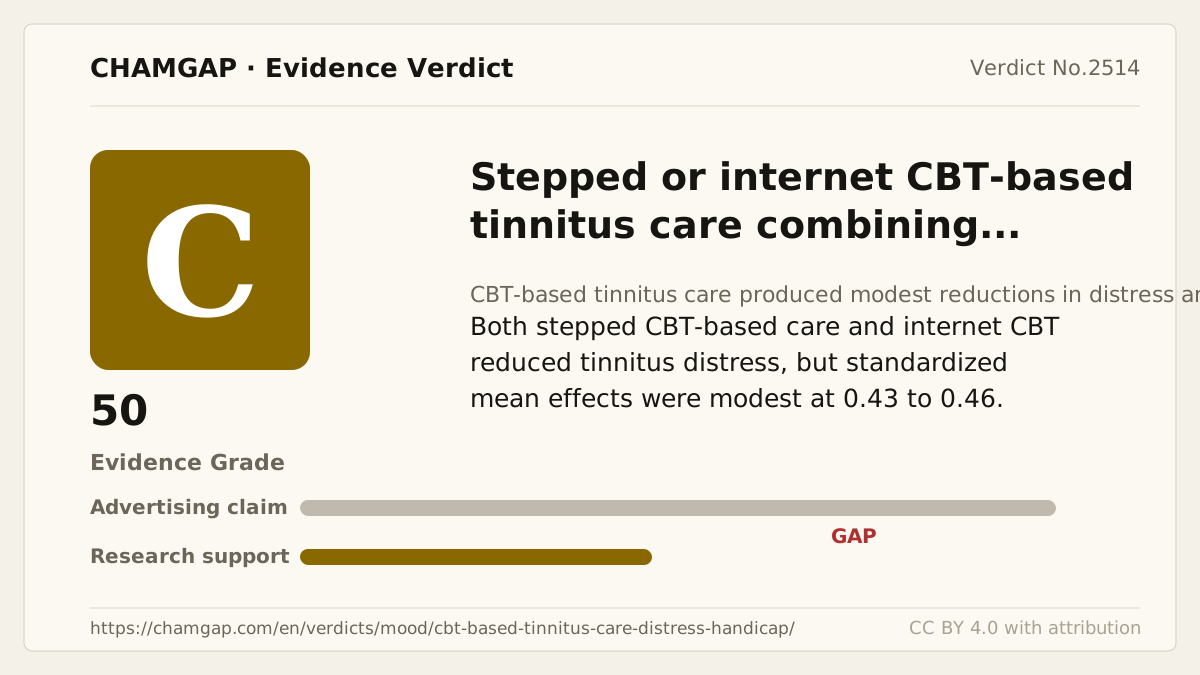
[Chamgap] CBT-based tinnitus care x reduced tinnitus distress and handicap — Evidence Grade C·50. 2 cited sources checked. Source: https://chamgap.com/en/verdicts/mood/cbt-based-tinnitus-care-distress-handicap/ · CC BY 4.0CC BY 4.0 — free to use with attribution; do not distort grades, numbers, or verdict meaning.
What this document does and does not do
Chamgap is an information source. It reports what research has and has not confirmed; it does not tell readers what to take or buy. That decision belongs to readers and, when needed, medical or legal professionals. This verdict reflects literature available up to the search date and may change as new research appears. Nothing here is medical advice.