
Cariprazine,
does it really help with Reduction of depressive symptoms in bipolar I major depressive episodes?
research showsCariprazine is rated C despite a statistically positive symptom effect in bipolar I depression. Earley 2020 randomized 493 participants and analyzed 478 by modified intention to treat; 1.5 mg improved six-week MADRS by 2.5 points versus placebo, adjusted P=.0417, meeting the primary endpoint, while 3 mg missed it with a 1.8-point difference, P=.1051. Evidence comes only from the manufacturer program, mean differences are small, and trials lasted six weeks.
ads claimFast, strong recovery or equal efficacy at every dose overstates average differences of two to four points and hides failed doses and trials.
Useful facts when choosing a product
- The usual bipolar-depression starting dose is 1.5 mg once daily, with some patients increased to 3 mg.
- Long-lived active metabolites can delay the full effect of dose changes and adverse reactions.
Chamgap Semantic Classification Code
Candidate index · review held
UNK.cariprazine.UNK.depressive-symptoms-in-bipolar-i-major-depressive-episodes.reduce.placeboUnknown > Cariprazine > Unknown > depressive symptoms in bipolar I major depressive episodes > Reduction claim > Placebo
An automated migration candidate, not an issued permanent code; exact claim scope remains under review. This machine-generated migration candidate helps retrieval but is not a permanent assignment. The original verdict ID and URL remain authoritative.
What the research actually shows
Earley 2020 randomized 493 participants and analyzed 478 by modified intention to treat. The six-week MADRS primary endpoint succeeded at 1.5 mg, LSMD -2.5 and adjusted P=.0417, but failed at 3 mg, LSMD -1.8 and P=.1051. Durgam 2016 analyzed 571 participants and found LSMD -4.0 (95% CI -6.3 to -1.6) at 1.5 mg. A separate 2024 meta-analysis reported MADRS MD -2.53 (95% CI -3.61 to -1.45) in bipolar I disorder. A different 2019 pooled analysis of registration trials reported response rates of 46.3% versus 35.9% and NNT 10 (95% CI 7 to 21). The two-point between-group threshold cited by CADTH was derived from MDD data and cannot be directly applied to bipolar depression. In Yatham's 233-person trial, low-dose LSMD was -0.7, P=.7408, and high-dose LSMD was 0.0, P=.9961; both missed the week-eight primary endpoint, establishing R0 inconsistency. All drug trials belonged to the manufacturer program. Verdict 760, which is B with 72 points, concerns lurasidone in the same indication; its broader and more consistent randomized evidence explains the different grade, and that evidence was not transferred to cariprazine.
Why this is classified as C (46)
The profile is P, R0, I0, E~, and B1. Positive trials conflict with the null Yatham trial, giving R0. The CADTH two-point threshold derives from MDD rather than an established bipolar-depression standard, so E~ is retained. Manufacturer-only short-term evidence gives C with 46 points.
Counterpoint. A small mean effect can coexist with meaningful response in some individuals, so response and tolerability require follow-up.
Rejudgment record. Cross-check applied — Manufacturer-only short-term evidence with a discordant Yatham trial and no bipolar-specific established MADRS threshold
| Endpoint | P | Symptom or function itself is the target - including patient reports and performance tests |
| Replication | R0 | Trials conflict in direction |
| Independence | I0 | Evidence comes only from manufacturer studies |
| Effect size | E~ | Statistically positive but below the threshold |
Stored derived and displayed grades match; this is not a current recalculation or validity check (C).
Sub-claim grades by effect
This ingredient is marketed for several effects. A single overall grade blends strong and weak claims together, so each effect is graded separately here. The overall grade reflects the strongest disconfirming or core claim.
| Effect (sub-claim) | Grade | Basis |
|---|---|---|
| Reduction in six-week MADRS depressive symptoms | C | Some doses were positive, but mean differences were small. |
| Higher rate of at least 50% MADRS response | C | Pooled response was 46.3% versus 35.9%, NNT 10. |
| Consistent symptom improvement across approved doses | D | A 3-mg arm and an entire trial were null. |
Cross-check — AI research and Codex final gate
Evidence Table
| Study | Design | Sample | Funding | Endpoint | Result | Weight |
|---|---|---|---|---|---|---|
| Earley WR et al. 2020 | Phase 3 double-blind placebo-controlled trial | 493 randomized and 478 analyzed by modified intention to treat | Funded and conducted by Allergan and Gedeon Richter | Change in MADRS at week six | 1.5 mg LSMD -2.5, adjusted P=.0417 met; 3 mg P=.1051 missed | Pivotal dose-inconsistent trial |
| Durgam S et al. 2016 | Double-blind placebo-controlled trial | 571 in intention-to-treat analysis | Funded by Forest Laboratories | Change in MADRS at week six | 1.5 mg LSMD -4.0 (95% CI -6.3 to -1.6); primary endpoint met | Supportive positive trial |
| Yatham LN et al. 2020 | Phase 2 double-blind placebo-controlled trial | 233 randomized | Allergan manufacturer program | Change in MADRS at week eight | Low-dose LSMD -0.7, P=.7408; high-dose LSMD 0.0, P=.9961; week-eight MADRS primary endpoint missed | Discordant evidence establishing R0 |
| Martins-Correia J et al. 2024 | Systematic review and meta-analysis of randomized trials | Nine randomized trials and 4,889 participants overall; bipolar I subgroup analysis | Academic meta-analysis | MADRS change in bipolar I disorder | MD -2.53 (95% CI -3.61 to -1.45) | Mean-effect estimate from a publication separate from the 2019 response-rate analysis |
| Citrome L 2019 | Pooled analysis of placebo-controlled registration trials | Pooled registration trials at approved doses | Analysis of registration-trial data | At least 50% MADRS response | 46.3% versus 35.9%, NNT 10 (95% CI 7 to 21) | Response-rate evidence from a publication separate from the 2024 MADRS MD meta-analysis |
| CADTH 2016 aripiprazole MDD review | Outcome-validity appendix in a clinical review | Based on MDD data | Public CADTH health-technology assessment | Clinically meaningful between-group MADRS difference | A two-point between-group threshold was reported, but it was derived from MDD data | Not directly transferable to bipolar depression; E~ retained |
Receipt — 6 References
All 6 cited sources were verified for existence at the original page (as of 2026-07-24).
Final verification and publication gate: Codex · Evidence date: 2026-07-24 · Corrections: none
Cite this verdict
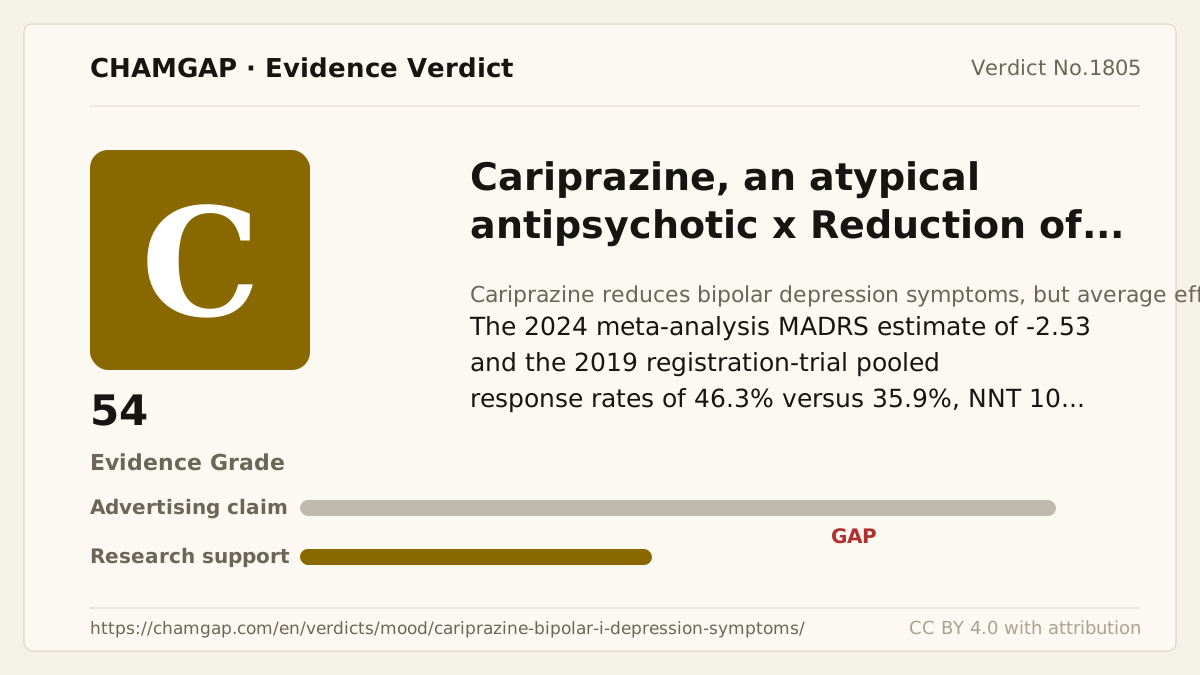
[Chamgap] Cariprazine x fewer bipolar I depression symptoms — Evidence Grade C·46. 6 cited sources checked. Source: https://chamgap.com/en/verdicts/mood/cariprazine-bipolar-i-depression-symptoms/ · CC BY 4.0CC BY 4.0 — free to use with attribution; do not distort grades, numbers, or verdict meaning.
What this document does and does not do
Chamgap is an information source. It reports what research has and has not confirmed; it does not tell readers what to take or buy. That decision belongs to readers and, when needed, medical or legal professionals. This verdict reflects literature available up to the search date and may change as new research appears. Nothing here is medical advice.