
Buspirone,
does it really help with Remission and depressive-symptom improvement as augmentation for major depressive disorder with inadequate SSRI response?
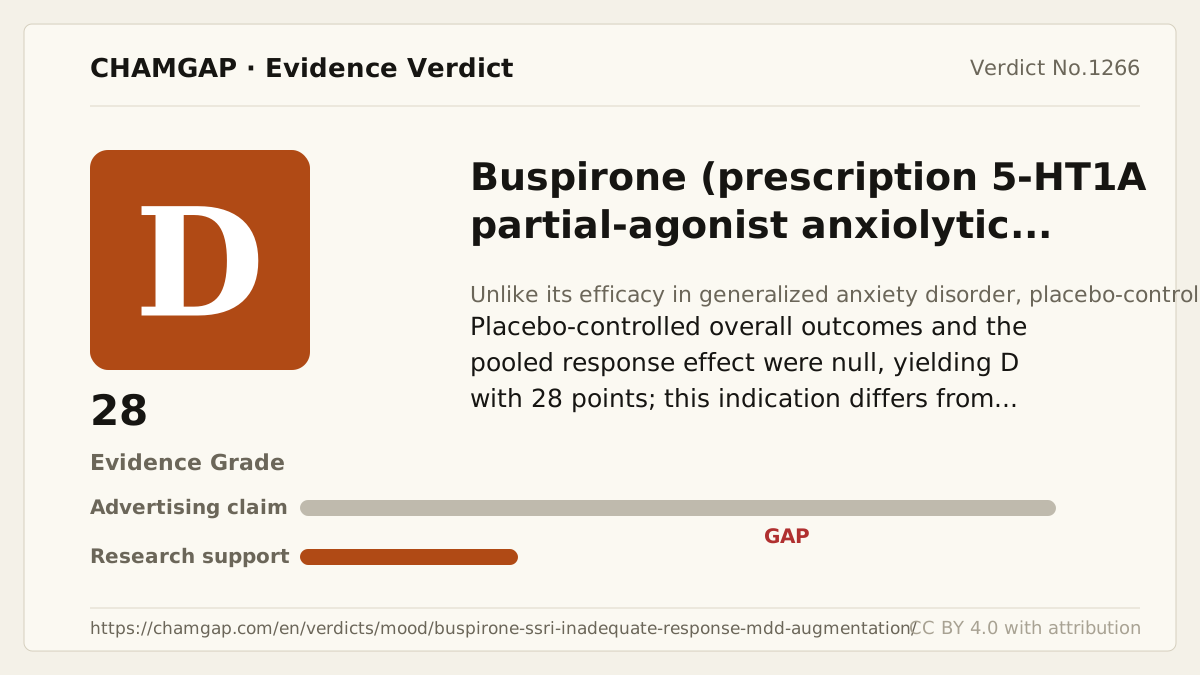
research showsBuspirone augmentation for major depressive disorder with inadequate SSRI response is rated D. A 102-participant double-blind placebo-controlled trial found no superiority on the six-week MADRS outcome in the full group, and a 119-participant placebo-controlled trial likewise failed to establish an efficacy difference between buspirone and placebo augmentation. A 2014 meta-analysis of four 5-HT1A-agonist augmentation trials involving 341 participants found a null response risk ratio of 0.98, while a 2019 Cochrane review found no evidence that buspirone augmentation improved depressive symptoms and rated the evidence as low certainty. Signals at week one and in a severe-depression subgroup were exploratory and do not overturn the failed overall results.
ads claimThe claim that adding buspirone after an SSRI failure raises remission rates generalizes open-label and subgroup signals to a confirmed placebo-controlled effect in all patients. It remains an off-label option that should be considered alongside reassessment of diagnosis, dose, adherence, and better-supported augmentation strategies.
Useful facts when choosing a product
- Buspirone is a prescription 5-HT1A partial-agonist anxiolytic. Its use as SSRI augmentation for major depressive disorder is off-label rather than an approved indication.
- Evidence for anxiety relief in generalized anxiety disorder and evidence for remission in SSRI-resistant major depressive disorder concern different indications. The B grade in record 611 must not be transferred to this claim.
- Buspirone is not an immediate sedative, and neither its dose nor the accompanying antidepressant should be changed or stopped without clinical guidance.
- Dizziness, headache, nausea, nervousness, and drowsiness can occur. Monoamine oxidase inhibitors, other serotonergic drugs, and strong CYP3A4 inhibitors or inducers require prescriber review.
Chamgap Semantic Classification Code
Candidate index · review held
M.buspirone.UNK.remission-and-depressive-symptom-improvement-as-augmentation-for-major-depressive-disorder-with-inadequate-ssri-response.improve.placeboMedicinal interventions > Buspirone > Unknown > Remission and depressive-symptom improvement as augmentation for major depressive disorder with inadequate SSRI response > Improvement claim > Placebo
An automated migration candidate, not an issued permanent code; exact claim scope remains under review. This machine-generated migration candidate helps retrieval but is not a permanent assignment. The original verdict ID and URL remain authoritative.
What the research actually shows
Landén 1998 randomized 119 SSRI nonresponders to buspirone or placebo augmentation and found no four-week efficacy difference. Appelberg 2001 studied 102 participants for six weeks; the overall endpoint was null, with a signal only among those with greater baseline severity. Kishi 2014 pooled four 5-HT1A augmentation trials, three involving buspirone, and found a response risk ratio of 0.98. Davies 2019 reported a buspirone MADRS mean difference of -0.30 points versus continued antidepressant treatment, with a 95% confidence interval from -9.48 to 8.88, and judged the evidence insufficient.
Why this is classified as D (28)
Full-group superiority failed in more than one placebo-controlled trial, and neither the 5-HT1A augmentation meta-analysis nor the Cochrane review verified a response or depressive-symptom benefit. Exploratory severe-subgroup and open-label findings do not establish a reliable overall effect, so the core-null rule gives D with 28 points. Dizziness and headache are assessed separately under safety.
Counterpoint. A clinician may still offer an individualized off-label trial, but improvement cannot readily be separated from natural history, delayed SSRI effects, or expectancy. Continued use should be reassessed with standardized symptoms and function after a defined interval.
Rejudgment record. New verdict — Applied the core-null rule to failed full-group superiority in the 102- and 119-participant placebo-controlled trials, a response risk ratio of 0.98 in the 5-HT1A augmentation meta-analysis, and no depressive-symptom benefit with low certainty in the Cochrane review; exploratory severe-subgroup findings were not used to raise the grade
Sub-claim grades by effect
This ingredient is marketed for several effects. A single overall grade blends strong and weak claims together, so each effect is graded separately here. The overall grade reflects the strongest disconfirming or core claim.
| Effect (sub-claim) | Grade | Basis |
|---|---|---|
| Increased remission in major depressive disorder after inadequate SSRI response | D | Placebo-controlled full-group and pooled response effects were null, and STAR*D was not placebo-controlled. |
| Improved depressive symptoms in major depressive disorder after inadequate SSRI response | D | The Cochrane MADRS estimate was a mean difference of -0.30 points and did not establish benefit. |
| Augmentation benefit in a severe-major-depression subgroup | D | The positive exploratory subgroup in one trial remains unreplicated and followed a failed overall result. |
Cross-check — AI research and Codex final gate
Evidence Table
| Study | Design | Sample | Funding | Endpoint | Result | Weight |
|---|---|---|---|---|---|---|
| Appelberg BG et al. 2001 | Randomized double-blind placebo-controlled augmentation trial | 102 outpatients with a major depressive episode and inadequate SSRI response | Grant support from Bristol-Myers Squibb Finland; one coauthor was company-affiliated | Six-week MADRS, Clinical Global Impression, and visual analogue scales | Signals appeared at week one and in the baseline-MADRS-above-30 subgroup, but the overall endpoint did not differ significantly. | Key direct placebo-controlled trial with a null full-group result |
| Landén M et al. 1998 | Randomized double-blind placebo-controlled augmentation trial | 119 patients with an SSRI-refractory major depressive episode | Supported by Bristol Myers-Squibb Sweden | Four-week depressive-symptom response and safety | The trial failed to demonstrate an efficacy difference between SSRI plus buspirone and SSRI plus placebo. | Independent core placebo-controlled null result |
| Kishi T et al. 2014 | Systematic review and meta-analysis of 5-HT1A partial-agonist randomized trials in major depressive disorder | Four augmentation trials with 365 participants; 341 in the response analysis | Academic research with author conflicts disclosed | Augmentation response, discontinuation, and adverse events | The augmentation response risk ratio was 0.98 with P=0.85, showing no significant effect. | Key pooled null evidence |
| Davies P et al. 2019 Cochrane review | Systematic review of randomized pharmacologic interventions for treatment-resistant depression | Ten randomized trials with 2,731 participants overall; buspirone evidence came from one small comparison | Cochrane and United Kingdom public and academic support | Depressive symptoms, response, remission, and discontinuation | Buspirone augmentation had a MADRS mean difference of -0.30 points (95% CI -9.48 to 8.88), with no evidence of benefit and low certainty. | Updated direct evidence assessment |
Receipt — 4 References
All 4 cited sources were verified for existence at the original page (as of 2026-07-24).
Final verification and publication gate: Codex · Evidence date: 2026-07-24 · Corrections: none
Cite this verdict
[Chamgap] Buspirone x remission and depressive-symptom improvement after inadequate SSRI response in major depressive disorder — Evidence Grade D·28. 4 cited sources checked. Source: https://chamgap.com/en/verdicts/mood/buspirone-ssri-inadequate-response-mdd-augmentation/ · CC BY 4.0CC BY 4.0 — free to use with attribution; do not distort grades, numbers, or verdict meaning.
What this document does and does not do
Chamgap is an information source. It reports what research has and has not confirmed; it does not tell readers what to take or buy. That decision belongs to readers and, when needed, medical or legal professionals. This verdict reflects literature available up to the search date and may change as new research appears. Nothing here is medical advice.