
Long-term antidepressant maintenance,
does it really help with Reduced 52-week depression relapse after remission among patients considering discontinuation?
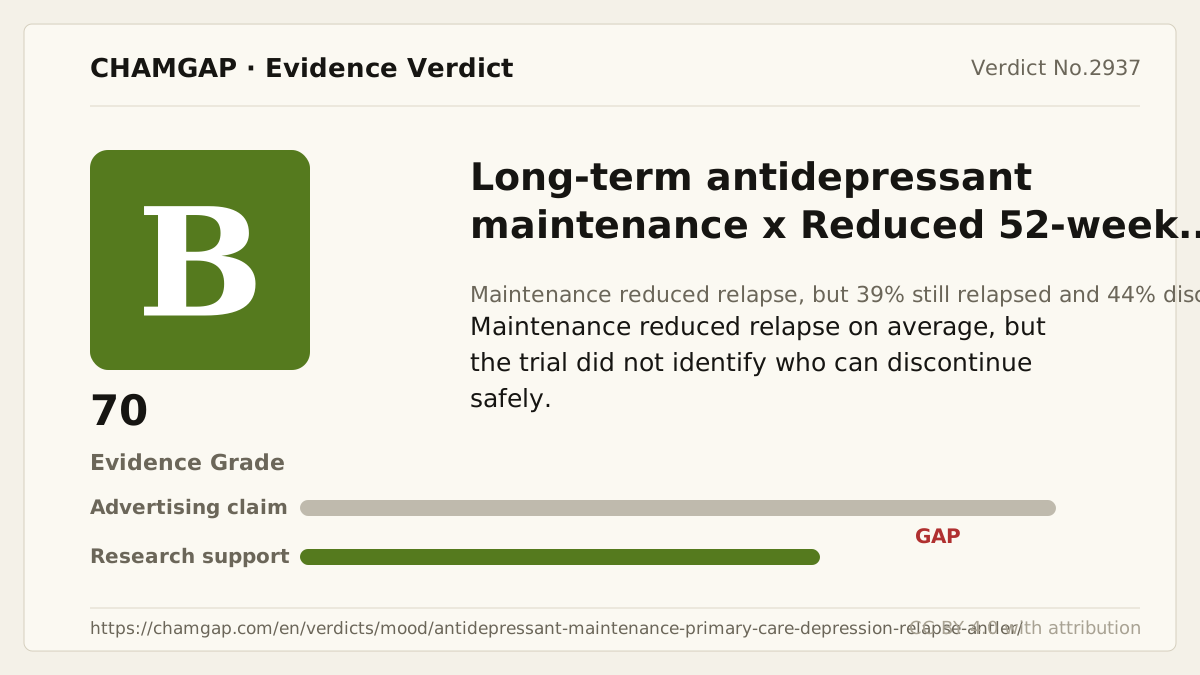
research showsGrade B. In ANTLER, relapse by 52 weeks occurred in 92/238 (39%) with maintenance versus 135/240 (56%) after tapering to placebo, an absolute difference of 17 points; the discontinuation-versus-maintenance HR was 2.06 (95% CI 1.56 to 2.70), P<0.001. Yet 39% relapsed despite maintenance, while 44% discontinued without relapse.
ads claimThe result does not mean everyone on maintenance avoids relapse or everyone who discontinues relapses. Participants used long-term citalopram, fluoxetine, sertraline, or mirtazapine, had at least two previous episodes or at least two years of treatment, and felt well enough to consider stopping. Prior relapse, withdrawal risk, adverse effects, and patient preference belong in an individualized tapering plan.
Useful facts when choosing a product
- ANTLER included citalopram 20 mg, fluoxetine 20 mg, sertraline 100 mg, or mirtazapine 30 mg.
- The discontinuation group tapered over one to two months before switching to matching placebo.
- Neither the NEJM article nor the NIHR HTA report describes donated trial drug or placebo from a pharmaceutical company.
Chamgap Semantic Classification Code
Candidate index · review held
UNK.long-term-antidepressant-maintenance.UNK.depression-relapse-after-remission-considering-discontinuation.reduce.placeboUnknown > Long-term antidepressant maintenance > Unknown > depression relapse after remission considering discontinuation > Reduction claim > Placebo
An automated migration candidate, not an issued permanent code; exact claim scope remains under review. This machine-generated migration candidate helps retrieval but is not a permanent assignment. The original verdict ID and URL remain authoritative.
What the research actually shows
Across 150 UK general practices, 478 adults were randomized to maintenance, 238, or tapering to placebo, 240. The double-blind trial used matching tablets and analyzed time to first relapse over 52 weeks. Ten participants without relapse timing, six maintenance and four discontinuation, were omitted from the primary time-to-event analysis but retained in absolute relapse counts; best- and worst-case missing-data analyses remained directionally consistent. Adherence was 70% versus 52%, and 39% of the discontinuation group restarted an antidepressant prescribed by a clinician before trial end.
Why this is classified as B (70)
A publicly funded double-blind randomized trial found a 17-point absolute reduction in 52-week relapse, but it is the single confirmatory trial for this real-world decision and excluded 10 participants from the primary time-to-event analysis, giving B with 70 points.
Counterpoint. A meta-analysis of 40 studies and 8,890 participants found relapse in 20.9% with maintenance versus 39.7% after placebo switch, OR 0.38 (95% CI 0.33 to 0.43). It pooled heterogeneous post-acute maintenance trials and therefore was not counted as an independent repeat of ANTLER's long-term primary-care discontinuation question.
Rejudgment record. Cross-check applied — Publicly funded double-blind randomized evidence on patient-important relapse, with the complete-case time-to-event limitation incorporated
| Endpoint | P | Symptom or function itself is the target - including patient reports and performance tests |
| Replication | R1 | Single confirmatory trial |
| Independence | I2 | Decisive evidence is publicly or non-profit funded |
| Effect size | E+ | Meets the clinically important threshold |
Stored derived and displayed grades match; this is not a current recalculation or validity check (B).
Sub-claim grades by effect
This ingredient is marketed for several effects. A single overall grade blends strong and weak claims together, so each effect is graded separately here. The overall grade reflects the strongest disconfirming or core claim.
| Effect (sub-claim) | Grade | Basis |
|---|---|---|
| Reduced depression relapse by 52 weeks | B | Rates were 39% versus 56%, an absolute difference of 17 points. |
| Discontinuation inevitably causes relapse | D | Forty-four percent of the discontinuation group did not relapse within 52 weeks. |
| Maintenance completely prevents relapse | D | Thirty-nine percent relapsed despite maintenance. |
Cross-check — AI research and Codex final gate
Evidence Table
| Study | Design | Sample | Funding | Endpoint | Result | Weight |
|---|---|---|---|---|---|---|
| Lewis et al. 2021 ANTLER and the NIHR HTA report of the same trial | Multicenter double-blind placebo-controlled superiority RCT | 478 randomized, 238 maintenance and 240 taper-to-placebo; 468 in the primary time-to-event analysis | NIHR Health Technology Assessment award 13/115/48 and NIHR core support for PRIMENT Clinical Trials Unit; University College London sponsor | Time to first depression relapse within 52 weeks | Relapse 92/238 (39%) versus 135/240 (56%); discontinuation-versus-maintenance HR 2.06 (95% CI 1.56 to 2.70), P<0.001; absolute difference 17 points | Pivotal publicly funded patient-centered evidence; complete-case primary time-to-event analysis |
| Kato et al. 2021 systematic review and meta-analysis | Meta-analysis of 40 antidepressant-maintenance versus placebo-switch studies | 40 studies and 8,890 participants | Research grants from the Ministry of Health, Labour and Welfare of Japan (H29-SEISHIN-ippan-001 and 19GC1012) | Depression relapse | Maintenance 20.9% versus placebo switch 39.7%, OR 0.38 (95% CI 0.33 to 0.43), P<0.00001 | Directionally supportive evidence; not counted as an independent repeat of the ANTLER question |
Receipt — 3 References
All 3 cited sources were verified for existence at the original page (as of 2026-08-26).
Final verification and publication gate: Codex · Evidence date: 2026-08-26 · Corrections: none
Cite this verdict
[Chamgap] Benefit of Antidepressant Maintenance for Reducing 52-Week Depression Relapse After Remission — Evidence Grade B·70. 3 cited sources checked. Source: https://chamgap.com/en/verdicts/mood/antidepressant-maintenance-primary-care-depression-relapse-antler/ · CC BY 4.0CC BY 4.0 — free to use with attribution; do not distort grades, numbers, or verdict meaning.
What this document does and does not do
Chamgap is an information source. It reports what research has and has not confirmed; it does not tell readers what to take or buy. That decision belongs to readers and, when needed, medical or legal professionals. This verdict reflects literature available up to the search date and may change as new research appears. Nothing here is medical advice.