
Alpha-Stim AID home cranial electrotherapy stimulation device,
does it really help with Improved depressive symptoms at 16 weeks in major depressive disorder?
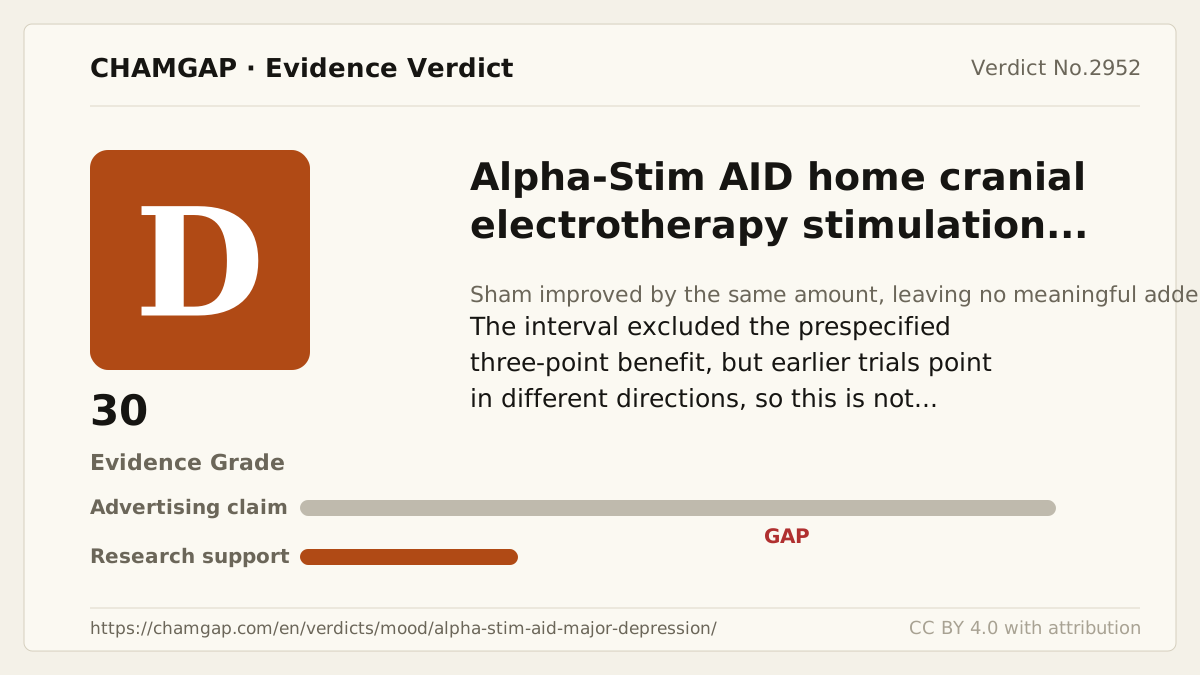
research showsThe grade is D with 30 points. GRID-HDRS-17 changed by -5.9 with active treatment and -6.5 with sham; adjusted active-minus-sham difference was +0.6 (95% CI -1.0 to 2.2), P=0.46. Improvement of about six points in both arms is not a device effect.
ads claimThe claim should remain specific to Alpha-Stim AID in major depression, not all cranial electrotherapy devices. The device was sold privately for about £500.
Useful facts when choosing a product
- The regimen was 100 microamps at 0.5 Hz for one hour daily over eight weeks.
- Both active and sham groups improved by about six points.
- The manufacturer supplied active and sham devices and some study funding.
Chamgap Semantic Classification Code
Candidate index · review held
P.alpha-stim-aid.device.major-depression-symptoms.improve.shamProcedures, devices and tests > Alpha-Stim AID device > Device delivered > Major depressive disorder symptoms > Improvement claim > Sham procedure or device
An automated migration candidate, not an issued permanent code; exact claim scope remains under review. This machine-generated migration candidate helps retrieval but is not a permanent assignment. The original verdict ID and URL remain authoritative.
What the research actually shows
Across 25 English primary-care sites, 236 participants were randomized 118 per arm through an independent web system. Participants, outcome assessors, and the data analyst were masked, and analysis was ITT, but only 200/236 had 16-week observations. NIHR ARC East Midlands supported the study; manufacturer EPI funded excess treatment and health-economic costs and supplied active and sham devices. The protocol stated that the companies had no role in design, collection, analysis, interpretation, or writing. The trial completed follow-up without early stopping.
Why this is classified as D (30)
A precise large sham-controlled trial excluded the prespecified clinical benefit, but earlier comparable findings differ, giving D with 30 points.
Counterpoint. Other waveforms and indications require separate verdicts.
Rejudgment record. Cross-check applied — Precise sham-controlled null result excluding the prespecified three-point benefit, with conflicting prior directions
| Endpoint | P | Symptom or function itself is the target - including patient reports and performance tests |
| Replication | R0 | Trials conflict in direction |
| Independence | I1 | Mixed funding sources |
| Effect size | E0 | Null |
| Precision | C1 | The confidence interval excludes meaningful benefit |
Stored derived and displayed grades match; this is not a current recalculation or validity check (D).
Sub-claim grades by effect
This ingredient is marketed for several effects. A single overall grade blends strong and weak claims together, so each effect is graded separately here. The overall grade reflects the strongest disconfirming or core claim.
| Effect (sub-claim) | Grade | Basis |
|---|---|---|
| Alpha-Stim AID efficacy at 16 weeks in major depression | D | Null in the large sham-controlled trial |
Cross-check — AI research and Codex final gate
Evidence Table
| Study | Design | Sample | Funding | Endpoint | Result | Weight |
|---|---|---|---|---|---|---|
| Morriss R et al. 2023 Alpha-Stim-D | Multicenter double-blind sham-controlled RCT | 236 randomized; 200 observed at 16 weeks | Mixed NIHR and EPI support; manufacturer supplied devices | Change in GRID-HDRS-17 at 16 weeks | +0.6 points (95% CI -1.0 to 2.2), P=0.46 | Pivotal precise null trial |
| Barclay TH et al. 2014 | Randomized sham-controlled trial | 115 participants | Not confirmed | Depression scale at five weeks | Active treatment superior, P=0.001, d=0.78 | Directionally conflicting evidence |
| Treatment-resistant major-depression trial | Randomized controlled trial | 30 participants | Not confirmed | Depressive symptoms | Null | Context from another device |
Receipt — 3 References
All 3 cited sources were verified for existence at the original page (as of 2026-08-26).
Final verification and publication gate: Codex · Evidence date: 2026-08-26 · Corrections: none
Cite this verdict
[Chamgap] No Benefit of Alpha-Stim AID for 16-Week Depressive Symptoms — Evidence Grade D·30. 3 cited sources checked. Source: https://chamgap.com/en/verdicts/mood/alpha-stim-aid-major-depression/ · CC BY 4.0CC BY 4.0 — free to use with attribution; do not distort grades, numbers, or verdict meaning.
What this document does and does not do
Chamgap is an information source. It reports what research has and has not confirmed; it does not tell readers what to take or buy. That decision belongs to readers and, when needed, medical or legal professionals. This verdict reflects literature available up to the search date and may change as new research appears. Nothing here is medical advice.