
Vitamin D3,
does it really help with Increased total and free testosterone and improved sexual function in otherwise healthy men?
research showsVitamin D3 is rated F because later randomized evidence repeatedly refuted the early claim that it increases total or free testosterone or sexual function in otherwise healthy men. A 2011 secondary analysis of 54 overweight men reported higher total and free testosterone, but it was judged at high risk of bias, and later trials by Lerchbaum, Zittermann, Heijboer, Jorde, Ulrich, and others repeatedly found null results. A 2024 meta-analysis of 17 randomized trials reported a small total-testosterone increase of 0.38 nmol/L with I² 67%, while free testosterone was null. A stricter 2026 meta-analysis was null for total testosterone across 11 comparisons and 703 participants, MD 0.47 nmol/L (95% CI -0.50 to 1.44), and for calculated free testosterone across three comparisons and 279 participants, MD -0.0096 nmol/L (95% CI -0.0525 to 0.0332). The heterogeneous 2024 signal places the verdict at the upper end of F, with 18 points.
ads claimMarketing turns correlations between low vitamin D and low testosterone, or the early 54-person report, into natural testosterone-booster and libido claims. Raising 25-hydroxyvitamin D after correcting deficiency does not itself show clinically important increases in total or free testosterone, erections, or desire.
Useful facts when choosing a product
- Vitamin D3 doses are labeled in international units and micrograms, with 1 microgram equal to 40 international units; serving size and schedule must be converted to a daily amount.
- The general adult tolerable upper intake level is 4,000 international units per day from total intake, although clinicians may use different temporary doses for documented deficiency; this is not a testosterone-enhancement dose.
- As a fat-soluble vitamin, excessive vitamin D can accumulate and cause hypercalcemia, nausea, thirst, polyuria, kidney stones or kidney injury, and arrhythmia.
- Deficiency and treatment goals require consideration of serum 25-hydroxyvitamin D, calcium, kidney function, medical conditions, and medicines, and supplementation does not replace evaluation or treatment of male sexual dysfunction.
Chamgap Semantic Classification Code
Candidate index · review held
S.vitamin-d3.UNK.total-and-free-testosterone-and-improved-sexual-function-in-otherwise-healthy-men.increase.placeboSupplements and nutraceuticals > Vitamin D3 (cholecalciferol) > Unknown > total and free testosterone and improved sexual function in otherwise healthy men > Increase claim > Placebo
An automated migration candidate, not an issued permanent code; exact claim scope remains under review. This machine-generated migration candidate helps retrieval but is not a permanent assignment. The original verdict ID and URL remain authoritative.
What the research actually shows
The positive 2011 report was a hormone secondary analysis in only 54 men who completed a 200-person weight-loss trial, with 31 receiving vitamin D and 23 placebo. The 2019 Graz Vitamin D and Testosterone trial randomized 100 healthy middle-aged men with low total testosterone and 25-hydroxyvitamin D below 75 nmol/L; 94 completed the trial, but mass-spectrometry total testosterone and all secondary androgen outcomes were null. The 2024 synthesis of 17 trials and 1,774 men reported total-testosterone WMD 0.38 but free-testosterone WMD 0.00. The 2026 review handled assay compatibility and duplicate comparisons more conservatively and reported total-testosterone MD 0.47 (95% CI -0.50 to 1.44) and calculated-free-testosterone MD -0.0096 (95% CI -0.0525 to 0.0332). No adequate placebo-controlled sexual-function trial in healthy men was identified.
Why this is classified as F (18)
The early positive 54-person Pilz secondary analysis was at high risk of bias, and subsequent trials by Lerchbaum, Zittermann, Heijboer, Jorde, Ulrich, and others repeatedly refuted it. The 2026 meta-analysis was null across 11 total-testosterone comparisons with 703 participants and three calculated-free-testosterone comparisons with 279 participants, while adequate healthy-men sexual-function trials are absent. The small heterogeneous total-testosterone signal in the 2024 meta-analysis places the verdict at the upper end of F, with 18 points; deficiency treatment and high-dose toxicity remain separate safety matters.
Counterpoint. Documented vitamin D deficiency can be treated for bone, muscle, and calcium-metabolism goals. Low testosterone or sexual dysfunction still calls for repeated morning testing and evaluation of medicines, obesity, sleep apnea, depression, vascular disease, and endocrine causes; evidence does not support substituting vitamin D3 alone.
Rejudgment record. Cross-verification incorporated — Applied F because subsequent randomized trials by Lerchbaum, Zittermann, Heijboer, Jorde, Ulrich, and others, together with the 2026 meta-analysis of 11 total-testosterone comparisons with 703 participants and three calculated-free-testosterone comparisons with 279 participants, repeatedly refuted the high-risk 2011 Pilz positive secondary analysis; placed the score at the upper end of F because the heterogeneous 2024 meta-analysis reported a small total-testosterone signal
Sub-claim grades by effect
This ingredient is marketed for several effects. A single overall grade blends strong and weak claims together, so each effect is graded separately here. The overall grade reflects the strongest disconfirming or core claim.
| Effect (sub-claim) | Grade | Basis |
|---|---|---|
| Increased total testosterone in otherwise healthy men | F | Multiple later trials and the 2026 synthesis of 11 comparisons with 703 participants repeatedly refuted the early Pilz signal, while the small positive 2024 result was heterogeneous. |
| Increased free testosterone in otherwise healthy men | F | Both the 2024 meta-analysis at WMD 0.00 and the 2026 method-compatible calculated-free-testosterone analysis of three comparisons with 279 participants were null. |
| Improved sexual function in otherwise healthy men | F | Positive data come from a small retrospective before-after study in deficient men, with no adequate placebo-controlled trial in healthy men to support the enhancement claim. |
Cross-check — AI research and Codex final gate
Evidence Table
| Study | Design | Sample | Funding | Endpoint | Result | Weight |
|---|---|---|---|---|---|---|
| Paez-Allendes L et al. 2026 | Systematic review and meta-analysis of randomized trials | 27 studies in qualitative synthesis; 11 total-testosterone comparisons with 703 participants and three calculated-free-testosterone comparisons with 279 participants | The article reported no external funding | Total testosterone, sex-hormone-binding globulin, free androgen index, and calculated free or bioactive testosterone | There was no clear effect on total testosterone, MD 0.47 nmol/L (95% CI -0.50 to 1.44), or calculated free testosterone, MD -0.0096 nmol/L (95% CI -0.0525 to 0.0332). | Latest key synthesis with null results |
| Abu-Zaid A et al. 2024 | Systematic review and meta-analysis of randomized trials | 17 trials with 1,774 men | No external research funding; institutional support for article-processing charges | Total and free testosterone and reproductive hormones | Total testosterone was slightly positive, WMD 0.38 (95% CI 0.06 to 0.70), with I² 67%, while free testosterone was null at WMD 0.00. | Conflicting synthesis |
| Lerchbaum E et al. 2019 | Randomized double-blind placebo-controlled trial | 100 healthy men with low testosterone; 94 completed | Supported by the Austrian National Bank OeNB Jubilaeumsfonds, Project 14846 | Mass-spectrometry total testosterone and free testosterone, free androgen index, and sex-hormone-binding globulin | Vitamin D3 20,000 IU/week for 12 weeks had no effect on total testosterone or any secondary androgen marker. | Key direct null randomized trial |
| Tirabassi G et al. 2018 | Retrospective cross-sectional and before-after longitudinal study | 114 men; a 41-person before-after supplementation subsample | No conflicts declared; funding not reported in the abstract | International Index of Erectile Function outcomes and total and free testosterone | Erectile function and hormones improved after supplementation, but the study was not randomized or placebo-controlled and other sexual-function domains were nonsignificant. | Positive sexual-function signal with major design limitations |
Receipt — 4 References
All 4 cited sources were verified for existence at the original page (as of 2026-07-21).
Final verification and publication gate: Codex · Evidence date: 2026-07-21 · Corrections: none
Cite this verdict
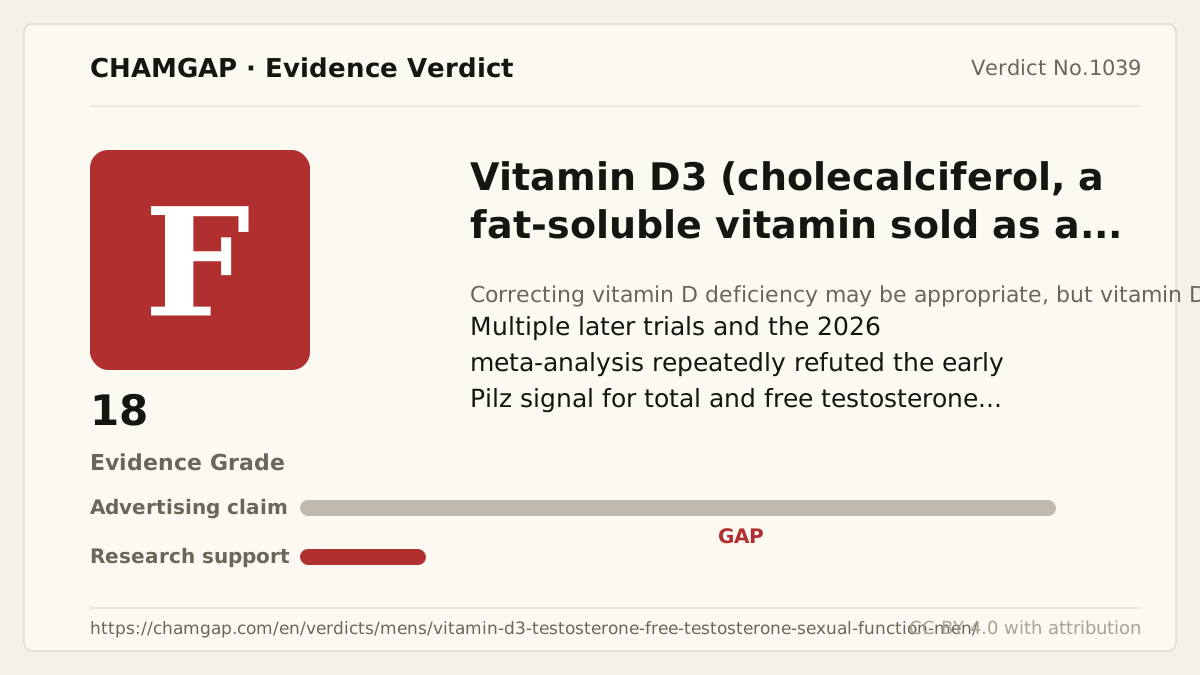
[Chamgap] Vitamin D3 x increased total and free testosterone and improved sexual function in healthy men — Evidence Grade F·18. 4 cited sources checked. Source: https://chamgap.com/en/verdicts/mens/vitamin-d3-testosterone-free-testosterone-sexual-function-men/ · CC BY 4.0CC BY 4.0 — free to use with attribution; do not distort grades, numbers, or verdict meaning.
What this document does and does not do
Chamgap is an information source. It reports what research has and has not confirmed; it does not tell readers what to take or buy. That decision belongs to readers and, when needed, medical or legal professionals. This verdict reflects literature available up to the search date and may change as new research appears. Nothing here is medical advice.