
Urinary phthalate metabolites,
does it really help with Changes in sperm concentration, total count, motility, and morphology?
research showsThe grade is C with 50 points. In the prospective LIFE cohort, 473 of 501 men provided baseline urine and semen, 378 provided a second semen sample about one month later, and 375 had complete covariates. Some metabolite-semen associations were reported, but metabolite-specific coefficients and confidence intervals could not be confirmed from the original table, so effect magnitude could not be established. Testing 14 metabolites across 34 semen measures was not multiplicity-adjusted.
ads claimA urinary biomarker integrates food, plastics, indoor dust, personal-care products, and other sources. This is an interpretation from a biomarker design that did not directly measure exposure sources, not a direct sentence from the paper. It cannot be rewritten as evidence that personal-care products caused poor semen quality or that phthalates caused infertility. Verdict 2179 is C with 56 points and concerns food-contact plastics and IVF pregnancy and live birth, a different exposure attribution and endpoint.
Useful facts when choosing a product
- Fourteen metabolites were measured in one baseline urine specimen.
- A total of 473 men provided baseline semen and 378 provided a second sample.
- The complete-covariate analysis included 375 men.
- Urinary metabolites integrate multiple exposure sources rather than one product category.
Chamgap Semantic Classification Code
Candidate index · review held
UNK.fourteen-urinary-phthalate-metabolites.UNK.changes-in-sperm-concentration-total-count-motility-and-morphology.assess.UNKUnknown > Fourteen urinary phthalate metabolites > Unknown > Changes in sperm concentration, total count, motility, and morphology > Association or change assessment > Unknown
An automated migration candidate, not an issued permanent code; exact claim scope remains under review. This machine-generated migration candidate helps retrieval but is not a permanent assignment. The original verdict ID and URL remain authoritative.
What the research actually shows
Bloom and colleagues prospectively followed 501 male partners of couples trying to conceive. Of them, 473 provided baseline urine and semen, 378 provided a second semen sample about one month later, and 375 had complete covariates. Urinary phthalates were measured once at baseline; mixed models used up to two semen samples. Adjustment included urine creatinine, age, BMI, smoking defined by serum cotinine, race, income, recruitment site, and abstinence time. The work was funded by the U.S. NICHD Intramural Research Program, and the authors reported no competing financial interests.
Why this is classified as C (50)
A publicly funded prospective cohort is limited by surrogate outcomes, one exposure measure, and metabolite-specific coefficients and intervals that could not be confirmed from the original table, giving C with 50 points. Uncorrected multiplicity is described without double counting.
Counterpoint. Adverse signals across several metabolites support exposure-reduction research, but this study did not measure pregnancy or live birth.
Rejudgment record. Cross-check applied — The LIFE design, analysis counts, one urine and up to two semen measurements, adjustment set, public funding, unavailable metabolite-specific coefficients and confidence intervals, and uncorrected multiplicity were applied
| Endpoint | S | Surrogate marker - laboratory or imaging measures |
| Replication | R1 | Single confirmatory trial |
| Independence | I2 | Decisive evidence is publicly or non-profit funded |
| Effect size | EX | The clinical size of the effect could not be judged |
Stored derived and displayed grades match; this is not a current recalculation or validity check (C).
Sub-claim grades by effect
This ingredient is marketed for several effects. A single overall grade blends strong and weak claims together, so each effect is graded separately here. The overall grade reflects the strongest disconfirming or core claim.
| Effect (sub-claim) | Grade | Basis |
|---|---|---|
| Lower sperm counts, concentration, and morphology | C | Selected adverse associations appeared for MCMHP, MEHHP, MBzP, and MNP. |
| Lower sperm motility | C | Some associations were reported, but metabolite-specific coefficients and confidence intervals could not be confirmed. |
| Infertility or reduced live birth | ? | This study did not measure pregnancy or live birth. |
Cross-check — AI research and Codex final gate
Evidence Table
| Study | Design | Sample | Funding | Endpoint | Result | Weight |
|---|---|---|---|---|---|---|
| Bloom MS et al. 2015 LIFE | Prospective cohort of male partners from couples in the general population | 501 enrolled; 473 provided baseline urine and semen; 378 provided repeat semen; 375 had complete covariates | Public funding from the U.S. NICHD Intramural Research Program; no competing interests reported | Thirty-four semen measures including concentration, total count, motility, and morphology | Some metabolite-semen associations were reported, but metabolite-specific coefficients and confidence intervals could not be confirmed from the original table; testing across 14 metabolites and 34 measures was not multiplicity-adjusted. | Decisive publicly funded prospective observational evidence |
Receipt — 1 References
All 1 cited sources were verified for existence at the original page (as of 2026-08-05).
Final verification and publication gate: Codex · Evidence date: 2026-08-05 · Corrections: none
Cite this verdict
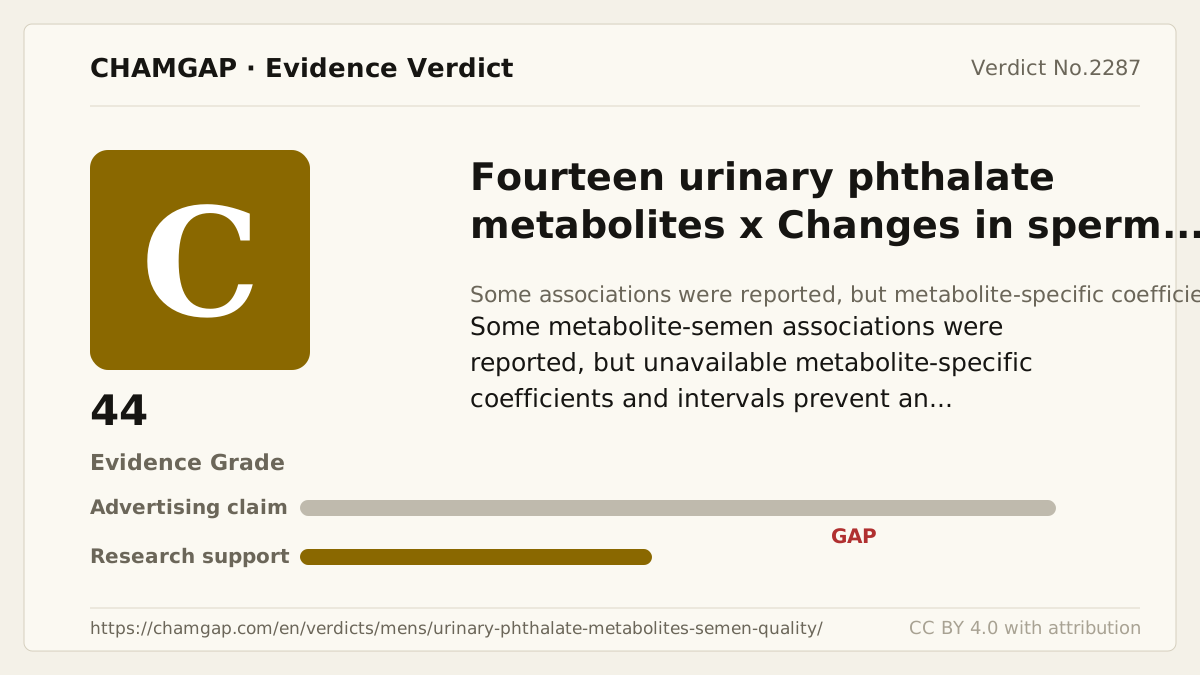
[Chamgap] Urinary phthalate metabolites x semen parameters — Evidence Grade C·50. 1 cited sources checked. Source: https://chamgap.com/en/verdicts/mens/urinary-phthalate-metabolites-semen-quality/ · CC BY 4.0CC BY 4.0 — free to use with attribution; do not distort grades, numbers, or verdict meaning.
What this document does and does not do
Chamgap is an information source. It reports what research has and has not confirmed; it does not tell readers what to take or buy. That decision belongs to readers and, when needed, medical or legal professionals. This verdict reflects literature available up to the search date and may change as new research appears. Nothing here is medical advice.