
Transurethral resection of the prostate,
does it really help with Prevention of long-term treatment failure, including urinary retention and crossover to invasive treatment, in moderately symptomatic benign prostatic hyperplasia?
research showsTURP is rated B because randomized evidence shows less long-term composite treatment failure and better symptoms than watchful waiting in moderately symptomatic benign prostatic hyperplasia. In the 556-participant Veterans Affairs trial, three-year failures numbered 23 with surgery and 47 with watchful waiting, for a relative risk of 0.48, and five-year failure rates were 10% versus 21%. Urinary retention was one component of a composite rather than a separately established benefit, and the old trial predates modern medicines, laser surgery, and minimally invasive alternatives, so grade A is not justified.
ads claimProcedure descriptions can imply that TURP certainly prevents retention and is best for every prostate size. The evidence supports lower composite failure and better symptoms in selected men with moderate symptoms, while prostate size, bleeding risk, and preference to preserve ejaculation may favor another approach.
Useful facts when choosing a product
- TURP passes a resectoscope through the urethra and electrically removes transition-zone prostate tissue that obstructs urine flow; the tissue can be examined histologically.
- A urologist considers it for bothersome moderate-to-severe symptoms, failed medical therapy, or complications such as recurrent retention, infection, bladder stones, or threatened renal function.
- Contemporary alternatives include monopolar or bipolar TURP, HoLEP, photovaporization, water-vapor therapy, and prostatic urethral lift, with selection influenced by prostate size, anticoagulation, and sexual-function preferences.
- Bleeding, infection, temporary voiding difficulty, urethral stricture, incontinence, and retrograde ejaculation can occur; monopolar surgery rarely causes TUR syndrome.
Chamgap Semantic Classification Code
Candidate index · review held
P.transurethral-resection-of-the-prostate.procedural.long-term-treatment-failure-including-urinary-retention-and-crossover-to-invasive-treatment-in-moderately-symptomatic-benign-prostatic-hyperplasia.prevent.UNKProcedures, devices and tests > Transurethral resection of the prostate > Procedural > long-term treatment failure, including urinary retention and crossover to invasive treatment, in moderately symptomatic benign prostatic hyperplasia > Occurrence-prevention claim > Unknown
An automated migration candidate, not an issued permanent code; exact claim scope remains under review. This machine-generated migration candidate helps retrieval but is not a permanent assignment. The original verdict ID and URL remain authoritative.
What the research actually shows
The Veterans Affairs cooperative trial randomized 556 men older than 54 years with moderate BPH symptoms to transurethral surgery or watchful waiting. At a mean 2.8 years, treatment failures numbered 23 versus 47, and urinary symptoms, bother, interference with daily activities, and peak flow all favored surgery. Five-year follow-up reported treatment failure of 10% versus 21% and crossover to surgery in 36% of the watchful-waiting group. Current AUA guidance continues to offer TURP as a surgical option for LUTS attributed to BPH, but guideline status alone was not treated as grade A evidence.
Why this is classified as B (72)
A large multicenter randomized trial and five-year follow-up showed composite treatment failure of 10% versus 21% with improved symptoms and flow. A composite rather than isolated retention endpoint, an old watchful-waiting comparator, contemporary alternatives, and surgical harms support B with 72 points.
Counterpoint. Watchful waiting or medication can be reasonable when symptoms are tolerable and complication risk is low. Recurrent retention, renal impairment, bladder stones, or infection also create harms from delaying effective intervention.
Rejudgment record. New verdict — Accepted reduced composite failure and improved symptoms in the Veterans Affairs multicenter randomized trial and five-year follow-up, while applying the B ceiling for a composite rather than component-specific retention endpoint, enrollment in the 1980s with watchful waiting as comparator, and availability of modern medical, laser, and minimally invasive alternatives
Sub-claim grades by effect
This ingredient is marketed for several effects. A single overall grade blends strong and weak claims together, so each effect is graded separately here. The overall grade reflects the strongest disconfirming or core claim.
| Effect (sub-claim) | Grade | Basis |
|---|---|---|
| Reduction in five-year composite treatment failure | B | Rates were 10% versus 21% in the original randomized cohort, but the endpoint combined several clinical and symptom components. |
| Reduction in progression events including retention and crossover to invasive treatment | B | Crossover to surgery was common in the watchful-waiting group, but the component-specific effect on retention was not separately established. |
| Improvement in urinary symptoms, bother, and flow | B | Three- and five-year follow-up consistently favored surgery, but the evidence uses an old watchful-waiting comparator. |
Cross-check — AI research and Codex final gate
Evidence Table
| Study | Design | Sample | Funding | Endpoint | Result | Weight |
|---|---|---|---|---|---|---|
| Wasson JH et al. Veterans Affairs Cooperative Study 1995 | Multicenter randomized trial of TURP versus watchful waiting | 556 men with moderately symptomatic BPH; 280 assigned to surgery and 276 to watchful waiting | United States Department of Veterans Affairs cooperative study | Composite failure including death, retention, high residual volume, bladder calculus, incontinence, high symptom score, or doubled creatinine | At a mean 2.8 years, failures numbered 23 with TURP and 47 with watchful waiting, for a relative risk of 0.48 (95% CI 0.30 to 0.77). | Key direct clinical randomized trial |
| Flanigan RC et al. Veterans Affairs Cooperative Study five-year follow-up 1998 | Five-year follow-up of the original randomized cohort | 556 men from the original trial | United States Department of Veterans Affairs cooperative study | Five-year composite failure, symptoms, and crossover to surgery | Treatment failure was 10% with surgery versus 21% with watchful waiting, and 36% of the watchful-waiting group crossed over to surgery within five years. | Key long-term durability evidence |
| Lerner LB et al. AUA guideline Part II 2021 | Surgical guideline based on systematic evidence review | Synthesis of surgical literature for LUTS attributed to BPH | American Urological Association | Symptoms, urinary flow, retreatment, and surgical harms | Retained TURP as a treatment option for LUTS attributed to BPH and the historical reference for comparing procedures. | Contemporary practice-context support |
Receipt — 3 References
All 3 cited sources were verified for existence at the original page (as of 2026-07-23).
Final verification and publication gate: Codex · Evidence date: 2026-07-23 · Corrections: none
Cite this verdict
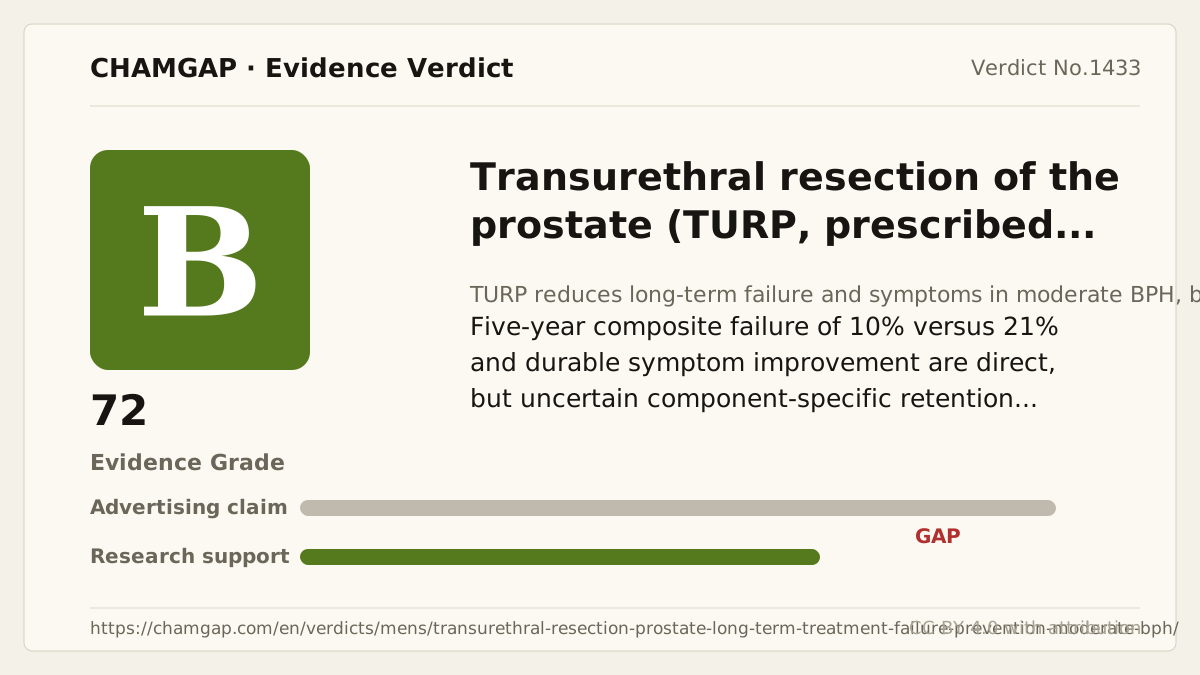
[Chamgap] Transurethral resection of the prostate x prevention of long-term treatment failure in moderate benign prostatic hyperplasia — Evidence Grade B·72. 3 cited sources checked. Source: https://chamgap.com/en/verdicts/mens/transurethral-resection-prostate-long-term-treatment-failure-prevention-moderate-bph/ · CC BY 4.0CC BY 4.0 — free to use with attribution; do not distort grades, numbers, or verdict meaning.
What this document does and does not do
Chamgap is an information source. It reports what research has and has not confirmed; it does not tell readers what to take or buy. That decision belongs to readers and, when needed, medical or legal professionals. This verdict reflects literature available up to the search date and may change as new research appears. Nothing here is medical advice.