
Silodosin,
does it really help with Improvement of IPSS, urinary flow, voiding discomfort, and quality of life in men with benign prostatic hyperplasia?
research showsSilodosin is rated B because it is a prescription medicine that reduces IPSS and voiding discomfort and modestly increases maximum urinary flow in men with lower urinary tract symptoms associated with benign prostatic hyperplasia. A meta-analysis of four trials and 2,504 participants found mean advantages over placebo of 2.78 IPSS points, 1.17 mL/s in maximum flow, and 0.42 quality-of-life points. A 2017 Cochrane review also found a short-term symptom-score mean difference of -2.65 versus placebo, but rated certainty as low and judged the quality-of-life difference potentially too small to be clinically important. Trials were mostly 12 weeks, IPSS is subjective, development-program studies dominate, and no benefit on prostate shrinkage, urinary retention, or surgery prevention was established, so the grade is not A. Unlike pumpkin seed or pygeum supplements rated C, silodosin is an active drug with repeated trials; its evidence is broader than beta-sitosterol rated B, but it remains symptom relief rather than prostate reduction.
ads claimClaims that silodosin shrinks the prostate, corrects the obstruction at its source, or works selectively without ejaculatory effects are exaggerated. It relaxes smooth muscle in the prostate and urethra for rapid symptom relief, but this verdict does not establish reduced prostate volume or long-term prevention of retention or surgery. Reduced or absent ejaculation is especially common because of its selectivity.
Useful facts when choosing a product
- Silodosin is a prescription drug that selectively blocks alpha-1A receptors in the prostate and bladder neck to reduce smooth-muscle tone. It does not shrink prostate tissue like a 5-alpha-reductase inhibitor.
- A common regimen is a total of 8 mg daily with food, depending on country and kidney function, and dose reduction may be required in moderate renal impairment. The prescription and product label take priority.
- Reduced or absent semen during orgasm is the characteristic adverse effect and is usually reversible after discontinuation. Dizziness, orthostatic hypotension, and nasal congestion can also occur, and caution is needed with blood-pressure medicines or phosphodiesterase type 5 inhibitors.
- Current or previous exposure is associated with intraoperative floppy iris syndrome during cataract surgery. Patients must tell their ophthalmologist before cataract surgery or eye care, and stopping the drug on their own does not necessarily remove the risk.
Chamgap Semantic Classification Code
Candidate index · review held
M.silodosin.UNK.ipss-urinary-flow-voiding-discomfort-and-quality-of-life-with-benign-prostatic-hyperplasia.improve.MULTIMedicinal interventions > Silodosin > Unknown > IPSS, urinary flow, voiding discomfort, and quality of life with benign prostatic hyperplasia > Improvement claim > Multiple: primary unresolved
An automated migration candidate, not an issued permanent code; exact claim scope remains under review. This machine-generated migration candidate helps retrieval but is not a permanent assignment. The original verdict ID and URL remain authoritative.
What the research actually shows
Kawabe and colleagues in 2006 assigned 457 Japanese men to silodosin, tamsulosin, or placebo for 12 weeks and found improvement in IPSS and quality of life. Chapple and colleagues in 2011 randomized 955 men across 11 European countries to silodosin 8 mg, tamsulosin 0.4 mg, or placebo. IPSS, storage and voiding subscores, and quality of life improved, but the maximum-flow difference from placebo was not significant. The four-trial, 2,504-participant meta-analysis by Ding and colleagues reported placebo-adjusted changes of -2.78 in IPSS, -0.42 in quality of life, and +1.17 mL/s in maximum flow. A Cochrane review of 19 studies and 4,295 men found a placebo-adjusted IPSS difference of -2.65 with low-certainty evidence and judged the quality-of-life difference of -0.42 potentially not clinically important; sexual adverse effects were more frequent than with placebo or other alpha blockers.
Why this is classified as B (68)
Thousands of participants in repeated placebo- and active-controlled trials and meta-analyses show improvements in IPSS, voiding subscores, and maximum urinary flow, supporting B. Cochrane found a placebo-adjusted IPSS difference of -2.65 points with low-certainty evidence and a quality-of-life difference of -0.42 that may not be clinically important. Flow improved by about 1.2 mL/s and follow-up was mostly 12 weeks. The combination of a direct symptom endpoint and objective flow avoids the subjective-only C ceiling, but prostate shrinkage and long-term prevention of retention or surgery remain unproven, giving 68 points.
Counterpoint. Watchful waiting and lifestyle measures may be appropriate for mild, minimally bothersome symptoms. A large prostate or high progression risk may call for a 5-alpha-reductase inhibitor or another strategy, while retention, repeated infection, or kidney complications despite medication require surgical assessment.
Rejudgment record. Cross-check reflected — Retained B for repeated improvements in IPSS, voiding symptoms, and maximum flow across placebo- and active-controlled trials and meta-analyses, while reflecting Cochrane's low-certainty placebo-adjusted IPSS difference of -2.65, a potentially clinically trivial quality-of-life difference of -0.42, 12-week-centered follow-up, and absent long-term disease-modification evidence, resulting in 68 points
Sub-claim grades by effect
This ingredient is marketed for several effects. A single overall grade blends strong and weak claims together, so each effect is graded separately here. The overall grade reflects the strongest disconfirming or core claim.
| Effect (sub-claim) | Grade | Basis |
|---|---|---|
| Improvement of IPSS and voiding discomfort related to benign prostatic hyperplasia | B | Repeated placebo-controlled trials were positive, but the mean advantage was about 2.7 points and evidence was mostly 12 weeks. |
| Improvement of maximum urinary flow related to benign prostatic hyperplasia | B | The pooled effect was positive at about +1.17 mL/s, but the large European trial did not differ significantly from placebo. |
| Improvement of urinary-symptom-related quality of life | B | A statistical improvement exists, but the Cochrane estimate of MD -0.42 may be clinically small. |
Cross-check — AI research and Codex final gate
Evidence Table
| Study | Design | Sample | Funding | Endpoint | Result | Weight |
|---|---|---|---|---|---|---|
| Kawabe K et al. 2006 | Three-arm randomized double-blind placebo- and active-controlled phase III trial | 457 Japanese men with benign prostatic hyperplasia | Development trial; funding source not clearly identified in the abstract record | Twelve-week IPSS, quality of life, and maximum urinary flow | IPSS changes were -8.3 with silodosin, -6.8 with tamsulosin, and -5.3 with placebo, and quality of life also improved versus placebo. | Key direct placebo-controlled trial |
| Chapple CR et al. 2011 | International multicenter randomized double-blind placebo- and active-controlled trial | 955 men in 11 countries; 381 silodosin, 384 tamsulosin, and 190 placebo | Development trial; funding source not clearly identified in the abstract record | Twelve-week IPSS, storage and voiding subscores, quality of life, and maximum flow | The IPSS difference versus placebo was -2.3 points; symptoms and quality of life improved, but maximum flow did not differ significantly. | Large international direct trial with a limitation on the flow endpoint |
| Jung JH et al. 2017 Cochrane review | Cochrane systematic review of randomized trials | 19 studies and 4,295 men; four placebo-comparison studies and 1,968 men for symptoms | Academic Cochrane review; no external funding reported | Urologic symptoms, quality of life, discontinuation, and cardiovascular and sexual adverse events | The symptom-score mean difference versus placebo was -2.65 with low certainty; quality-of-life benefit was small and sexual adverse events increased. | Key assessment of certainty and effect-size limitations |
Receipt — 5 References
All 5 cited sources were verified for existence at the original page (as of 2026-07-21).
Final verification and publication gate: Codex · Evidence date: 2026-07-21 · Corrections: none
Cite this verdict
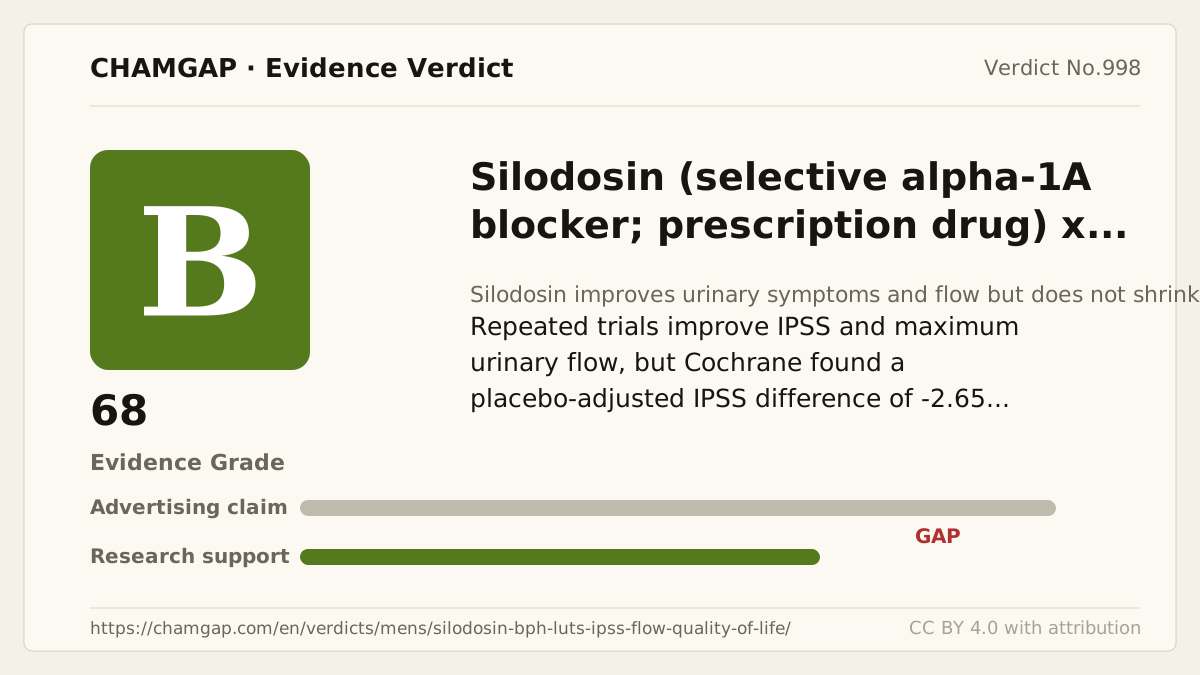
[Chamgap] Silodosin x improved urinary symptoms, flow, and quality of life in benign prostatic hyperplasia — Evidence Grade B·68. 5 cited sources checked. Source: https://chamgap.com/en/verdicts/mens/silodosin-bph-luts-ipss-flow-quality-of-life/ · CC BY 4.0CC BY 4.0 — free to use with attribution; do not distort grades, numbers, or verdict meaning.
What this document does and does not do
Chamgap is an information source. It reports what research has and has not confirmed; it does not tell readers what to take or buy. That decision belongs to readers and, when needed, medical or legal professionals. This verdict reflects literature available up to the search date and may change as new research appears. Nothing here is medical advice.