
Salsa plus avocado,
does it really help with Increased 9.5-hour plasma TRL exposure to lycopene and beta-carotene?
research showsThe grade is C with 50 points. Eleven healthy adults ate 300 g salsa alone or with 150 g avocado in a crossover study. Median 9.5-hour TRL lycopene AUC rose from 18.97 to 68.97 nmol-hours/L, a 3.64-fold median ratio. The paper's separately reported approximately 4.4-fold figure refers to mean AUC and must not be conflated with the median ratio. This was a one-meal study with mixed industry and public support.
ads claimThe narrow claim that avocado increases lycopene absorption from tomato salsa is supported by human data. Extending it to prostate-cancer prevention or PSA reduction goes beyond what this study measured.
Useful facts when choosing a product
- The 300 g salsa contained 39.62±0.74 mg lycopene and 1.18±0.03 mg beta-carotene.
- Measured avocado fat was 16.1%, about 24 g in 150 g avocado, and the combined meal derived 37% of energy from fat.
- Median lycopene TRL AUC rose from 18.97 to 68.97 nmol-hours/L, and Cmax from 3.2±1.1 to 26.5±7.2 nmol/L.
- The endpoint was the plasma TRL fraction over 9.5 hours, not prostate tissue, PSA, cancer incidence, or progression.
Chamgap Semantic Classification Code
Candidate index · review held
F.tomato-salsa-eaten-with-avocado.oral.plasma-trl-exposure-to-lycopene-and-beta-carotene.increase.UNKFoods and beverages > Tomato salsa eaten with avocado > Oral > plasma TRL exposure to lycopene and beta-carotene > Increase claim > Unknown
An automated migration candidate, not an issued permanent code; exact claim scope remains under review. This machine-generated migration candidate helps retrieval but is not a permanent assignment. The original verdict ID and URL remain authoritative.
What the research actually shows
Eleven healthy nonsmoking adults aged 21 to 42 consumed 300 g salsa alone and with 150 g avocado in crossover conditions. Baseline-corrected AUC was calculated from the plasma triacylglycerol-rich lipoprotein fraction over 9.5 hours. Median lycopene AUC rose from 18.97 (interquartile range 6.04 to 36.28) to 68.97 (50.41 to 121.84) nmol-hours/L, a 3.64-fold median ratio. The paper separately reported an approximately 4.4-fold mean-AUC increase; it did not print corresponding mean absolute values in the reported summary, so that multiplier is not substituted for the median values. The funding statement names the California Avocado Commission, a USDA initiative, NIH and NCI, and the Ohio Agricultural Research and Development Center. This is mixed industry and public support. More absorption and better health are different questions, and no clinical trial was identified that measured prostate-cancer incidence or progression for this exact pairing.
Why this is classified as C (50)
An eleven-person crossover study clearly increased single-meal TRL AUC for lycopene and beta-carotene, but it was acute, unregistered, and supported by both industry and public sources and did not measure prostate outcomes, giving C with 50 points.
Counterpoint. The 150 g avocado dose is a real food portion but also adds calories and fat; an absorption multiplier alone cannot determine the net value of an entire diet.
Rejudgment record. Cross-check applied — An eleven-person crossover study increased 9.5-hour TRL lycopene and beta-carotene AUC with salsa plus avocado, but it was an acute mixed-funded study and did not measure prostate clinical outcomes
| Endpoint | S | Surrogate marker - laboratory or imaging measures |
| Replication | R1 | Single confirmatory trial |
| Independence | I1 | Mixed funding sources |
| Effect size | E+ | Meets the clinically important threshold |
Stored derived and displayed grades match; this is not a current recalculation or validity check (C).
Sub-claim grades by effect
This ingredient is marketed for several effects. A single overall grade blends strong and weak claims together, so each effect is graded separately here. The overall grade reflects the strongest disconfirming or core claim.
| Effect (sub-claim) | Grade | Basis |
|---|---|---|
| Increased single-meal lycopene absorption from salsa with avocado | C | Median TRL AUC rose from 18.97 to 68.97 nmol-hours/L, a 3.64-fold ratio. |
| Prevention of prostate-cancer incidence or progression | ? | No prostate clinical-outcome study of this exact food pairing was identified. |
Cross-check — AI research and Codex final gate
Evidence Table
| Study | Design | Sample | Funding | Endpoint | Result | Weight |
|---|---|---|---|---|---|---|
| Unlu et al. 2005 Study 1 | Single-meal crossover feeding study | Eleven healthy adults completing both conditions | California Avocado Commission, USDA, NIH, NCI, and Ohio public funds | Plasma TRL lycopene and beta-carotene AUC over zero to 9.5 hours | Median lycopene AUC 18.97 to 68.97 nmol-hours/L, a 3.64-fold median ratio; mean AUC separately reported as about 4.4-fold | Core direct absorption evidence |
Receipt — 1 References
All 1 cited sources were verified for existence at the original page (as of 2026-08-04).
Final verification and publication gate: Codex · Evidence date: 2026-08-04 · Corrections: none
Cite this verdict
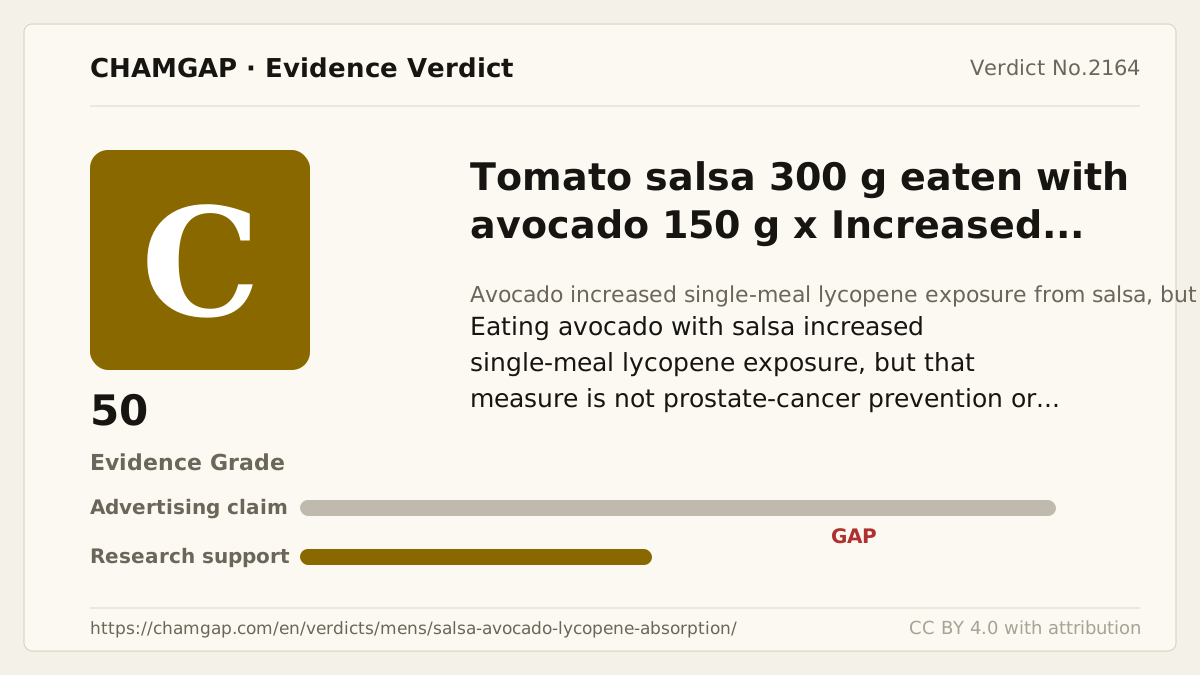
[Chamgap] Salsa plus avocado x increased lycopene absorption — Evidence Grade C·50. 1 cited sources checked. Source: https://chamgap.com/en/verdicts/mens/salsa-avocado-lycopene-absorption/ · CC BY 4.0CC BY 4.0 — free to use with attribution; do not distort grades, numbers, or verdict meaning.
What this document does and does not do
Chamgap is an information source. It reports what research has and has not confirmed; it does not tell readers what to take or buy. That decision belongs to readers and, when needed, medical or legal professionals. This verdict reflects literature available up to the search date and may change as new research appears. Nothing here is medical advice.