
Repeated PSA screening,
does it really help with Reduction in prostate-cancer mortality over 13 years?
research showsThe grade is B with 72 points. In the 13-year ERSPC report, prostate-cancer deaths were 355/72,891 in the screening-offer arm and 545/89,352 in control, rate ratio 0.79 (95% CI 0.69 to 0.91). Diagnosis increased, and reports at multiple follow-up times are updates from one ERSPC trial rather than independent replications.
ads claimA mortality claim must be paired with biopsy, overdiagnosis, and treatment-related urinary and sexual harms. Screening should be a shared decision based on age, life expectancy, family history, and preferences.
Useful facts when choosing a product
- Most centers used two-to-four-year intervals and the mean number of screens was 2.3.
- A PSA threshold around 3.0 ng/mL generally prompted further assessment and biopsy.
- ERSPC is registered as ISRCTN49127736.
Chamgap Semantic Classification Code
Candidate index · review held
P.repeated-psa-based-prostate-cancer-screening-offered-every-to-men-aged-55-to-69.diagnostic.prostate-cancer-mortality-over.reduce.UNKProcedures, devices and tests > Repeated PSA-based prostate-cancer screening offered every to men aged 55 to 69 > Diagnostic or screening > prostate-cancer mortality over > Reduction claim > Unknown
An automated migration candidate, not an issued permanent code; exact claim scope remains under review. This machine-generated migration candidate helps retrieval but is not a permanent assignment. The original verdict ID and URL remain authoritative.
What the research actually shows
The core age group included 162,388 randomized men; 145 who died before the first screening date were excluded, leaving 162,243, 72,891 versus 89,352, in mortality analysis. Random-number generation, allocation concealment from investigators, intention-to-screen analysis, blinded independent cause-of-death committees, and the prespecified prostate-cancer-mortality primary endpoint were confirmed. Exclusion of 145 participants after randomization was counted as one analysis limitation. Center-specific public and nonprofit funding was mixed with an unconditional Beckman-Coulter-Hybritech grant. The nine-, eleven-, and thirteen-year papers are follow-up updates from the same ERSPC trial; only the 13-year report counts as one evidence item.
Why this is classified as B (72)
One large randomized trial reduced prostate-cancer mortality, but mixed funding and postrandomization exclusion keep the evidence at B with 72 points.
Counterpoint. PSA elevation has noncancer causes and can lead to biopsy, overdiagnosis, and overtreatment; screening requires shared decision-making.
Rejudgment record. Cross-check applied — Cross-checked the 13-year ERSPC paper, registry, and supplemental funding material for randomized and analyzed denominators, mortality adjudication, single-trial follow-up reports, and overdiagnosis
| Endpoint | H | Hard endpoint - actual events such as death |
| Replication | R1 | Single confirmatory trial |
| Independence | I1 | Mixed funding sources |
| Effect size | E+ | Meets the clinically important threshold |
Stored derived and displayed grades match; this is not a current recalculation or validity check (B).
Sub-claim grades by effect
This ingredient is marketed for several effects. A single overall grade blends strong and weak claims together, so each effect is graded separately here. The overall grade reflects the strongest disconfirming or core claim.
| Effect (sub-claim) | Grade | Basis |
|---|---|---|
| Reduction in prostate-cancer mortality over 13 years | B | The mortality rate ratio was 0.79 (0.69 to 0.91). |
| Increase in prostate-cancer diagnosis | B | There were 7,408 versus 6,107 diagnoses, compatible with substantial overdiagnosis burden. |
Cross-check — AI research and Codex final gate
Evidence Table
| Study | Design | Sample | Funding | Endpoint | Result | Weight |
|---|---|---|---|---|---|---|
| Schröder FH, Hugosson J, Roobol MJ, Tammela TL, Zappa M, Nelen V, Kwiatkowski M, Lujan M, Määttänen L, Lilja H, Denis LJ, Recker F, Paez A, Bangma CH, Carlsson S, Puliti D, Villers A, Rebillard X, Hakama M, Stenman UH, Kujala P, Taari K, Aus G, Huber A, van der Kwast TH, van Schaik RH, de Koning HJ, Moss SM, Auvinen A, ERSPC Investigators. 2014 | Thirteen-year follow-up report of a multinational individually randomized repeated-PSA screening trial | 162,388 randomized in the core age group; 162,243 in mortality analysis (72,891/89,352) | Mixed national cancer-agency and European public/nonprofit funding plus an unconditional Beckman-Coulter-Hybritech grant | Death from prostate cancer over 13 years | 355/72,891 versus 545/89,352; mortality rate ratio 0.79 (95% CI 0.69 to 0.91), P=0.001; absolute reduction 1.28 per 1,000 men | Thirteen-year report from one ERSPC trial; not double-counted with other follow-up updates |
Receipt — 1 References
All 1 cited sources were verified for existence at the original page (as of 2026-08-15).
Final verification and publication gate: Codex · Evidence date: 2026-08-15 · Corrections: none
Cite this verdict
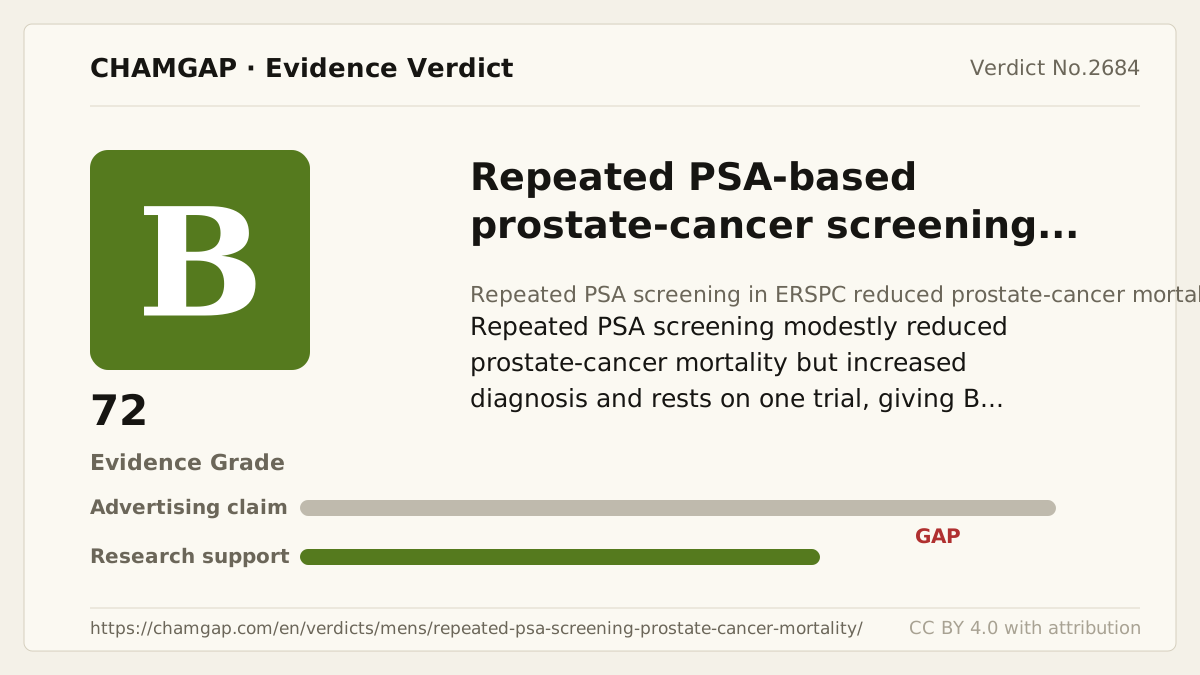
[Chamgap] Repeated PSA screening x lower prostate-cancer mortality — Evidence Grade B·72. 1 cited sources checked. Source: https://chamgap.com/en/verdicts/mens/repeated-psa-screening-prostate-cancer-mortality/ · CC BY 4.0CC BY 4.0 — free to use with attribution; do not distort grades, numbers, or verdict meaning.
What this document does and does not do
Chamgap is an information source. It reports what research has and has not confirmed; it does not tell readers what to take or buy. That decision belongs to readers and, when needed, medical or legal professionals. This verdict reflects literature available up to the search date and may change as new research appears. Nothing here is medical advice.