
Autologous platelet-rich plasma,
does it really help with Clinically meaningful IIEF-EF improvement in mild-to-moderate erectile dysfunction?
research showsC. Small randomized trials conflict, and the strictest independent placebo-controlled trial failed its 1-month MCID primary endpoint in the actual 52-patient analysis, supporting C with 43 points. The publication form is peer-reviewed original randomized trials. The Poulios trial met its 6-month MCID primary endpoint in an actual per-protocol analysis of 55, 69% versus 27%. However, the strictest independent double-blind placebo-controlled Masterson trial randomized 61 but analyzed 52 for the primary endpoint, 24 versus 28; its 1-month MCID primary endpoint failed, 58.3% versus 53.6% (P=.730). IIEF-EF change also did not differ between groups (P=.756). Other small randomized trials were positive, creating conflict, while protocol, platelet concentration, and durability remain uncertain. Rule ①(c) therefore supports C with 43 points. Verdict 1297, which is D with 30 points, concerns knee PRP, while verdict 1156 concerns PRP for hair loss; neither different indication was automatically transferred to ED.
ads claimMarketing may claim that autologous growth factors regenerate vessels and cure erectile dysfunction at its source. The strictest placebo-controlled trial found no advantage in MCID or IIEF-EF, and no standard procedure is established.
Useful facts when choosing a product
- PRP is prepared by centrifuging a patient's blood and injecting platelet-concentrated plasma into the corpora cavernosa.
- Platelet concentration, activation, injection number, and dose are not standardized for erectile dysfunction.
- Injection-site pain, bruising, hematoma, swelling, and infection are possible; anticoagulant use or bleeding disorders require prior assessment.
- It is not an established replacement for standard first-line therapy, and cardiovascular, medication-related, endocrine, and psychological causes should be evaluated first.
Chamgap Semantic Classification Code
Candidate index · review held
P.autologous-platelet-rich-plasma.procedural.clinically-meaningful-iief-ef-improvement-in-mild-to-moderate-erectile-dysfunction.improve.placeboProcedures, devices and tests > Autologous platelet-rich plasma > Procedural > Clinically meaningful IIEF-EF improvement in mild-to-moderate erectile dysfunction > Improvement claim > Placebo
An automated migration candidate, not an issued permanent code; exact claim scope remains under review. This machine-generated migration candidate helps retrieval but is not a permanent assignment. The original verdict ID and URL remain authoritative.
What the research actually shows
The publication form is peer-reviewed original randomized trials. The Poulios trial met its 6-month MCID primary endpoint in an actual per-protocol analysis of 55, 69% versus 27%. However, the strictest independent double-blind placebo-controlled Masterson trial randomized 61 but analyzed 52 for the primary endpoint, 24 versus 28; its 1-month MCID primary endpoint failed, 58.3% versus 53.6% (P=.730). IIEF-EF change also did not differ between groups (P=.756). Other small randomized trials were positive, creating conflict, while protocol, platelet concentration, and durability remain uncertain. Rule ①(c) therefore supports C with 43 points. Verdict 1297, which is D with 30 points, concerns knee PRP, while verdict 1156 concerns PRP for hair loss; neither different indication was automatically transferred to ED.
Why this is classified as C (43)
The publication form is peer-reviewed original randomized trials. The Poulios trial met its 6-month MCID primary endpoint in an actual per-protocol analysis of 55, 69% versus 27%. However, the strictest independent double-blind placebo-controlled Masterson trial randomized 61 but analyzed 52 for the primary endpoint, 24 versus 28; its 1-month MCID primary endpoint failed, 58.3% versus 53.6% (P=.730). IIEF-EF change also did not differ between groups (P=.756). Other small randomized trials were positive, creating conflict, while protocol, platelet concentration, and durability remain uncertain. Rule ①(c) therefore supports C with 43 points. Verdict 1297, which is D with 30 points, concerns knee PRP, while verdict 1156 concerns PRP for hair loss; neither different indication was automatically transferred to ED. Rule ①: (a) improvement only in surrogate biomarkers such as HbA1c, LDL, blood pressure, intraocular pressure, bone density, laboratory values, or imaging has a ceiling of C; (b) a failed primary endpoint with only positive subjective secondary endpoints has a ceiling of C; and (c) small, single-manufacturer, short-term, or conflicting evidence has a ceiling of C. Patient-reported symptoms that are themselves treatment targets, including pain, sleep, bowel function, IRLS, IIEF/SEP, and depression or anxiety scales, are not surrogates. Consistent achievement of clinical-importance thresholds such as MCID in multiple independent randomized trials can support B, and large, consistent, independent evidence can exceptionally support A. If effects do not meet clinical-importance thresholds, the grade remains C regardless of trial count.
Counterpoint. Efficacy was judged separately from safety and regulatory status. Diagnosis and standard treatment choices require clinical discussion.
Rejudgment record. Cross-check applied — The publication form is peer-reviewed original randomized trials. The Poulios trial met its 6-month MCID primary endpoint in an actual per-protocol analysis of 55, 69% versus 27%. However, the strictest independent double-blind placebo-controlled Masterson trial randomized 61 but analyzed 52 for the primary endpoint, 24 versus 28; its 1-month MCID primary endpoint failed, 58.3% versus 53.6% (P=.730). IIEF-EF change also did not differ between groups (P=.756). Other small randomized trials were positive, creating conflict, while protocol, platelet concentration, and durability remain uncertain. Rule ①(c) therefore supports C with 43 points. Verdict 1297, which is D with 30 points, concerns knee PRP, while verdict 1156 concerns PRP for hair loss; neither different indication was automatically transferred to ED. Rule ①: (a) improvement only in surrogate biomarkers such as HbA1c, LDL, blood pressure, intraocular pressure, bone density, laboratory values, or imaging has a ceiling of C; (b) a failed primary endpoint with only positive subjective secondary endpoints has a ceiling of C; and (c) small, single-manufacturer, short-term, or conflicting evidence has a ceiling of C. Patient-reported symptoms that are themselves treatment targets, including pain, sleep, bowel function, IRLS, IIEF/SEP, and depression or anxiety scales, are not surrogates. Consistent achievement of clinical-importance thresholds such as MCID in multiple independent randomized trials can support B, and large, consistent, independent evidence can exceptionally support A. If effects do not meet clinical-importance thresholds, the grade remains C regardless of trial count.
Sub-claim grades by effect
This ingredient is marketed for several effects. A single overall grade blends strong and weak claims together, so each effect is graded separately here. The overall grade reflects the strongest disconfirming or core claim.
| Effect (sub-claim) | Grade | Basis |
|---|---|---|
| Improvement in IIEF-EF score | C | Small trials conflict, and the strictest trial found no between-group difference. |
| Achievement of MCID at one month | D | The primary endpoint failed in the actual 52-patient analysis of an independent placebo-controlled trial. |
| Clinical improvement lasting six months or longer | ? | A small positive trial exists, but conflicting results and lack of standardization prevent a firm durability conclusion. |
Cross-check — AI research and Codex final gate
Evidence Table
| Study | Design | Sample | Funding | Endpoint | Result | Weight |
|---|---|---|---|---|---|---|
| Masterson TA et al. 2023 | Prospective randomized double-blind placebo-controlled trial; peer-reviewed original article | Randomized 61; actual primary analysis 52 (PRP 24; placebo 28) | Independent academic study | IIEF-EF MCID achievement one month after the second injection | Primary endpoint failed: 58.3% versus 53.6%, P=.730; between-group IIEF-EF P=.756. | Key efficacy evidence |
| Poulios E et al. 2021 | Randomized double-blind placebo-controlled trial; peer-reviewed original article | Per protocol 55 (PRP 29; placebo 26) | Academic; no external commercial funding reported | IIEF-EF MCID achievement six months after final treatment | Primary endpoint met: 69% versus 27%, risk difference 42% (95% CI 18 to 66), P<.001. | Key efficacy evidence |
Receipt — 3 References
All 3 cited sources were verified for existence at the original page (as of 2026-07-24).
Final verification and publication gate: Codex · Evidence date: 2026-07-24 · Corrections: none
Cite this verdict
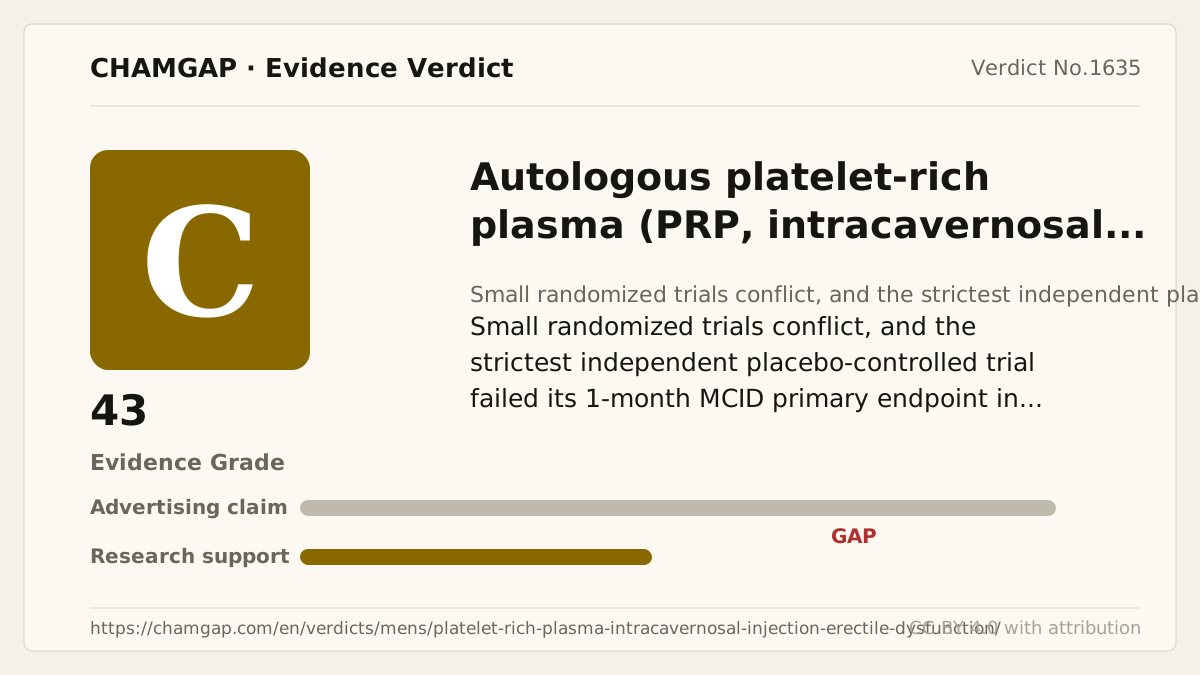
[Chamgap] Autologous platelet-rich plasma x Clinically meaningful IIEF-EF improvement in mild-to-moderate erectile dysfunction — Evidence Grade C·43. 3 cited sources checked. Source: https://chamgap.com/en/verdicts/mens/platelet-rich-plasma-intracavernosal-injection-erectile-dysfunction/ · CC BY 4.0CC BY 4.0 — free to use with attribution; do not distort grades, numbers, or verdict meaning.
What this document does and does not do
Chamgap is an information source. It reports what research has and has not confirmed; it does not tell readers what to take or buy. That decision belongs to readers and, when needed, medical or legal professionals. This verdict reflects literature available up to the search date and may change as new research appears. Nothing here is medical advice.