
Pelvic floor muscle training,
does it really help with Faster early recovery of urinary continence after radical prostatectomy?
research showsThe grade is D. A 2019 synthesis of 22 trials was positive, but the latest 2023 Cochrane review did not confirm benefit in more rigorous long-term pooling. At six to 12 months, subjective cure or improvement was RR 0.97 (95% CI 0.79 to 1.19; 2 trials, 788 participants), while the objective diary result was MD 0.18 (-0.24 to 0.60; 2 trials, 565 participants). Older positive and newer long-term evidence conflict, giving D with 28 points.
ads claimThe supported claim is that guided pelvic floor training can bring continence recovery forward. It does not show that more repetitions cure everyone or that a particular app or device has an exclusive effect.
Useful facts when choosing a product
- Pelvic floor muscle training teaches accurate contraction and relaxation of muscles supporting urethral closure, followed by repeated practice.
- Included trials used different definitions of continence, including pad-free status, 24-hour pad weight, bladder diaries, and questionnaires.
- Continence also recovers naturally after prostatectomy, so the relevant estimate compares groups at the same follow-up time.
Chamgap Semantic Classification Code
Candidate index · review held
X.physiotherapist-guided-pelvic-floor-muscle-training.behavioral.faster-early-recovery-of-urinary-continence-after-radical-prostatectomy.improve.UNKBehaviors, exposures and policies > Physiotherapist-guided pelvic floor muscle training > Behavioral delivery > Faster early recovery of urinary continence after radical prostatectomy > Improvement claim > Unknown
An automated migration candidate, not an issued permanent code; exact claim scope remains under review. This machine-generated migration candidate helps retrieval but is not a permanent assignment. The original verdict ID and URL remain authoritative.
What the research actually shows
Filocamo randomized 300 men; six-month continence was 144/150 (96.0%) versus 97/150 (64.7%). The abstract's 146 and 94.6% are arithmetically inconsistent with the full-text denominator. Twelve-month analysis used 150 versus 148. Wu's 2019 meta-analysis of 22 trials and 2,647 participants was positive at three, six, and 12 months. The 2023 Cochrane review assessed 25 trials and 3,079 men; subjective cure or improvement at six to 12 months was RR 0.97 (95% CI 0.79 to 1.19; 2 trials, 788), and the objective diary result was MD 0.18 (95% CI -0.24 to 0.60; 2 trials, 565). Many trials used unblinded self-reported pad counts or questionnaires.
Why this is classified as D (28)
Earlier positive low-certainty evidence conflicts with the latest null six-to-12-month synthesis, with unblinded subjective outcomes and unreported funding remaining, giving D with 28 points.
Counterpoint. Incorrect excessive contraction may not help. Persistent leakage, urgency, pain, or voiding difficulty warrants evaluation rather than simply more repetitions.
Rejudgment record. Cross-check applied — Earlier low-certainty positive evidence conflicted with the latest Cochrane synthesis, which did not confirm subjective or objective benefit at six to 12 months
| Endpoint | P | Symptom or function itself is the target - including patient reports and performance tests |
| Replication | R0 | Trials conflict in direction |
| Independence | I1 | Mixed funding sources |
| Effect size | E0 | Null |
| Precision | C0 | The confidence interval leaves room for benefit |
Stored derived and displayed grades match; this is not a current recalculation or validity check (D).
Sub-claim grades by effect
This ingredient is marketed for several effects. A single overall grade blends strong and weak claims together, so each effect is graded separately here. The overall grade reflects the strongest disconfirming or core claim.
| Effect (sub-claim) | Grade | Basis |
|---|---|---|
| Faster early continence recovery after surgery | D | Earlier analyses were positive, but the latest six-to-12-month subjective and objective synthesis did not confirm benefit. |
| Permanent cure of incontinence in every patient | ? | Trials measured recovery timing and outcomes through at most one year, not permanent cure in every patient. |
Cross-check — AI research and Codex final gate
Evidence Table
| Study | Design | Sample | Funding | Endpoint | Result | Weight |
|---|---|---|---|---|---|---|
| Filocamo MT et al. 2005 | Prospective randomized controlled trial | 300 randomized; 150/150 analyzed at six months and 150/148 at 12 months | Funding source not reported; noncommercial funding cannot be confirmed | Recovery of urinary continence | 144/150 (96.0%) versus 97/150 (64.7%) at six months, P<0.001 | Positive early direct functional-outcome trial |
| Wu MLY et al. 2019 meta-analysis | Systematic review and random-effects meta-analysis of randomized trials | 22 trials and 2,647 participants | Review supported by Chinese public and university grants; included trials came from multiple independent academic institutions | Continence recovery at three, six, and 12 months | OR 2.80 (95% CI 1.87 to 4.19), 4.11 (2.24 to 7.55), and 2.41 (1.33 to 4.36) | Replication across many independent trials |
Receipt — 3 References
All 3 cited sources were verified for existence at the original page (as of 2026-08-01).
Final verification and publication gate: Codex · Evidence date: 2026-08-01 · Corrections: none
Cite this verdict
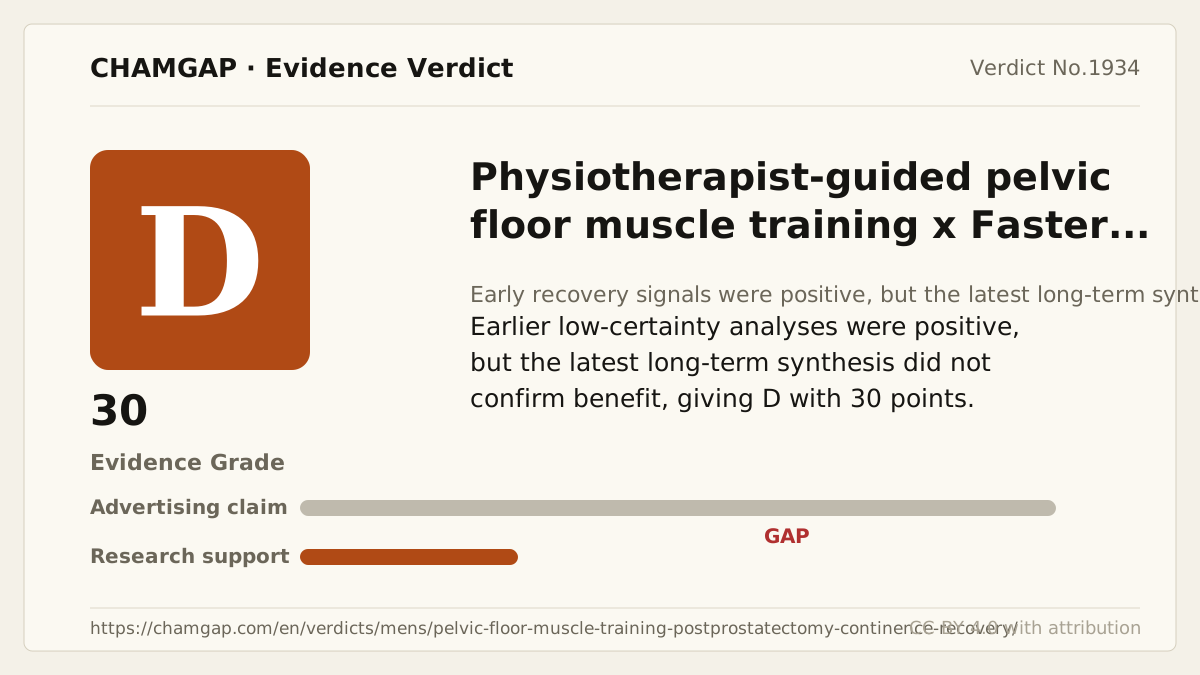
[Chamgap] Pelvic floor muscle training x continence recovery after prostatectomy — Evidence Grade D·28. 3 cited sources checked. Source: https://chamgap.com/en/verdicts/mens/pelvic-floor-muscle-training-postprostatectomy-continence-recovery/ · CC BY 4.0CC BY 4.0 — free to use with attribution; do not distort grades, numbers, or verdict meaning.
What this document does and does not do
Chamgap is an information source. It reports what research has and has not confirmed; it does not tell readers what to take or buy. That decision belongs to readers and, when needed, medical or legal professionals. This verdict reflects literature available up to the search date and may change as new research appears. Nothing here is medical advice.