
One-time abdominal aortic aneurysm ultrasound screening in men aged 65 to 74 years,
does it really help with Reduced abdominal aortic aneurysm rupture and related mortality in older men?
research showsOne-time abdominal aortic aneurysm ultrasound screening in men aged 65 to 74 years is rated A because it reduces AAA rupture and AAA-related mortality. The 2019 USPSTF evidence review pooled long-term data from independent randomized trials including MASS, Viborg, Chichester, and Western Australia and found OR 0.65 for AAA-related mortality, OR 0.62 for rupture, and OR 0.57 for emergency surgery. All-cause mortality showed no significant benefit, with RR 0.99, but disease-specific mortality is the standard hard endpoint for screening. Replication across independent randomized trials gives A with 90 points; evidence in women is insufficient.
ads claimPromotion may expand a simple ultrasound into lower all-cause mortality for every older adult. Strong evidence primarily concerns AAA-related death and rupture in men aged 65 years or older; the same conclusion does not apply to women or all-cause mortality.
Useful facts when choosing a product
- Abdominal aortic ultrasound is a noninvasive imaging test without ionizing radiation and is generally offered once; direct test harms are minimal.
- If an aneurysm is found, its size determines whether serial ultrasound surveillance or vascular-surgery assessment is needed.
- Screening can reduce emergency surgery while increasing elective surgery and total procedures; repair carries cardiovascular complication and mortality risks.
- Evidence applies mainly to men aged 65 to 74 years, with smoking history, family history, surgical fitness, and life expectancy considered.
Chamgap Semantic Classification Code
Candidate index · review held
P.one-time-abdominal-aortic-aneurysm-ultrasound-screening-in-men-aged.diagnostic.abdominal-aortic-aneurysm-rupture-and-related-mortality.reduce.UNKProcedures, devices and tests > One-time abdominal aortic aneurysm ultrasound screening in men aged > Diagnostic or screening > abdominal aortic aneurysm rupture and related mortality > Reduction claim > Unknown
An automated migration candidate, not an issued permanent code; exact claim scope remains under review. This machine-generated migration candidate helps retrieval but is not a permanent assignment. The original verdict ID and URL remain authoritative.
What the research actually shows
MASS randomized 67,800 British men aged 65 to 74 years to ultrasound invitation or control and reduced AAA-related mortality. The Viborg trial in 12,639 men aged 65 years or older pointed in the same direction, with Chichester and Western Australia adding independent evidence. The 2019 USPSTF review estimated OR 0.65 for AAA-related mortality and OR 0.62 for rupture across four trials and 124,926 participants followed 12 to 15 years. All-cause mortality was not significantly reduced at RR 0.99, and total procedures increased in screened groups.
Why this is classified as A (90)
Long-term meta-analysis of four independent population randomized trials reproduced disease-specific hard-endpoint benefits: OR 0.65 for AAA-related mortality, OR 0.62 for rupture, and OR 0.57 for emergency surgery. All-cause mortality was nonsignificant, but the standard screening endpoint gives A with 90 points.
Counterpoint. The examination itself is low risk, but a positive result leads to long-term surveillance or a repair decision. If a person would not undergo repair or has severe comorbidity that makes repair unlikely to help, the net screening benefit may be smaller.
Rejudgment record. New verdict — Assessed replicated reductions in AAA-related mortality, rupture, and emergency surgery in long-term meta-analysis of the MASS, Viborg, Chichester, and Western Australia population randomized trials, while separating all-cause from disease-specific mortality and evidence in men from that in women
Sub-claim grades by effect
This ingredient is marketed for several effects. A single overall grade blends strong and weak claims together, so each effect is graded separately here. The overall grade reflects the strongest disconfirming or core claim.
| Effect (sub-claim) | Grade | Basis |
|---|---|---|
| Reduction in abdominal aortic aneurysm rupture | A | Long-term meta-analysis of four randomized trials directly reproduced the benefit with OR 0.62. |
| Reduction in abdominal-aortic-aneurysm-related mortality | A | Four randomized trials and 124,926 participants reproduced a disease-specific mortality benefit with OR 0.65. |
| Reduction in emergency abdominal aortic aneurysm surgery | A | Long-term analysis of five trials found OR 0.57, although elective and total procedures increase. |
Cross-check — AI research and Codex final gate
Evidence Table
| Study | Design | Sample | Funding | Endpoint | Result | Weight |
|---|---|---|---|---|---|---|
| Ashton HA et al. MASS. 2002 | Multicenter population-based randomized controlled trial | 67,800 men aged 65 to 74 years | United Kingdom Medical Research Council and Department of Health | AAA-related mortality and surgery | Invitation to ultrasound screening significantly reduced AAA-related mortality. | Largest key independent randomized trial |
| Lindholt JS et al. Viborg. 2005 | Single-region population-based randomized controlled trial | 12,639 men aged 65 years or older | Danish public and academic support | AAA-specific and all-cause mortality, elective and emergency surgery | Showed reductions in AAA-specific mortality and emergency surgery. | Independent replication |
| Guirguis-Blake JM et al. USPSTF evidence review. 2019 | Systematic evidence review and randomized-trial meta-analysis | 4 trials and 124,926 participants for AAA death; 5 trials and 175,085 overall | AHRQ and USPSTF | AAA death, rupture, emergency surgery, all-cause mortality, and harms | AAA death OR 0.65, rupture OR 0.62, emergency surgery OR 0.57; all-cause mortality RR 0.99. | Decisive long-term synthesis |
Receipt — 3 References
All 3 cited sources were verified for existence at the original page (as of 2026-07-23).
Final verification and publication gate: Codex · Evidence date: 2026-07-23 · Corrections: none
Cite this verdict
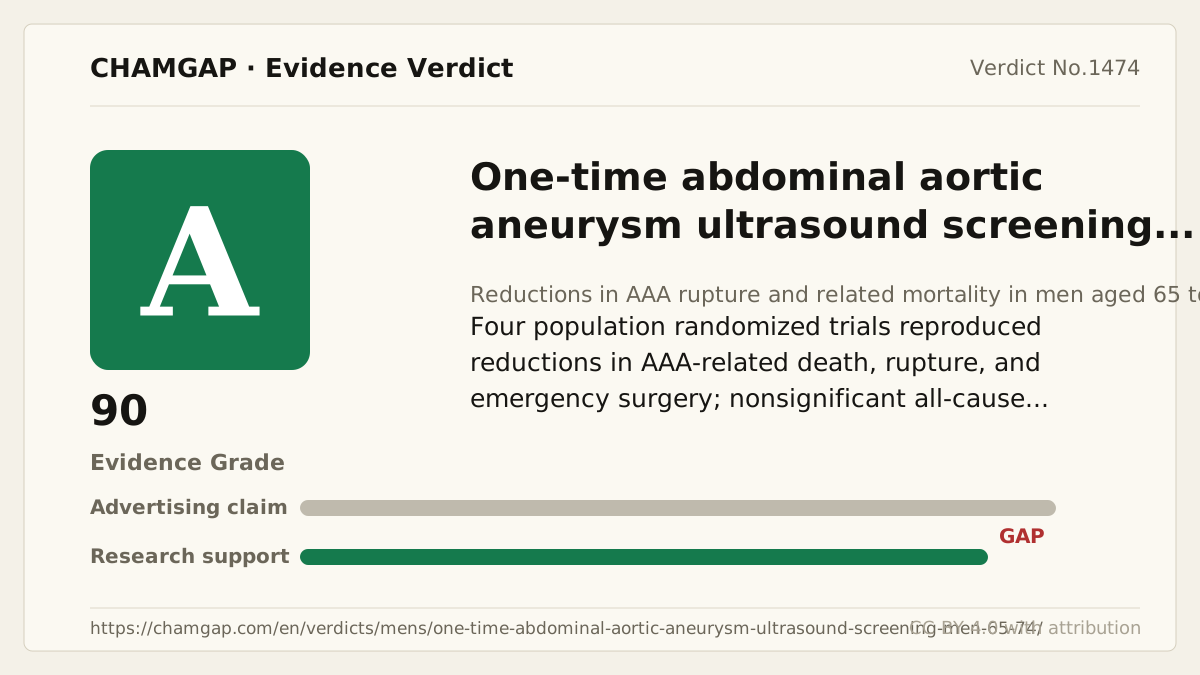
[Chamgap] One-time abdominal aortic aneurysm ultrasound screening in men aged 65 to 74 years x Reduced abdominal aortic aneurysm rupture and related mortality in older men — Evidence Grade A·90. 3 cited sources checked. Source: https://chamgap.com/en/verdicts/mens/one-time-abdominal-aortic-aneurysm-ultrasound-screening-men-65-74/ · CC BY 4.0CC BY 4.0 — free to use with attribution; do not distort grades, numbers, or verdict meaning.
What this document does and does not do
Chamgap is an information source. It reports what research has and has not confirmed; it does not tell readers what to take or buy. That decision belongs to readers and, when needed, medical or legal professionals. This verdict reflects literature available up to the search date and may change as new research appears. Nothing here is medical advice.