
Low-intensity extracorporeal shockwave therapy,
does it really help with Improved erectile function and erection hardness in vasculogenic erectile dysfunction?
research showsLow-intensity extracorporeal shockwave therapy receives C for improving erectile function and erection hardness in vasculogenic erectile dysfunction. The 2025 Cochrane review included 21 randomized trials with 1,357 participants and found a short-term IIEF-EF score 3.89 points higher than sham (95% CI 2.89 to 4.89; 15 trials, 937 participants). This is a positive signal, but it sits at the review's 4-point minimal clinically important difference threshold and was rated low certainty because of bias and heterogeneity of I-squared 62%. Long-term erection-hardness evidence came from only 3 trials and 169 participants with I-squared 89%, so limited, subjective evidence supports C.
ads claimCommercial marketing emphasizes vascular regeneration, correction of the root cause, and permanent drug-free recovery. Trials have shown an average questionnaire improvement with particular research devices and heterogeneous short-term protocols, not established permanent vascular regeneration or freedom from phosphodiesterase-5 inhibitors.
Useful facts when choosing a product
- Li-ESWT is a noninvasive local procedure that applies repeated low-energy acoustic shockwaves to several penile sites; it is not an electrical shock or the high-energy lithotripsy used for stones.
- Research protocols vary from roughly 600 to 3,000 shocks per session, one or two sessions weekly, and 5 to 12 total sessions, leaving no established standard dose, device, or treatment cycle.
- Pain, bruising, and local discomfort were generally uncommon and serious treatment-related harms were rarely reported, but adverse-event reporting and long-term safety data are limited.
- Erectile dysfunction can signal cardiovascular disease, diabetes, tobacco injury, medication effects, or hormonal, neurologic, and psychological conditions. Evaluation of the cause, risk-factor treatment, lifestyle change, and established options such as phosphodiesterase-5 inhibitors should be considered.
Chamgap Semantic Classification Code
Candidate index · review held
P.low-intensity-extracorporeal-shockwave-therapy.procedural.erectile-function-and-erection-hardness-in-vasculogenic-erectile-dysfunction.improve.shamProcedures, devices and tests > Low-intensity extracorporeal shockwave therapy > Procedural > erectile function and erection hardness in vasculogenic erectile dysfunction > Improvement claim > Sham procedure or device
An automated migration candidate, not an issued permanent code; exact claim scope remains under review. This machine-generated migration candidate helps retrieval but is not a permanent assignment. The original verdict ID and URL remain authoritative.
What the research actually shows
The Cochrane review by Ergun and colleagues included 21 randomized trials and 1,357 participants; only 16 were full-text publications and 5 were conference abstracts. Short-term IIEF-EF improved by a mean 3.89 points across 15 trials and 937 participants, but certainty was low, while long-term erection hardness improved by a mean 0.91 points across only 3 trials and 169 participants, also with low certainty. An earlier randomized-trial meta-analysis by Sokolakis and Hatzichristodoulou reported IIEF-EF improvement of 3.97 points and an odds ratio of 4.35 for EHS of at least 3, but it pooled small heterogeneous studies. The American Urological Association classified Li-ESWT as investigational because restoration of normal erections, durability, and standardized delivery remained uncertain. More positive studies now exist, but large independent standardized trials with durable patient-important outcomes remain lacking.
Why this is classified as C (52)
The latest Cochrane review of 21 randomized trials found a positive short-term IIEF-EF mean difference of 3.89 points, but this was at the 4-point minimal clinically important difference boundary, with I-squared 62% and low certainty. Long-term EHS evidence was limited to 3 trials and 169 participants with I-squared 89%, while devices, doses, and cointerventions were not standardized. Subjective outcomes, heterogeneity, and uncertain durability yield C with 52 points.
Counterpoint. Some people with mild-to-moderate vasculogenic erectile dysfunction, inadequate response to standard therapy, and a clear understanding of uncertainty may consider the procedure in a clinical trial or after transparent counseling. They should verify cost, device type, whether true focused shockwaves or radial pressure waves are used, co-medications, expected benefit, and probability of failure.
Rejudgment record. Cross-check applied — Accepted the positive short-term IIEF-EF signal in the latest Cochrane review, but applied the rule ① ceiling of C because the effect sits at the minimal-clinical-importance threshold with low certainty, high heterogeneity, subjective outcomes, nonstandard protocols, and uncertain durability
Sub-claim grades by effect
This ingredient is marketed for several effects. A single overall grade blends strong and weak claims together, so each effect is graded separately here. The overall grade reflects the strongest disconfirming or core claim.
| Effect (sub-claim) | Grade | Basis |
|---|---|---|
| Short-term improvement in erectile function measured by IIEF-EF | C | The mean improvement was 3.89 points, but evidence was low certainty, heterogeneous at I-squared 62%, and at the minimal-clinical-importance threshold. |
| Improvement in erection hardness measured by EHS | C | A positive signal exists, but the long-term analysis involved only 3 trials and 169 participants with I-squared 89%. |
| Durable medication-free restoration of erectile function | C | Some durability signals exist, but long-term controlled evidence for normal erections or freedom from phosphodiesterase-5 inhibitors is inadequate. |
Cross-check — AI research and Codex final gate
Evidence Table
| Study | Design | Sample | Funding | Endpoint | Result | Weight |
|---|---|---|---|---|---|---|
| Ergun O, Kızılkan Y, Başar MM, et al. Low-intensity shockwave therapy for erectile dysfunction. Cochrane Database Syst Rev. 2025;2025(7):CD013166. | Systematic review and meta-analysis of sham-controlled randomized trials | 21 randomized trials with 1,357 participants; 15 trials and 937 participants for short-term IIEF-EF | Academic Cochrane review; funding varied or was inadequately reported across included trials | Short- and long-term IIEF-EF, erection hardness, discontinuation, and adverse events | Short-term IIEF-EF mean difference was +3.89 points with I-squared 62% and low certainty; long-term EHS mean difference of +0.91 came from only 3 trials and 169 participants with I-squared 89%. | Latest pivotal synthesis |
| Sokolakis I and Hatzichristodoulou G. 2019 | Systematic review and meta-analysis of Li-ESWT randomized trials | A collection of small randomized trials with varying samples by outcome | Academic review with mixed funding across included trials | IIEF-EF, erection hardness, and penile peak systolic velocity | Reported positive signals of +3.97 IIEF-EF points and an odds ratio of 4.35 for EHS of at least 3, but trials were small and protocols heterogeneous. | Earlier positive synthesis |
| Burnett AL et al. 2018 AUA guideline | Evidence-based clinical practice guideline for erectile dysfunction | Systematic review of erectile-dysfunction literature through July 2017 | American Urological Association | Restoration of normal erections, durability, burden, and harms | Classified Li-ESWT as investigational with Grade C evidence and recommended use only in a clinical-trial setting. | Clinical-scope limitation |
Receipt — 3 References
All 3 cited sources were verified for existence at the original page (as of 2026-07-24).
Final verification and publication gate: Codex · Evidence date: 2026-07-24 · Corrections: none
Cite this verdict
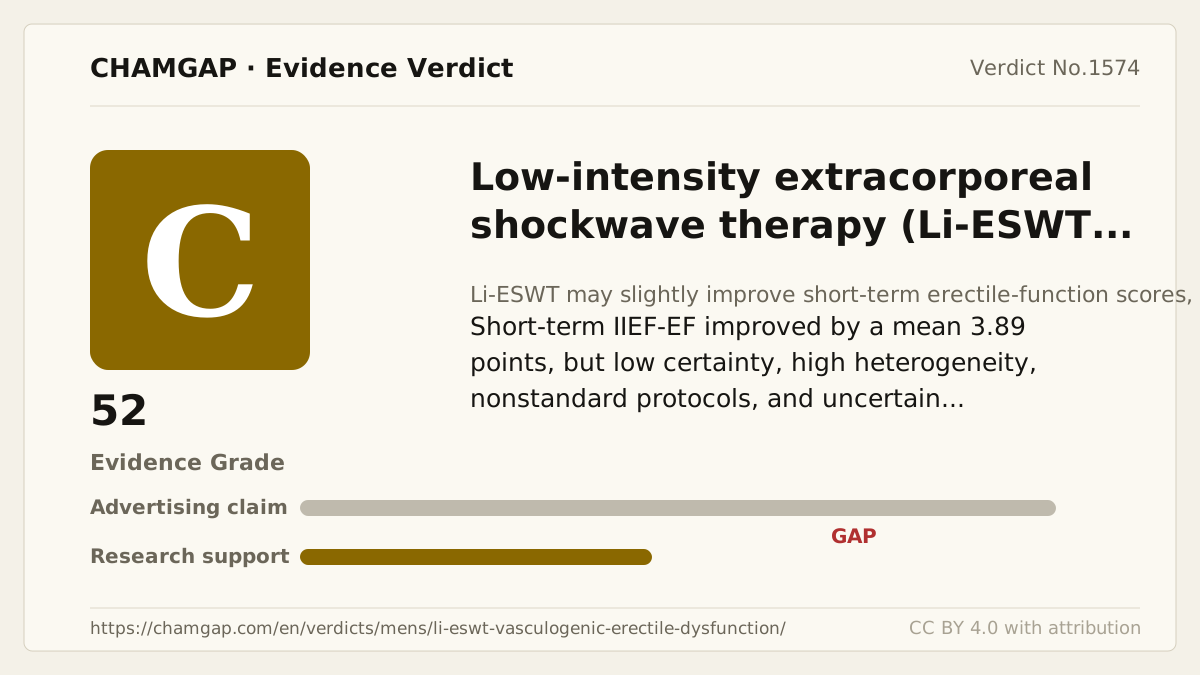
[Chamgap] Low-intensity extracorporeal shockwave therapy x improved erectile function and erection hardness in vasculogenic erectile dysfunction — Evidence Grade C·52. 3 cited sources checked. Source: https://chamgap.com/en/verdicts/mens/li-eswt-vasculogenic-erectile-dysfunction/ · CC BY 4.0CC BY 4.0 — free to use with attribution; do not distort grades, numbers, or verdict meaning.
What this document does and does not do
Chamgap is an information source. It reports what research has and has not confirmed; it does not tell readers what to take or buy. That decision belongs to readers and, when needed, medical or legal professionals. This verdict reflects literature available up to the search date and may change as new research appears. Nothing here is medical advice.