
Goserelin plus radiotherapy,
does it really help with Improved overall survival and prostate-cancer mortality when used as long-term adjuvant therapy with radiotherapy for locally advanced high-risk prostate cancer?
research showsLong-term adjuvant goserelin with radiotherapy is rated A because it improved overall survival and prostate-cancer mortality in locally advanced or high-risk prostate cancer. In long-term RTOG 85-31 results, 10-year overall survival was 49% versus 39% and disease-specific mortality was 16% versus 22%. EORTC 22863 replicated benefit with three years of goserelin: 10-year survival was 58.1% versus 39.8% and prostate-cancer mortality was 10.3% versus 30.4%. Because this is a stage-specific combination effect rather than goserelin monotherapy, it is rated A.
ads claimSurvival benefit should not be expanded into a claim for goserelin monotherapy or every low-risk localized prostate cancer. Stage, risk, radiotherapy plan, androgen-deprivation duration, and comorbidity must be considered together.
Useful facts when choosing a product
- Goserelin is a subcutaneous depot GnRH agonist that suppresses gonadotropins and testosterone after an initial stimulatory phase.
- The evidence applies to long-term use with radiotherapy in locally advanced or high-risk prostate cancer.
- Hot flashes, reduced libido, erectile dysfunction, bone loss, muscle loss, and changes in weight, glucose, and lipids can occur.
- Tumor flare can occur initially, while long-term treatment requires bone-health and cardiometabolic monitoring.
Chamgap Semantic Classification Code
Candidate index · review held
M.goserelin-acetate.subcutaneous.overall-survival-and-prostate-cancer-mortality-when-used-as-long-term-adjuvant-therapy-with-radiotherapy-for-locally-advanced-high-risk-prostate-cancer.improve.addonMedicinal interventions > Goserelin acetate > Subcutaneous > overall survival and prostate-cancer mortality when used as long-term adjuvant therapy with radiotherapy for locally advanced high-risk prostate cancer > Improvement claim > Added intervention on common background care
An automated migration candidate, not an issued permanent code; exact claim scope remains under review. This machine-generated migration candidate helps retrieval but is not a permanent assignment. The original verdict ID and URL remain authoritative.
What the research actually shows
RTOG 85-31 compared radiotherapy followed by hormonal therapy at relapse with long-term adjuvant goserelin beginning during the last week of radiotherapy. It enrolled 977 patients and long-term analysis improved overall survival, local failure, distant metastasis, and disease-specific mortality. EORTC 22863 randomized 415 patients with high-risk T1-2 high-grade or T3-4 disease to radiotherapy alone or radiotherapy plus three years of goserelin and replicated survival benefit. The evidence therefore concerns goserelin-containing long-term androgen deprivation added to radiotherapy.
Why this is classified as A (84)
RTOG 85-31 and EORTC 22863 replicated improvements in overall and prostate-cancer-specific survival, and because randomization compared radiotherapy alone with radiotherapy plus goserelin, the component's survival contribution is directly isolated. Two independent phase 3 hard-endpoint benefits give A with 84 points; the high-risk locally advanced stage restriction and androgen-deprivation adverse effects are noted separately.
Counterpoint. Duration and agent selection should reflect current radiation dose, disease risk, and bone and cardiometabolic comorbidity.
Rejudgment record. Cross-check applied — Reflected that RTOG 85-31 and EORTC 22863 randomized radiotherapy with or without goserelin, isolating and replicating the component-specific overall and prostate-cancer-specific survival benefit, raising the B draft to A at cross-check (84 points); the high-risk locally advanced restriction and androgen-deprivation toxicity are noted separately.
Sub-claim grades by effect
This ingredient is marketed for several effects. A single overall grade blends strong and weak claims together, so each effect is graded separately here. The overall grade reflects the strongest disconfirming or core claim.
| Effect (sub-claim) | Grade | Basis |
|---|---|---|
| Improved overall survival with long-term use alongside radiotherapy | A | The result was replicated in RTOG 85-31 and EORTC 22863 but is a combination effect. |
| Reduced prostate-cancer-specific mortality | A | Disease-specific mortality fell significantly in both long-term analyses. |
| Improved clinical disease-free survival | B | In EORTC 22863, 10-year clinical disease-free survival was 47.7% versus 22.7%. |
Cross-check — AI research and Codex final gate
Evidence Table
| Study | Design | Sample | Funding | Endpoint | Result | Weight |
|---|---|---|---|---|---|---|
| Pilepich et al. RTOG 85-31 long-term analysis 2005 | Phase 3 randomized trial of radiotherapy with or without long-term goserelin | 977 enrolled; median follow-up 7.6 years in the long-term analysis | Radiation Therapy Oncology Group and United States NCI collaboration | Overall survival, local failure, distant metastasis, and disease-specific mortality | Ten-year overall survival was 49% versus 39% (P=0.002), and disease-specific mortality was 16% versus 22% (P=0.0052). | Key long-term survival randomized trial |
| Bolla et al. EORTC 22863 10-year analysis 2010 | Phase 3 open randomized trial of radiotherapy with or without three years of goserelin | 415 patients with prostate cancer at high metastatic risk | EORTC study | Clinical disease-free survival, overall survival, and prostate-cancer mortality | Ten-year overall survival was 58.1% versus 39.8% (HR 0.60), and prostate-cancer mortality was 10.3% versus 30.4% (HR 0.38). | Independent replicating long-term survival trial |
Receipt — 2 References
All 2 cited sources were verified for existence at the original page (as of 2026-07-23).
Final verification and publication gate: Codex · Evidence date: 2026-07-23 · Corrections: none
Cite this verdict
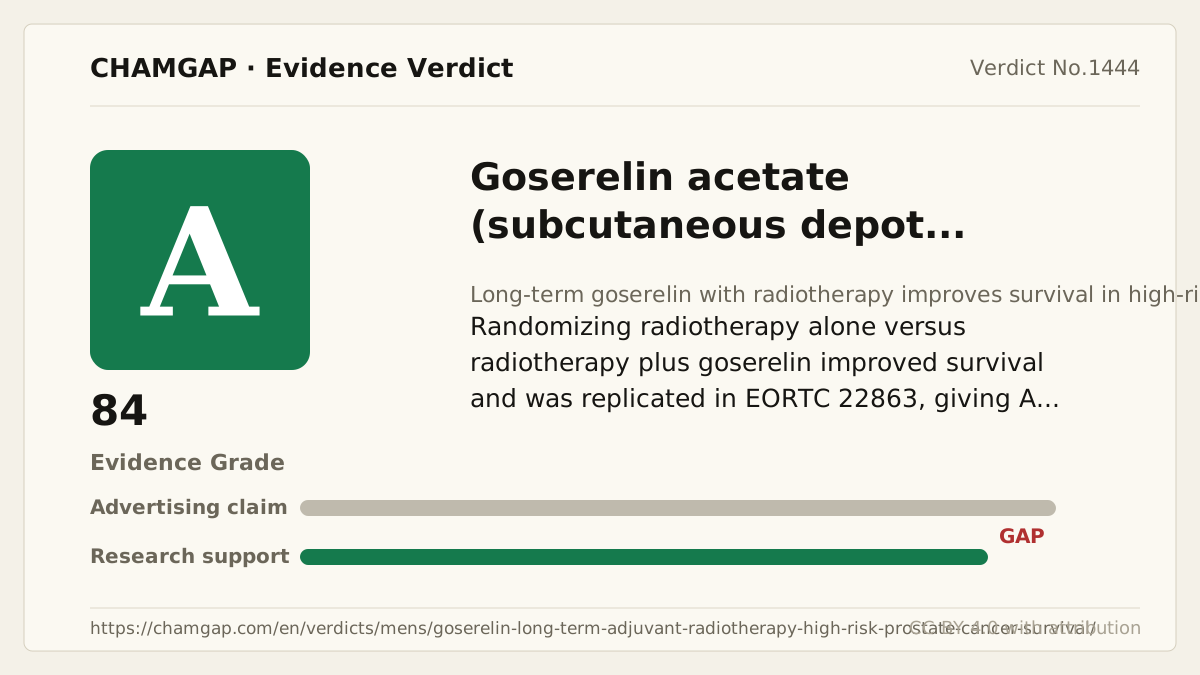
[Chamgap] Goserelin plus radiotherapy x improved survival in high-risk prostate cancer — Evidence Grade A·84. 2 cited sources checked. Source: https://chamgap.com/en/verdicts/mens/goserelin-long-term-adjuvant-radiotherapy-high-risk-prostate-cancer-survival/ · CC BY 4.0CC BY 4.0 — free to use with attribution; do not distort grades, numbers, or verdict meaning.
What this document does and does not do
Chamgap is an information source. It reports what research has and has not confirmed; it does not tell readers what to take or buy. That decision belongs to readers and, when needed, medical or legal professionals. This verdict reflects literature available up to the search date and may change as new research appears. Nothing here is medical advice.