
Front-pocket mobile phone carrying,
does it really help with Lower fecundability and worse semen parameters?
research showsThe grade is D. In prospective preconception cohorts of 751 Danish and 2,349 North American men, 3,100 total, the pooled fecundability ratio for any front-pocket carrying was 0.94, 95% CI 0.83-1.05, and was not significant. The interval still permits 17% lower cycle-specific fecundability, while self-reported carrying location poorly measures radiofrequency, heat, and output, so neither harm nor safety is established.
ads claimThe study did not measure phone SAR, transmitted power, or testicular temperature. It therefore supplies neither a physical exposure value nor evidence that a particular shielding product works.
Useful facts when choosing a product
- Pocket location and carrying time were asked once at baseline.
- SAR, transmitted power, model, cover, base-station distance, testicular temperature, and carrying logs were not measured.
- Natural conception is an event; semen volume, concentration, and motility are surrogate laboratory measures.
Chamgap Semantic Classification Code
Candidate index · review held
UNK.self-reported-habit-of-carrying-an-active-mobile-phone-in-a-front-pants-pocket.UNK.fecundability-and-worse-semen-parameters.reduce.UNKUnknown > Self-reported habit of carrying an active mobile phone in a front pants pocket > Unknown > fecundability and worse semen parameters > Reduction claim > Unknown
An automated migration candidate, not an issued permanent code; exact claim scope remains under review. This machine-generated migration candidate helps retrieval but is not a permanent assignment. The original verdict ID and URL remain authoritative.
What the research actually shows
Female partners reported pregnancy every eight weeks for up to 12 months. Fecundability models adjusted for male and female age and BMI, race, education, income, male activity, smoking, sleep, work hours, sexually transmitted infection history, sugary drinks, and intercourse frequency. Occupation type and true radiofrequency exposure remained potential confounders. Semen analyses used 341 North American men at first sample and 95 Danish samples, including repeat samples for some participants. Funding was NIH R03HD090315. Sandstone Diagnostics provided semen-testing kits, Swiss Precision Diagnostics provided home pregnancy tests, and Kindara and FertilityFriend provided fertility-app access in kind. L.A.W. advised AbbVie on uterine fibroids. M.L.E. advised Sandstone Diagnostics, Ro, Dadi, Hannah, and Underdog. G.J.S. held equity in Sandstone Diagnostics and disclosed a pending patent related to the Trak Male Fertility Testing System.
Why this is classified as D (34)
Overall fecundability and semen outcomes were null in 3,100 men, but exposure misclassification, residual occupational confounding, and a wide interval give D with 34 points rather than F.
Counterpoint. A null result does not prove front-pocket carrying is safe. Independent cohorts with objective exposure measurement or a randomized carrying intervention are needed.
Rejudgment record. Cross-check applied — Verified overall fecundability and semen tables, separated the subgroup, and incorporated self-reported exposure, residual occupational confounding, and a confidence interval that leaves harm possible
| Endpoint | H | Hard endpoint - actual events such as death |
| Replication | R1 | Single confirmatory trial |
| Independence | I2 | Decisive evidence is publicly or non-profit funded |
| Effect size | E0 | Null |
| Precision | C0 | The confidence interval leaves room for benefit |
Stored derived and displayed grades match; this is not a current recalculation or validity check (D).
Sub-claim grades by effect
This ingredient is marketed for several effects. A single overall grade blends strong and weak claims together, so each effect is graded separately here. The overall grade reflects the strongest disconfirming or core claim.
| Effect (sub-claim) | Grade | Basis |
|---|---|---|
| Lower overall fecundability | D | FR 0.94 (0.83-1.05) was null. |
| Worse semen volume, concentration, and motility | D | No consistent associations were observed. |
| Lower fecundability among men with BMI below 25 | C | FR was 0.72, but this was a subgroup without a duration trend. |
Cross-check — AI research and Codex final gate
Evidence Table
| Study | Design | Sample | Funding | Endpoint | Result | Weight |
|---|---|---|---|---|---|---|
| Hatch et al. 2021 | Two prospective preconception cohorts | 751 Danish and 2,349 North American men; 3,100 total | NIH R03HD090315; in-kind support from Sandstone Diagnostics, Swiss Precision Diagnostics, Kindara, and FertilityFriend; AbbVie and other company consulting, Sandstone Diagnostics equity, and a Trak patent relationship disclosed | Natural conception over up to 12 months and semen volume, concentration, and motility | Overall front-pocket FR 0.94 (0.83-1.05); no consistent semen associations | Direct prospective evidence with self-reported exposure |
Receipt — 1 References
All 1 cited sources were verified for existence at the original page (as of 2026-08-05).
Final verification and publication gate: Codex · Evidence date: 2026-08-05 · Corrections: none
Cite this verdict
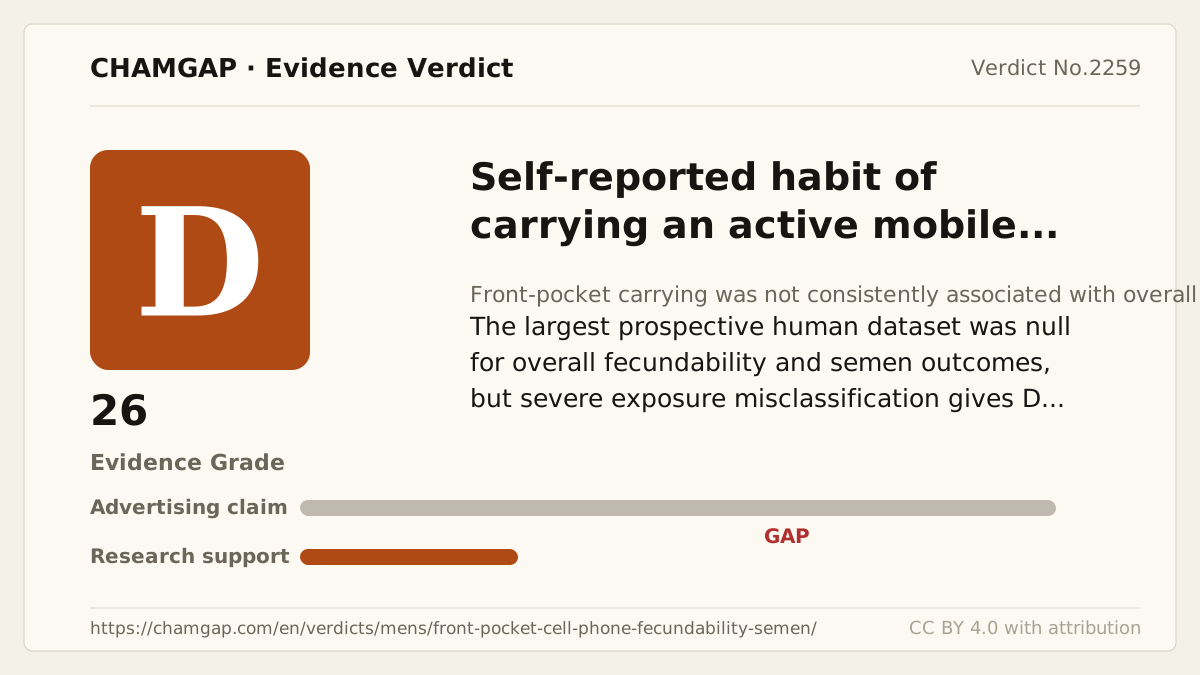
[Chamgap] Front-pocket mobile phone carrying x fecundability and semen — Evidence Grade D·34. 1 cited sources checked. Source: https://chamgap.com/en/verdicts/mens/front-pocket-cell-phone-fecundability-semen/ · CC BY 4.0CC BY 4.0 — free to use with attribution; do not distort grades, numbers, or verdict meaning.
What this document does and does not do
Chamgap is an information source. It reports what research has and has not confirmed; it does not tell readers what to take or buy. That decision belongs to readers and, when needed, medical or legal professionals. This verdict reflects literature available up to the search date and may change as new research appears. Nothing here is medical advice.