
Edible mushroom consumption,
does it really help with Prevention of incident prostate cancer?
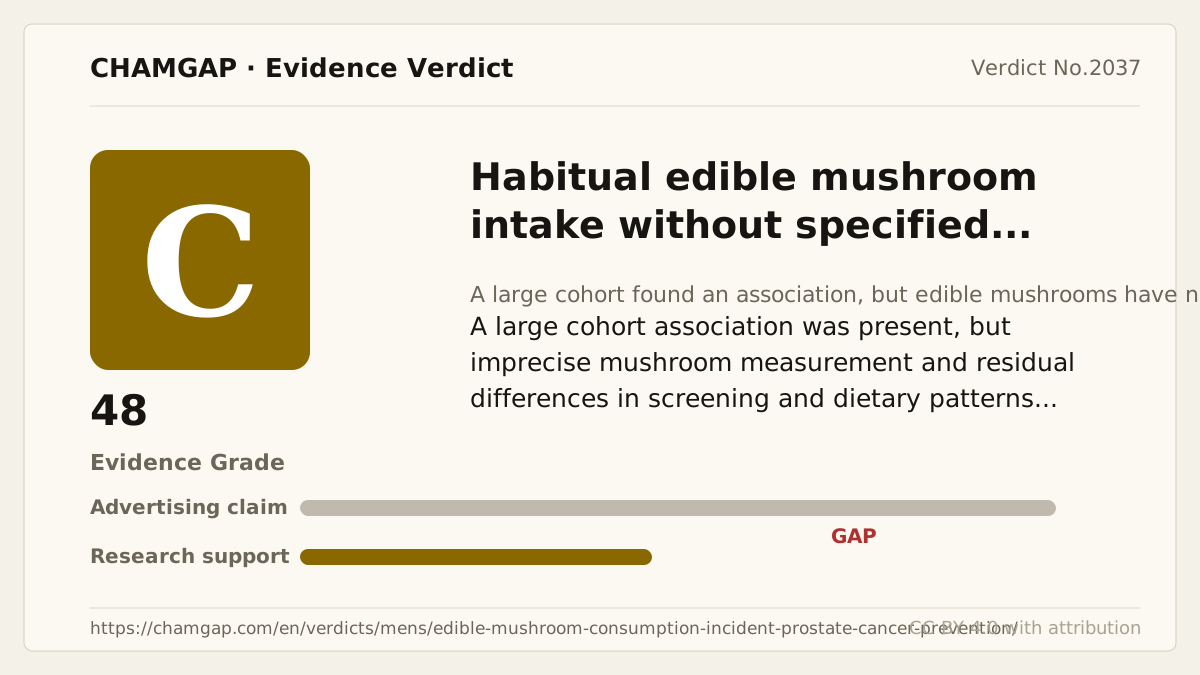
research showsThe grade is C with 56 points. A pooled analysis of two Japanese cohorts followed 36,499 men for a median 13.2 years and found a prostate-cancer incidence hazard ratio of 0.83, 95% CI 0.70 to 0.98, for at least three times weekly versus less than once weekly. This is a large prospective dataset with 1,204 events, but the mushroom-item validity coefficient was only 0.32 and the nonrandomized design cannot establish prevention.
ads claimThe lower hazard among frequent consumers is an observation, not proof that eating mushrooms three times weekly prevents prostate cancer. Species, grams, and UV exposure were unavailable, so vitamin D2 or other constituent doses cannot be calculated. Verdict 174 is C with 41 points for shiitake lentinan extract and immune or anticancer claims, while verdict 729 has an unknown grade and no score for Agaricus extract and cancer-prevention or survival claims; both differ from habitual whole-food intake.
Useful facts when choosing a product
- Exposure was recorded only as weekly frequency, not species, grams, or cooking method.
- The at-least-three-times-weekly group had lower prostate-cancer hazard, which remains an observational association.
- Mushroom vitamin D2 changes markedly with UV exposure, which this cohort did not record; ordinary mushrooms cannot be assumed to match UV-enhanced products.
- Mushroom D2 and supplement D3 are different molecules and do not raise total 25(OH)D with equal efficiency.
Chamgap Semantic Classification Code
Candidate index · review held
F.habitual-edible-mushroom-intake-without-specified-species-or-amount.oral.incident-prostate-cancer.prevent.UNKFoods and beverages > Habitual edible mushroom intake without specified species or amount > Oral > incident prostate cancer > Occurrence-prevention claim > Unknown
An automated migration candidate, not an issued permanent code; exact claim scope remains under review. This machine-generated migration candidate helps retrieval but is not a permanent assignment. The original verdict ID and URL remain authoritative.
What the research actually shows
The Miyagi 1990 and Ohsaki 1994 cohorts contributed 36,499 cancer-free men aged 40 to 79, 574,397 person-years, a median 13.2 years, and 1,204 cases. Groups included 15,958 men consuming less than weekly, 13,124 consuming one to two times weekly, and 7,417 consuming at least three times weekly. The same FFQ measured intake once at baseline. Funding came from Japan's public NARO research program and National Cancer Center Research and Development Fund, and the paper declared no conflicts.
Why this is classified as C (56)
A large publicly funded long-term cohort found an incidence association, but it remains one pooled observational analysis with low FFQ validity and residual PSA-screening or healthcare-use confounding, giving C with 56 points.
Counterpoint. C does not discard the association. Better exposure measurement, independent replication, or randomized evidence is needed before calling it prevention.
Rejudgment record. Cross-check applied — Original-table hazard ratios, denominators, events, FFQ validity, follow-up loss, and public funding were checked, with residual screening confounding reflected
| Endpoint | H | Hard endpoint - actual events such as death |
| Replication | R1 | Single confirmatory trial |
| Independence | I2 | Decisive evidence is publicly or non-profit funded |
| Effect size | E+ | Meets the clinically important threshold |
Stored derived and displayed grades match; this is not a current recalculation or validity check (C).
Sub-claim grades by effect
This ingredient is marketed for several effects. A single overall grade blends strong and weak claims together, so each effect is graded separately here. The overall grade reflects the strongest disconfirming or core claim.
| Effect (sub-claim) | Grade | Basis |
|---|---|---|
| Prevention of incident prostate cancer through habitual edible mushroom intake | C | A large cohort association exists, but causality and independent replication are unestablished. |
Cross-check — AI research and Codex final gate
Evidence Table
| Study | Design | Sample | Funding | Endpoint | Result | Weight |
|---|---|---|---|---|---|---|
| Zhang S et al. 2019 pooled Miyagi and Ohsaki cohorts | Pooled observational analysis of two prospective FFQ cohorts | 36,499 men, 574,397 person-years, median 13.2 years, 1,204 prostate cancers | NARO Bio-oriented Technology Research Advancement Institution and Japan National Cancer Center Research and Development Fund | Incident prostate cancer | Versus less than weekly, HR 0.92 (0.81-1.05) for one to two times and 0.83 (0.70-0.98) for at least three times weekly, trend P=0.023 | Only direct long-term evidence for this food and incidence endpoint |
Receipt — 2 References
All 2 cited sources were verified for existence at the original page (as of 2026-08-03).
Final verification and publication gate: Codex · Evidence date: 2026-08-03 · Corrections: none
Cite this verdict
[Chamgap] Edible mushroom consumption x prevention of incident prostate cancer — Evidence Grade C·56. 2 cited sources checked. Source: https://chamgap.com/en/verdicts/mens/edible-mushroom-consumption-incident-prostate-cancer-prevention/ · CC BY 4.0CC BY 4.0 — free to use with attribution; do not distort grades, numbers, or verdict meaning.
What this document does and does not do
Chamgap is an information source. It reports what research has and has not confirmed; it does not tell readers what to take or buy. That decision belongs to readers and, when needed, medical or legal professionals. This verdict reflects literature available up to the search date and may change as new research appears. Nothing here is medical advice.