
Dutasteride,
does it really help with Improved urinary symptoms and reduced acute urinary retention and surgery in benign prostatic hyperplasia?
research showsDutasteride only narrowly warrants A, and 88 points was inconsistent with the evidence for finasteride. Across three identically designed GSK placebo-controlled trials involving 4,325 men, two-year acute urinary retention fell from 4.2% to 1.8%, a 57% relative reduction, and surgery fell from 4.1% to 2.2%, a 48% relative reduction. These direct hard endpoints are strong. CombAT, however, was not a placebo replication of dutasteride monotherapy, REDUCE was a post hoc BPH analysis in asymptomatic or mildly symptomatic men, and all evidence was concentrated in the GSK program. Finasteride has separate evidence including the independent NIDDK MTOPS trial, so dutasteride should not score higher. The result is low A with 81 points.
ads claimClaims that dutasteride immediately shrinks the prostate, instantly restores urination, or completely prevents surgery are inaccurate. Benefit develops over months and reduces rather than eliminates risk. The androgenetic-alopecia verdict 694 and this BPH progression, retention, and surgery verdict are separate efficacy axes.
Useful facts when choosing a product
- Dutasteride inhibits both type 1 and type 2 5-alpha-reductase and is a once-daily prescription medicine whose progression-prevention evidence best applies to men with demonstrable prostate enlargement.
- Symptom benefit usually takes months, and an alpha blocker may be combined for faster relief; treatment should not be stopped arbitrarily or judged ineffective from a brief trial.
- After about six months, prostate-specific antigen may be reduced by approximately half, requiring adjustment of the baseline and trend when screening for prostate cancer.
- Reduced libido, erectile dysfunction, ejaculatory dysfunction, and rare breast tenderness or enlargement can occur, and anyone who could be pregnant should not handle leaking or broken capsules.
Chamgap Semantic Classification Code
Candidate index · review held
M.dutasteride.UNK.urinary-symptoms-and-reduced-acute-urinary-retention-and-surgery-in-benign-prostatic-hyperplasia.reduce.placeboMedicinal interventions > Dutasteride > Unknown > urinary symptoms and reduced acute urinary retention and surgery in benign prostatic hyperplasia > Reduction claim > Placebo
An automated migration candidate, not an issued permanent code; exact claim scope remains under review. This machine-generated migration candidate helps retrieval but is not a permanent assignment. The original verdict ID and URL remain authoritative.
What the research actually shows
Roehrborn and colleagues randomized 4,325 men with prostate volume of at least 30 mL and symptom score of at least 12 in three identical trials to dutasteride 0.5 mg or placebo for two years. At 24 months, symptom score fell by 4.5 points, maximum flow rose by 2.2 mL/s, and relative risks of acute urinary retention and surgery were 57% and 48% lower. CombAT assigned 4,844 men at high risk of progression to dutasteride, tamsulosin, or both for four years; the combination reduced retention or surgery versus tamsulosin but not versus dutasteride alone, while reducing overall progression more than either monotherapy. In a REDUCE post hoc cohort of 1,617 men, BPH clinical progression was 36% with placebo and 21% with dutasteride.
Why this is classified as A (81)
Three identically designed placebo-controlled trials involving 4,325 men directly reduced acute urinary retention from 4.2% to 1.8% and surgery from 4.1% to 2.2%. All were in the GSK program, CombAT did not replicate dutasteride monotherapy against placebo, and REDUCE was a post hoc BPH analysis. Finasteride has separate evidence including independent NIDDK MTOPS, so dutasteride should not rank higher. The result is low A with 81 points. Sexual effects and prostate-specific antigen changes remain separate safety concerns.
Counterpoint. Absolute benefit may be small in men without prostate enlargement or with low progression risk. Residual urine, infection, hematuria, renal function, and severity of retention may make surgery or another approach preferable, so diagnosis and follow-up matter.
Rejudgment record. New verdict — Assigned low A because three identically designed GSK placebo-controlled trials involving 4,325 men directly reduced acute urinary retention from 4.2% to 1.8% and BPH surgery from 4.1% to 2.2%, while CombAT was not a placebo replication of dutasteride monotherapy, REDUCE was post hoc, and finasteride has stronger independent replication
Sub-claim grades by effect
This ingredient is marketed for several effects. A single overall grade blends strong and weak claims together, so each effect is graded separately here. The overall grade reflects the strongest disconfirming or core claim.
| Effect (sub-claim) | Grade | Basis |
|---|---|---|
| Improvement of urinary symptoms in benign prostatic hyperplasia | A | Symptom scores improved in large placebo-controlled trials, although onset of benefit can take several months. |
| Reduction of acute urinary retention risk in benign prostatic hyperplasia | A | Relative risk fell by 57% over two years in the 4,325-participant placebo-controlled program, with supportive long-term evidence. |
| Reduction of BPH-related surgery risk | A | This direct clinical endpoint showed a 48% relative risk reduction over two years in 4,325 participants. |
Cross-check — AI research and Codex final gate
Evidence Table
| Study | Design | Sample | Funding | Endpoint | Result | Weight |
|---|---|---|---|---|---|---|
| Roehrborn CG et al. 2002 ARIA3001/3002/3003 | Pooled analysis of three identical multicenter randomized double-blind placebo-controlled two-year phase 3 trials | 4,325 randomized; 2,951 completed | GlaxoSmithKline development program | Symptom score, maximum urinary flow, acute urinary retention, and BPH-related surgery | At 24 months, acute urinary retention fell from 4.2% to 1.8%, a 57% relative reduction, and surgery fell from 4.1% to 2.2%, a 48% relative reduction. | Pivotal large placebo-controlled direct hard endpoints from the GSK program |
| Roehrborn CG et al. 2010 CombAT | Four-year multicenter randomized double-blind three-group comparative trial | 4,844 participants | Sponsored by GlaxoSmithKline with company-employed coauthors | Time to first acute urinary retention or BPH surgery, clinical progression, and symptoms | Combination reduced retention or surgery versus tamsulosin but not versus dutasteride alone and reduced overall progression more than either monotherapy. | Large four-year supportive progression and hard-endpoint evidence |
| Toren P et al. 2013 REDUCE post hoc analysis | Post hoc analysis of a four-year double-blind placebo-controlled randomized trial | 1,617 men with prostate volume over 40 mL and International Prostate Symptom Score below 8 | Parent trial sponsored by GlaxoSmithKline | Composite clinical progression of symptom worsening, acute urinary retention, infection, or BPH surgery | Clinical progression was 36% with placebo versus 21% with dutasteride, an absolute reduction of 15%. | Placebo-controlled supportive replication with post hoc limitations |
Receipt — 3 References
All 3 cited sources were verified for existence at the original page (as of 2026-07-20).
Final verification and publication gate: Codex · Evidence date: 2026-07-20 · Corrections: none
Cite this verdict
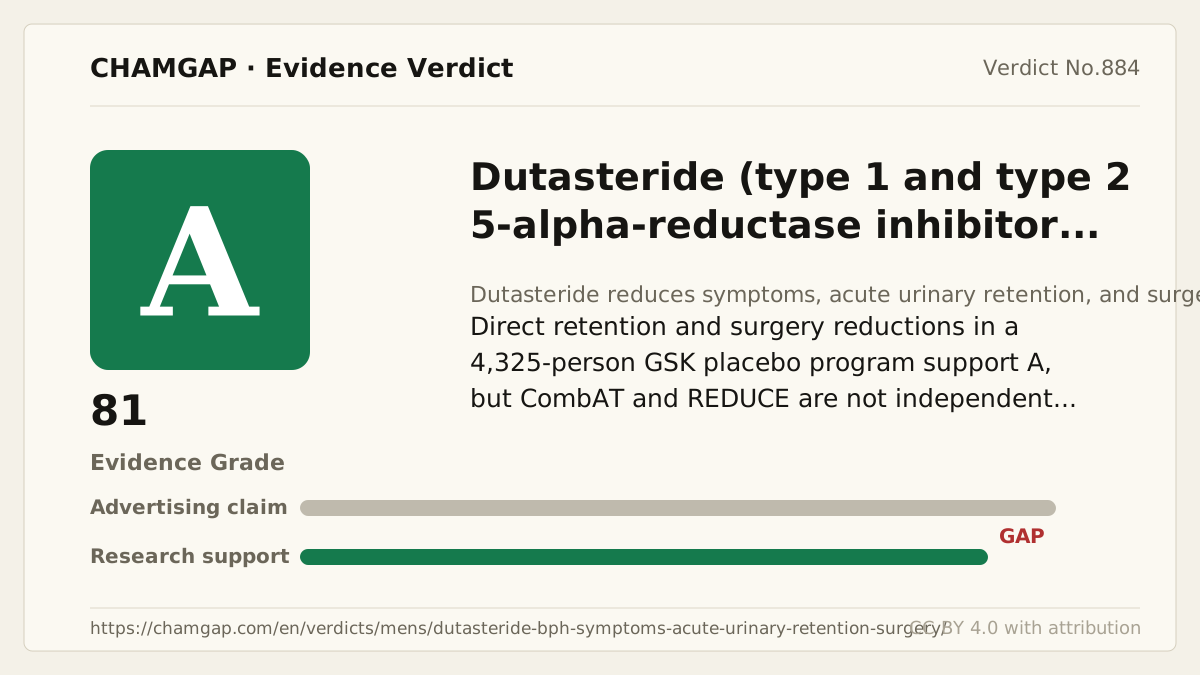
[Chamgap] Dutasteride x improved BPH symptoms and reduced urinary retention and surgery — Evidence Grade A·81. 3 cited sources checked. Source: https://chamgap.com/en/verdicts/mens/dutasteride-bph-symptoms-acute-urinary-retention-surgery/ · CC BY 4.0CC BY 4.0 — free to use with attribution; do not distort grades, numbers, or verdict meaning.
What this document does and does not do
Chamgap is an information source. It reports what research has and has not confirmed; it does not tell readers what to take or buy. That decision belongs to readers and, when needed, medical or legal professionals. This verdict reflects literature available up to the search date and may change as new research appears. Nothing here is medical advice.