
Docetaxel,
does it really help with Prolonged overall survival when added to ADT for metastatic hormone-sensitive prostate cancer?
research showsDocetaxel is rated A because its early addition to androgen-deprivation therapy (ADT) prolongs overall survival in patients with metastatic hormone-sensitive prostate cancer (mHSPC) who are fit for chemotherapy. The publicly led 790-patient CHAARTED trial reported a death hazard ratio of 0.61 in its initial 2015 analysis, and the benefit persisted with a hazard ratio of 0.72 in the 2018 long-term analysis. A separate randomized comparison of 1,086 metastatic patients in STAMPEDE reproduced the result with a hazard ratio of 0.81, directly attributing a hard survival benefit to adding docetaxel. The long-term CHAARTED analysis did not establish benefit in low-volume disease, whereas STAMPEDE found no treatment heterogeneity by metastatic burden, so patient selection and comparison with current intensification options still require clinical judgment.
ads claimPromotional summaries may imply the same survival extension for every patient with metastatic disease. The evidence specifically concerns adding six cycles of docetaxel when starting ADT in chemotherapy-fit mHSPC, with some trial-level uncertainty about the magnitude of benefit in low-volume disease.
Useful facts when choosing a product
- In CHAARTED, docetaxel 75 mg per square meter was infused intravenously every three weeks for six cycles in addition to ADT. An oncology team determines actual use after assessing performance status, organ function, and comorbidities.
- Docetaxel is a taxane cytotoxic drug that disrupts microtubule function during cell division. It is not a hormonal monotherapy for prostate cancer but a treatment-intensification component used with ADT.
- Blood counts, liver function, signs of infection, and peripheral neuropathy are monitored around treatment. Premedication may be used to reduce formulation-related hypersensitivity and fluid retention.
- Important harms include neutropenia, febrile neutropenia, infection, peripheral neuropathy, alopecia, fatigue, nail changes, and hypersensitivity reactions. Severe marrow suppression or hepatic dysfunction can limit treatment.
Chamgap Semantic Classification Code
Candidate index · review held
M.docetaxel.UNK.prolonged-overall-survival-when-added-to-adt-for-metastatic-hormone-sensitive-prostate-cancer.assess.addonMedicinal interventions > Docetaxel > Unknown > Prolonged overall survival when added to ADT for metastatic hormone-sensitive prostate cancer > Association or change assessment > Added intervention on common background care
An automated migration candidate, not an issued permanent code; exact claim scope remains under review. This machine-generated migration candidate helps retrieval but is not a permanent assignment. The original verdict ID and URL remain authoritative.
What the research actually shows
The 2015 CHAARTED report randomized 790 patients and added docetaxel 75 mg/m² every three weeks for six cycles to ADT, extending median overall survival by 13.6 months and lowering the hazard of death by 39% (hazard ratio 0.61). Its 2018 long-term analysis reported a hazard ratio of 0.72 overall and 0.63 in high-volume disease, but no significant benefit in the low-volume subgroup, whose hazard ratio was 1.04. The long-term STAMPEDE analysis of 1,086 metastatic patients found hazard ratios of 0.81 for overall survival, 0.66 for failure-free survival, and 0.69 for progression-free survival, without evidence of heterogeneity by metastatic burden. CHAARTED was primarily supported through the National Cancer Institute collaborative network; Sanofi supplied drug and partial funding but reported no role in protocol design, data analysis, or manuscript preparation. STAMPEDE received mixed public and industry support and independently replicated the survival result in a separate platform trial.
Why this is classified as A (92)
CHAARTED reported a death hazard ratio of 0.61 initially and 0.72 with long-term follow-up in 790 patients, while the 1,086-patient metastatic STAMPEDE analysis reproduced benefit with a hazard ratio of 0.81. Docetaxel was the sole randomized addition to ADT and the endpoint was overall survival, supporting A with 92 points. Trial differences in low-volume disease and toxicity reduce the score but safety is assessed separately.
Counterpoint. The same benefit-risk balance cannot be assumed for patients who are frail or have major comorbidity. Treatment selection should include disease burden, symptoms, preferences, feasibility, and comparison with other mHSPC intensification options.
Rejudgment record. New verdict — CHAARTED and STAMPEDE randomized docetaxel as the sole addition to ADT and confirmed and replicated an overall-survival benefit, meeting the direct hard-endpoint and ingredient-attribution criteria; trial differences in low-volume disease were deducted
Sub-claim grades by effect
This ingredient is marketed for several effects. A single overall grade blends strong and weak claims together, so each effect is graded separately here. The overall grade reflects the strongest disconfirming or core claim.
| Effect (sub-claim) | Grade | Basis |
|---|---|---|
| Prolonged overall survival when added to ADT in mHSPC | A | CHAARTED reported hazard ratios of 0.61 initially and 0.72 long term, and STAMPEDE replicated direct survival benefit at 0.81. |
| Prolonged overall survival in high-volume metastatic disease | A | The long-term CHAARTED death hazard ratio was 0.63 in high-volume disease, while STAMPEDE found no treatment heterogeneity by burden. |
| Delayed disease progression | A | CHAARTED reported 20.2 versus 11.7 months to progression, and STAMPEDE reported a progression-free-survival hazard ratio of 0.69. |
Cross-check — AI research and Codex final gate
Evidence Table
| Study | Design | Sample | Funding | Endpoint | Result | Weight |
|---|---|---|---|---|---|---|
| Sweeney CJ et al. 2015 CHAARTED | Multicenter open-label randomized phase 3 trial | 790 patients with mHSPC | Primarily supported by the US NCI collaborative network; Sanofi supplied drug and partial funding but reported no role in design, analysis, or manuscript preparation | Overall survival primary endpoint; progression and PSA response | Median overall survival was 57.6 versus 44.0 months, with a death hazard ratio of 0.61 (95% CI 0.47 to 0.80); time to progression was 20.2 versus 11.7 months. | Key large ingredient-specific survival trial |
| Kyriakopoulos CE et al. 2018 CHAARTED long-term follow-up | Prespecified long-term survival analysis of a randomized phase 3 trial | 790 patients with mHSPC; 513 high-volume and 277 low-volume | Public support from NCI, NIH, and the US Department of Health and Human Services; Sanofi supplied docetaxel and funding | Overall survival and overall survival by metastatic burden | Median survival was 57.6 versus 47.2 months overall, hazard ratio 0.72; the hazard ratio was 0.63 in high-volume and 1.04 in low-volume disease. | Durability and subgroup-boundary evidence |
| Clarke NW et al. 2019 STAMPEDE | Long-term metastatic analysis of a multicenter platform randomized trial | 1,086 patients with M1 disease; 724 standard-care and 362 docetaxel-addition patients | Mixed public support from Cancer Research UK and MRC and support from several pharmaceutical companies | Overall survival, failure-free survival, and progression-free survival | Overall-survival hazard ratio was 0.81 (95% CI 0.69 to 0.95), failure-free-survival hazard ratio 0.66, and progression-free-survival hazard ratio 0.69, without heterogeneity by metastatic burden. | Independent large-trial replication of overall survival |
Receipt — 3 References
All 3 cited sources were verified for existence at the original page (as of 2026-07-24).
Final verification and publication gate: Codex · Evidence date: 2026-07-24 · Corrections: none
Cite this verdict
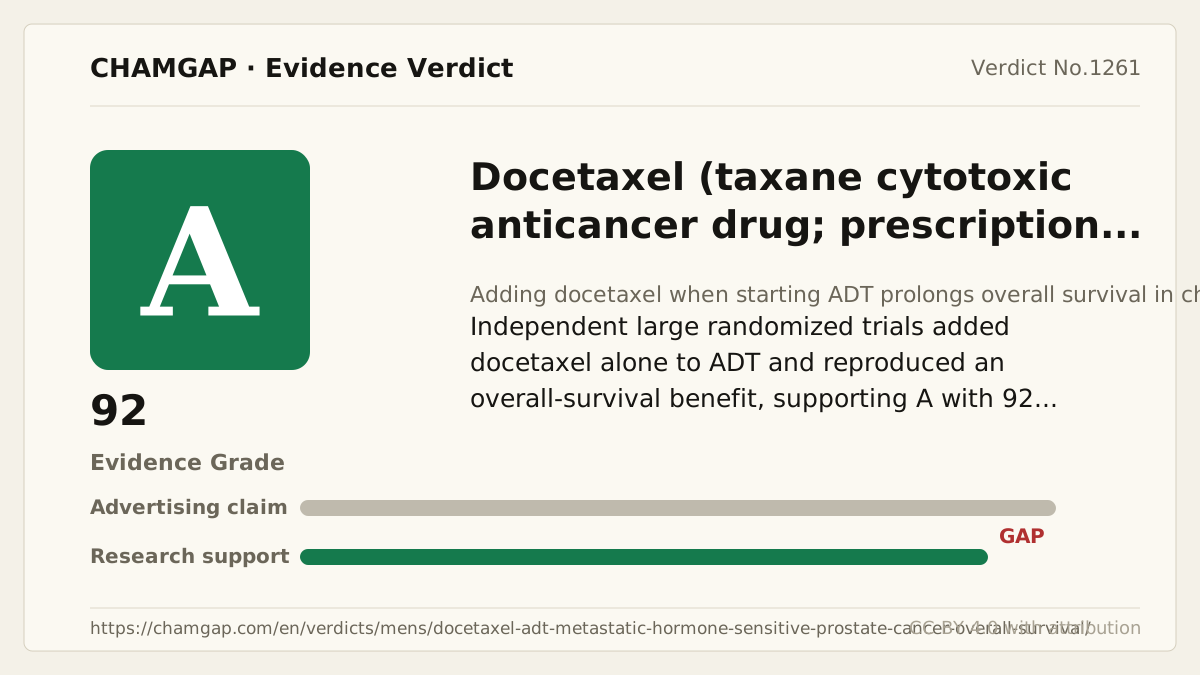
[Chamgap] Docetaxel x prolonged overall survival with ADT in mHSPC — Evidence Grade A·92. 3 cited sources checked. Source: https://chamgap.com/en/verdicts/mens/docetaxel-adt-metastatic-hormone-sensitive-prostate-cancer-overall-survival/ · CC BY 4.0CC BY 4.0 — free to use with attribution; do not distort grades, numbers, or verdict meaning.
What this document does and does not do
Chamgap is an information source. It reports what research has and has not confirmed; it does not tell readers what to take or buy. That decision belongs to readers and, when needed, medical or legal professionals. This verdict reflects literature available up to the search date and may change as new research appears. Nothing here is medical advice.