
Darolutamide,
does it really help with Prolonged overall survival when added to androgen-deprivation therapy and docetaxel in metastatic hormone-sensitive prostate cancer?
research showsGrade B evidence shows that adding darolutamide to androgen-deprivation therapy (ADT) and docetaxel prolongs overall survival in metastatic hormone-sensitive prostate cancer. In the 1,306-participant, phase 3, double-blind ARASENS trial, the risk of death was 32.5% lower than with added placebo (hazard ratio 0.68, 95% CI 0.57 to 0.80; P<0.001), and castration-resistant progression and symptomatic skeletal events were also delayed. However, the citations are repeated reports of a single trial, and no replication by different investigators with different funding has been confirmed, so the axis-2 R1 ceiling applies and the grade is B with 72 points. The separately recruited ARANOTE trial shares the same Bayer-Orion funding and tested a docetaxel-free doublet (rPFS hazard ratio 0.54, 95% CI 0.41 to 0.71) without a significant overall-survival benefit, so it is not an independent replication of this triplet claim. This verdict is limited to triplet use with ADT and docetaxel, not darolutamide monotherapy, and toxicity requires a separate judgment.
ads claimA 32.5% reduction in relative mortality risk does not mean that every patient lives 32.5% longer or is cured. It compares group-level relative hazards when darolutamide is added to ADT and docetaxel; absolute benefit and suitability vary with disease burden, comorbidity, and fitness for docetaxel.
Useful facts when choosing a product
- The ARASENS darolutamide dose was 600 mg orally twice daily, given together with ADT and docetaxel.
- The survival evidence applies to darolutamide added to ADT and docetaxel rather than to darolutamide monotherapy.
- Fatigue, rash, hypertension, and liver-enzyme elevations can occur, so symptoms, blood pressure, and liver function require clinical review.
- During docetaxel treatment, chemotherapy toxicities such as myelosuppression and infection also require management, and an oncology specialist should individualize the complete regimen.
Chamgap Semantic Classification Code
Candidate index · review held
M.darolutamide.UNK.prolonged-overall-survival-when-added-to-androgen-deprivation-therapy-and-docetaxel-in-metastatic-hormone-sensitive-prostate-cancer.assess.MULTIMedicinal interventions > Darolutamide > Unknown > Prolonged overall survival when added to androgen-deprivation therapy and docetaxel in metastatic hormone-sensitive prostate cancer > Association or change assessment > Multiple: primary unresolved
An automated migration candidate, not an issued permanent code; exact claim scope remains under review. This machine-generated migration candidate helps retrieval but is not a permanent assignment. The original verdict ID and URL remain authoritative.
What the research actually shows
The 2022 report by Smith and colleagues and the ARASENS Trial Investigators randomized 1,306 participants to darolutamide 600 mg twice daily or placebo, with ADT and docetaxel in both groups. The primary overall-survival analysis showed a 32.5% lower risk of death, hazard ratio 0.68, with consistent improvement in key secondary outcomes. A 2026 prespecified and post hoc analysis found hazard ratios of 0.36 for time to metastatic castration-resistant disease and 0.79 for pain progression, while times to worsening of pain interference, pain severity, and quality of life were similar. Efficacy is judged from survival and progression; fatigue, rash, liver-enzyme elevations, possible cardiovascular events, and docetaxel toxicity are separated under safety.
Why this is classified as B (72)
The 1,306-participant, phase 3, double-blind ARASENS trial significantly improved the direct hard endpoint of overall survival, hazard ratio 0.68, with concordant delay of castration-resistant progression and symptomatic skeletal events. The axis-3 manufacturer ceiling does not apply to a large hard-endpoint prescription-drug trial. However, the citations are repeated reports of one trial, and no replication by different investigators with different funding has been confirmed, so the axis-2 R1 ceiling of B applies. The same-funder ARANOTE trial tested a docetaxel-free doublet, with a significant rPFS hazard ratio of 0.54 (95% CI 0.41 to 0.71) but nonsignificant overall survival, so it does not count as independent replication; the grade is B with 72 points.
Counterpoint. Use without docetaxel, or use in frail patients, requires separate evidence and an individualized benefit-harm assessment.
Rejudgment record. New verdict — Applied grade B with 72 points: the direct hard overall-survival hazard ratio of 0.68 in the 1,306-participant, double-blind phase 3 ARASENS trial stands, with concordant delay of castration-resistant progression and symptomatic skeletal events, and the prescription-drug hard-endpoint exception keeps the axis-3 manufacturer ceiling inapplicable; however, both citations are repeated reports of the single trial NCT02799602, no replication by different investigators with different funding was confirmed, and the same Bayer-Orion-funded, docetaxel-free ARANOTE trial does not count as independent replication, so the axis-2 R1 ceiling of B applies
| Endpoint | H | Hard endpoint - actual events such as death |
| Replication | R1 | Single confirmatory trial |
| Independence | I0 | Evidence comes only from manufacturer studies |
| Effect size | E+ | Meets the clinically important threshold |
Stored derived and displayed grades match; this is not a current recalculation or validity check (B).
Sub-claim grades by effect
This ingredient is marketed for several effects. A single overall grade blends strong and weak claims together, so each effect is graded separately here. The overall grade reflects the strongest disconfirming or core claim.
| Effect (sub-claim) | Grade | Basis |
|---|---|---|
| Prolonged overall survival when added to ADT and docetaxel | A | ARASENS demonstrated a direct hard-endpoint benefit in 1,306 participants, with a death hazard ratio of 0.68. |
| Delayed progression to metastatic castration-resistant prostate cancer | B | The prespecified secondary endpoint had a hazard ratio of 0.36 but remains lower in the evidence hierarchy than overall survival. |
| Delayed first symptomatic skeletal event | B | The ARASENS secondary endpoint was significant with a hazard ratio of 0.71, interpreted in the context of event count and multiple secondary endpoints. |
Cross-check — AI research and Codex final gate
Evidence Table
| Study | Design | Sample | Funding | Endpoint | Result | Weight |
|---|---|---|---|---|---|---|
| Smith MR et al.; ARASENS Trial Investigators. 2022 | International multicenter randomized double-blind placebo-controlled phase 3 trial | 1,306 patients with metastatic hormone-sensitive prostate cancer | Bayer and Orion Pharma | Primary overall survival; key secondary castration-resistant progression, pain progression, and symptomatic skeletal events | Death hazard ratio 0.68 (95% CI 0.57 to 0.80; P<0.001); symptomatic skeletal event-free survival hazard ratio 0.61 and first symptomatic skeletal event hazard ratio 0.71. | Pivotal large randomized trial with a direct hard endpoint |
| Fizazi K et al. 2026 ARASENS clinical-endpoint and quality-of-life analysis | Prespecified and post hoc secondary analysis of ARASENS | 1,305 evaluable participants | Bayer-Orion development program with company employees among the authors | Castration-resistant progression, pain progression, and worsening of pain and quality of life | The hazard ratio was 0.36 for castration-resistant progression and 0.79 for pain progression, while times to worsening of pain interference, pain severity, and quality of life were similar. | Support for delayed progression with limits on quality-of-life claims |
Receipt — 2 References
All 2 cited sources were verified for existence at the original page (as of 2026-08-11).
Final verification and publication gate: Codex · Evidence date: 2026-08-11 · Corrections: 1
Correction log — 1
Corrections applied to this verdict, in chronological order. Changes are logged, not erased.
- 2026-08-11 · Grade correction for unmet independent-replication requirement — Both cited papers were repeated reports of the same ARASENS population (NCT02799602). Chamgap grade A requires axis-2 R2 (multiple RCTs by different investigators with different funding); the separately recruited ARANOTE trial shares the same Bayer-Orion funding, tested a docetaxel-free doublet, and did not show a significant overall-survival benefit, so it is not an independent replication. Axis 2 is R1 and the ceiling is B. The axes were recorded as B·H·R1·I0·E+·B1 (the axis-3 manufacturer ceiling remains inapplicable under the large hard-endpoint prescription-drug RCT exception), and 72 points were assigned. The effect itself (death hazard ratio 0.68, 95% CI 0.57 to 0.80; P<0.001) is not disputed. Confirmed in the 2026-08-11 internal audit (workflow verification plus concordant Codex cross-check). (grade A→B)
Cite this verdict
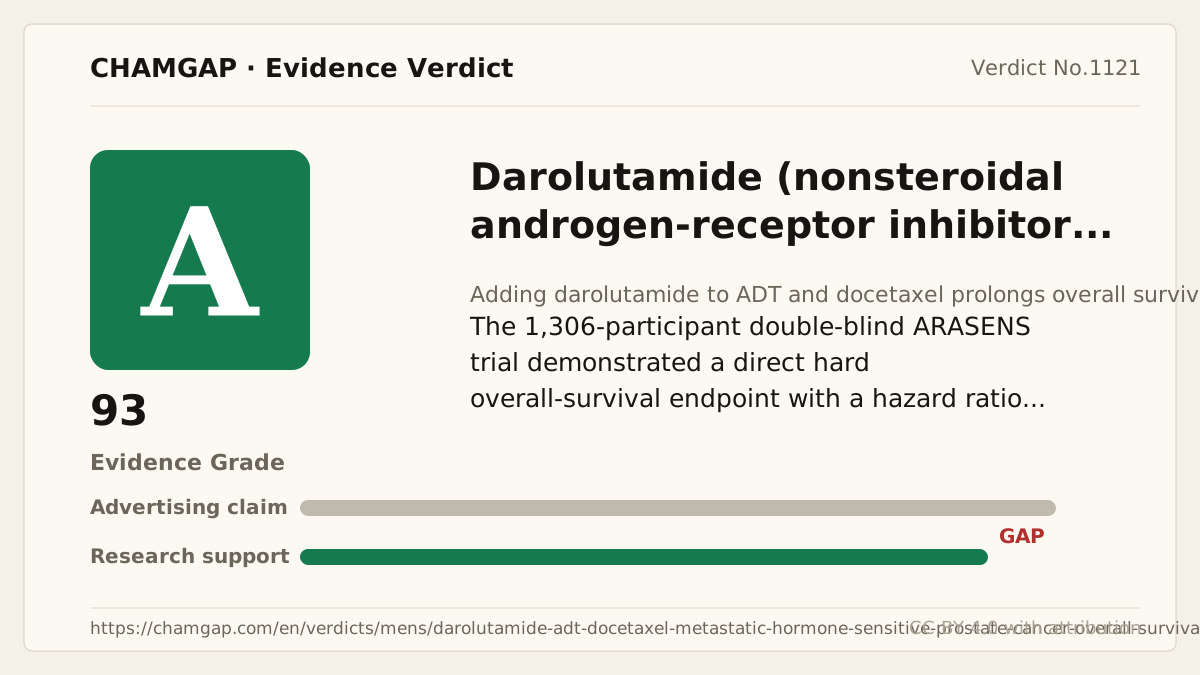
[Chamgap] Darolutamide x prolonged overall survival in metastatic hormone-sensitive prostate cancer — Evidence Grade B·72. 2 cited sources checked. Source: https://chamgap.com/en/verdicts/mens/darolutamide-adt-docetaxel-metastatic-hormone-sensitive-prostate-cancer-overall-survival/ · CC BY 4.0CC BY 4.0 — free to use with attribution; do not distort grades, numbers, or verdict meaning.
What this document does and does not do
Chamgap is an information source. It reports what research has and has not confirmed; it does not tell readers what to take or buy. That decision belongs to readers and, when needed, medical or legal professionals. This verdict reflects literature available up to the search date and may change as new research appears. Nothing here is medical advice.