
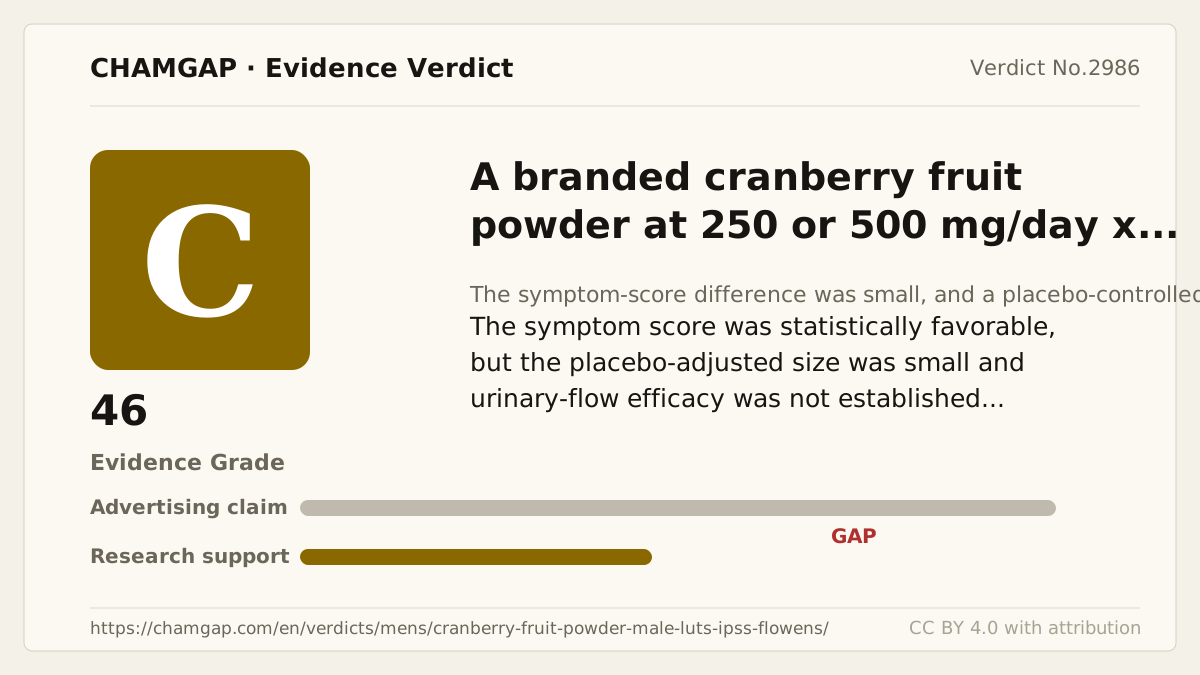
A branded cranberry fruit powder at 250 or 500 mg/day,
does it really help with Reduced six-month IPSS in men aged over 45 with lower urinary tract symptoms?
research showsGrade C. In a six-month double-blind placebo-controlled trial of 124 men aged over 45 with IPSS at least 8, score changes were -3.1 with 250 mg, -4.1 with 500 mg, and -1.5 with placebo. The placebo-adjusted differences, about -1.6 and -2.6 points, fell below patient-anchored minimal important-difference estimates of about 3.1 to 5.2 points. Two authors were employed by the manufacturer, and objective flow findings were mainly within-group changes.
ads claimClaims that the powder shrinks the prostate or reliably strengthens urinary flow exceed the measured or between-group evidence. The primary supportive result was the IPSS symptom score.
Useful facts when choosing a product
- The study used a branded cranberry fruit powder.
- Doses were 250 or 500 mg/day.
- Cranberry juice or products with different PAC content are not interchangeable.
Chamgap Semantic Classification Code
Permanent code issued
S.cranberry-fruit-powder.oral.ipss.reduce.placeboSupplements and nutraceuticals > A branded cranberry fruit powder at 250 or 500 mg/day > Oral > Reduced six-month IPSS in men aged over 45 with lower urinary tract symptoms > Reduction claim > Placebo
Codex retrospectively verified the principal intervention, delivery, population, endpoint, and comparator from the existing reviewed verdict and issued a permanent semantic code. Secondary outcomes on the page are not transferred as separate claims. The code identifies the intervention and claim; it never contains the evidence grade, score, or safety result.
Exact Claim Classification
These independent facets prevent evidence from different forms, routes, populations, effects, and comparators from being mixed.
| Intervention class | S · Supplement or nutraceutical |
|---|---|
| Canonical ingredient or intervention | A branded cranberry fruit powder at 250 or 500 mg/day |
| Source or part used | Single supplement ingredient specified in the verdict; unreported manufacturing details remain unverified |
| Formulation or processing | A branded cranberry fruit powder at 250 or 500 mg/day |
| Route | Oral |
| Dose | A branded cranberry fruit powder at 250 or 500 mg/day |
| Duration | Six months |
| Population | 124 men aged over 45, six months |
| Effect or condition | Reduced six-month IPSS in men aged over 45 with lower urinary tract symptoms |
| Primary endpoint | International Prostate Symptom Score at three and six months |
| Comparator | Placebo |
| Duplicate-detection key | cranberry-fruit-powder|oral|124 men aged over 45, six months|ipss|Six months |
What the research actually shows
Participants were assigned to 250 mg, 500 mg, or placebo. Six-month IPSS changes were -3.1, -4.1, and -1.5, with reported P values near .05 and below .001 for the active groups. Qmax, Qavg, and residual volume changes were mainly reported against baseline rather than as confirmed placebo contrasts.
Why this is classified as C (46)
A placebo-controlled IPSS difference is offset by subthreshold size, manufacturer involvement, n=124, and single-trial evidence, giving C with 46 points.
Counterpoint. Clinical chemistry and hematology showed no clear effect, but the study was too small for rare harms.
Rejudgment record. Codex PubMed, effect-size, and scoring cross-check — Accepted a significant prespecified IPSS result while applying published patient-anchored important-difference estimates of about 3.1 to 5.2 points to placebo-adjusted changes of about -1.6 to -2.6 points and accounting for manufacturer authors and n=124 single-trial evidence
| Endpoint | P | Symptom or function itself is the target - including patient reports and performance tests |
| Replication | R1 | Single confirmatory trial |
| Independence | I0 | Evidence comes only from manufacturer studies |
| Effect size | E~ | Statistically positive but below the threshold |
Stored derived and displayed grades match; this is not a current recalculation or validity check (C).
Sub-claim grades by effect
This ingredient is marketed for several effects. A single overall grade blends strong and weak claims together, so each effect is graded separately here. The overall grade reflects the strongest disconfirming or core claim.
| Effect (sub-claim) | Grade | Basis |
|---|---|---|
| Reduction in six-month IPSS | C | Statistically favorable but small versus placebo. |
| Placebo-controlled improvement in objective urinary flow | ? | Reported changes were mainly within-group comparisons. |
Cross-check — AI research and Codex final gate
Evidence Table
| Study | Design | Sample | Funding | Endpoint | Result | Weight |
|---|---|---|---|---|---|---|
| Vidlar A et al. 2016 | Three-arm double-blind randomized placebo-controlled trial | 124 men aged over 45, six months | Two Naturex-employed authors and a branded test product | International Prostate Symptom Score at three and six months | Six-month changes -3.1 points (250 mg), -4.1 points (500 mg), and -1.5 points (placebo) | Single manufacturer-linked symptom-score trial |
Receipt — 2 References
Of 2 cited sources, 1 had limited original-page access (blocked or summary-only) and were verified via index/summary, marked partial; the rest were verified at the original page. As of 2026-09-07.
Final verification and publication gate: Codex · Evidence date: 2026-09-07 · Corrections: none
Cite this verdict
[Chamgap] Cranberry Fruit Powder for Six-Month IPSS Reduction in Men With LUTS — Evidence Grade C·46. 2 cited sources checked. Source: https://chamgap.com/en/verdicts/mens/cranberry-fruit-powder-male-luts-ipss-flowens/ · CC BY 4.0CC BY 4.0 — free to use with attribution; do not distort grades, numbers, or verdict meaning.
What this document does and does not do
Chamgap is an information source. It reports what research has and has not confirmed; it does not tell readers what to take or buy. That decision belongs to readers and, when needed, medical or legal professionals. This verdict reflects literature available up to the search date and may change as new research appears. Nothing here is medical advice.